The best time frame for the busy, the lazy and the greedy …

What do antique dealers, hunting trophy collectors, Pokemon card traders and lovers of a bloody steak all have in common?
For all of them, ‘the rarer the better’ is a phrase that’ll ring true.
And the same is true of trades.
When we start out in the markets, there’s an urge to jump in, to place trades, even if we’re not very confident they’ll be winners. However, the most profitable strategies have strict rules on timing and entry criteria – this means that they trade longer time frames and must pass a series of entry filters to be triggered.
On the journey to uncovering this truth about trading, many novices fall by the wayside. Boring periods of sitting on our hands, rejecting setups because they aren’t quite perfect – it’s not the image of trading that most of us set out with. Even telling you about this, I feel like a government health warning, advising against putting salt on your food, or butter on your toast. Where’s the fun in that?
But this doesn’t have to be bad news.
The best time frame I advise traders to head to may not have ‘Wolf of Wall St’ energy, but it has a ton of benefits, making it too good to ignore …
Why you should be using daily charts
Better decision-making
If you’ve tried to follow 1-minute, 5-minute or 10-minute charts, you’ll know how quickly they come at you, and how much pressure you’re under to make split-second decisions.
This can be very tough. Just a few seconds of hesitation can mean that you’ve missed your entry and lost crucial points – because every point matters in this style of trading.
When you’re trading a daily chart, a new candlestick pops up on the right of your screen every 24 hours – that gives you plenty of time to think … to run through your checklist … to evaluate your setup … think about risk …
The result is that you’ll make better decisions, and have less stress in your life.
Precise entries are less important
It follows from my previous point that exact timings become less crucial when trading a daily chart. If you trade at 7am on some days, and 8.30am on other days, it won’t make a big difference to your long-term results. These kind of fluctuations will even out.
Again, it makes for a more relaxed trading style.
News events don’t bother you
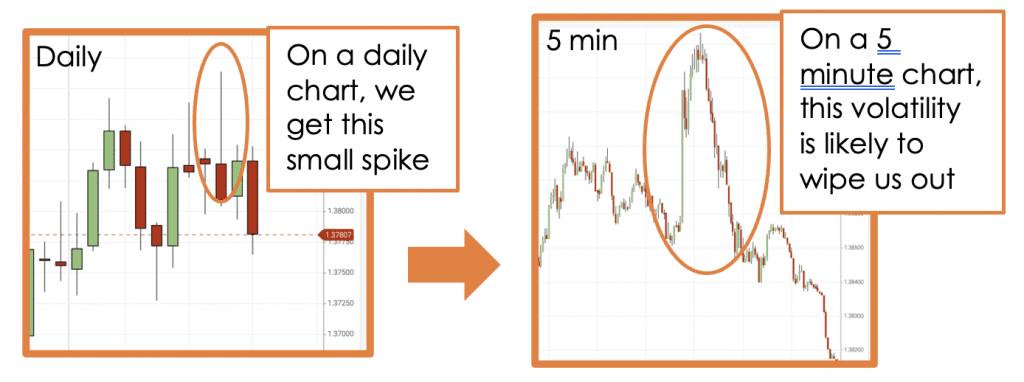
When you’re trading a low time frame, data announcements, central bank statements and news stories can easily knock out stop loss levels as the price leaps one way then the next.
It’s not true that these events can’t affect our longer time-frame positions, but it is much less likely.
As an example, here’s the effect Tuesday’s US inflation figures had on GBPUSD …
Freedom to get on with your life
We’re often told that the big advantage of trading short time frames on 5-minute charts is that you can dip in and out of the markets when it suits you. For example, if you have a couple of spare hours one day, you can spend it trading. Those positions will all be closed out by the time to finish, so if you don’t manage to find time to trade again for a few days, it doesn’t matter.
However, while this flexibility often sounds appealing to new traders, it’s tough to keep a consistent trading plan going this way. We can often get stuck in front of charts for hours and hours, overtrading when we’ve had a good run, only to give that all back.
Trading daily candles gives us the best of both worlds – very limited time needed to check charts each day, but we keep the consistency of that trading habit, knowing that we have to check back each day to manage trades or look for new opportunities. Trading daily charts gives far more genuine flexibility, allowing you to get on with life.
Costs
If you are trading multiple times each day, paying a spread cost each time, these charges become a sizeable cost to your trading that needs to be paid off before you move into profit. When holding positions for more than one day, these costs are a smaller percentage of the market moves (and profits) you’re looking for.
Day traders are often looking for just 10 pips or so. If they are paying 1 pip in spread costs, that’s 10% of the market move eaten up by charges. Also, they are likely to be trading with higher stakes, bumping up those spread costs further.
By comparison, a swing trader might be looking for 100 pips profit, trading with low stakes. Paying 1 pip in spread costs is just 1% of that market move. (There will be daily rolling charges to add to this, but they tend to be lower.)
Profitability
Studies have shown that traders of longer time frames tend to outperform those who are in and out of the markets more quickly.
Longer time frames are not suitable for everyone, as they often require bigger trading pots and can involve a lot of ‘waiting’ for the profits to come in. This is certainly true of position trading, where trades are held for months, even years.
Daily candles, however, offer a great balance, which is why I believe they are the best time frame to trade, allowing us to ride medium-term trends for a few days, even weeks. Returns are faster, drawdowns aren’t as steep, and they don’t require such a large fund to get started.
If you think trading daily charts isn’t for you – perhaps it seems too slow and boring – I’d urge you to give it a try with just a portion of your trading fund to experience the low-effort, high-profit boost it can give to your fund.
To enjoy more content and get it faster Follow @TradersBulletin


JOIN US ...
Get full access to members-only resources, plus my weekly email updates ...
I will NEVER share your details for marketing purposes. Privacy policy
Strategies I'm Using
 It has taken 2 years to persuade this market…
- These videos show how to make 24% gains in…
 As you can see from all the data I've…
 Get the low down on the Heikin Ashi Mountain…