Fair Value Gaps are the ‘unfinished business’ of the markets – a vacuum in the pricing, where orders are left hanging.
A couple of weeks back, I ran through some basic terms in Smart Money Concept trading, including Fair Value Gaps. If you missed it, you can check back here, but here’s the basics of an FVG …
What’s a Fair Value Gap?
A Fair Value Gap (FVG) is an important indicator of inefficiency for SMC traders. It takes the form of a three-candlestick pattern, in which there’s no overlap in the prices reached by candles 1 and 3.
These candles show that the price moved rapidly between the range of candlestick 1 and the range of candlestick 3, without lots of to-ing and fro-ing during that period.
A bullish FVG implies that buyers overwhelmed sellers during the period of candle 2, suggesting that there was institutional buying pressure here, but not the sellers to fill those orders.
Fair Value Gaps are important because they highlight areas of market inefficiency. During a ‘gap’ period, there will be orders that haven’t been filled, and price tends to gravitate back to these zones.
Nothing new under the sun
If you’ve been around the trading block a few times, like myself, you might recognize an FVG pattern something that’s not in trading fashion right now …
Three white soldiers or three black crows.
It’s not quite the same thing (and doesn’t have the overlapping rules), but it definitely looks familiar.
If you take a look at any chart, you’ll spot FVGs all over it – they are very common patterns. But not all of these FVGs offer trading opportunities, so I want to show you which you should be paying attention to.
Understanding Fair Value
A fair value gap is a breakdown in ‘fair value’, so it’s useful to understand what fair value means and looks like on our charts.
Fair value is where price is in equilibrium – a balance, with buyers and sellers. On your chart, this looks like a period of range-bound consolidation, and will be accompanied by a high volume of transactions.
An FVG is what happens as price moves rapidly out of one of these zones.
How to know which FVGs to are worth your attention
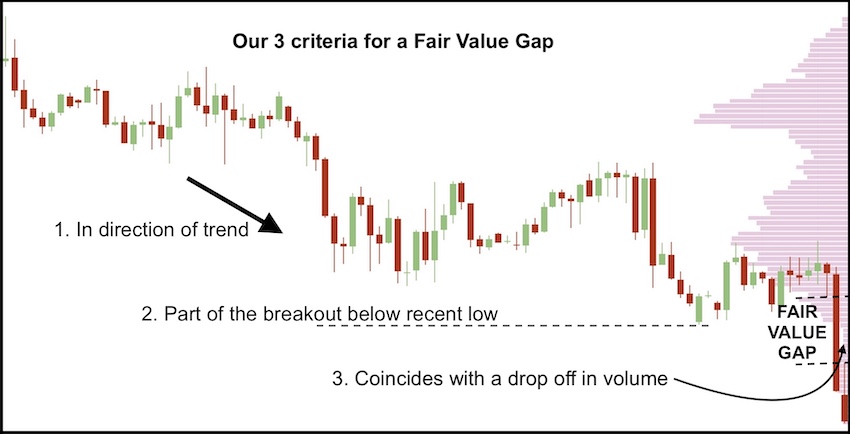
There are lots of different ways to approach FVGs in trading, but these are the three main criteria that I’ll demand of any FVG before considering it worth watching …
1 • Must be part of or lead into a breakout from an area of Fair Value
2 • Must be in the direction of the trend
3 • Must coincide with a dip in volume (For me, the best FVGs are not just visual gaps – I also want to see evidence that price moved quickly through that zone with a lower volume of trading taking place.)
How to trade an FVG
Once you’ve found an FVG that meets our criteria … what next?
A Fair Value Gap signifies that the buying/selling demand were not balanced. That low-volume reading tells us that just a relatively small number of orders instigated a big market move. This suggests that there may be unfilled orders around this level, and market makers could be looking to drive price back into this zone to get these orders filled.
There’s no ‘conspiracy theory’ about this – it’s the way that institutional algorithms are built, and markets naturally pull into areas of liquidity.
Therefore, we’re looking for price to pull back into this zone, as it hoovers up those outstanding orders.
Your FVG isn’t about clear levels that price will bounce off. Instead, it’s about a ‘zone of interest’. Once price moves back into this zone, we’ll start to look for setups back into the direction of the trend once market makers have swept out the orders that are sitting there.
The example below shows two Fair Value Gaps stacked on top of each other as the price breaks through that recent low …
Zooming into a 5 minute chart, we can watch as the price moves back into that ‘zone of interest’ … This is where we start looking for a ‘sweep’ of those orders and a strong move back downwards …
The FVG in itself is only an area to watch, rather than a clear turning point. Note how, in the example above, the turning point for price comes right on that volume low.
FVG trading tips
• Always trade with the overall trend
• Once price is moving back into our area of interest, switch down to a shorter timeframe to find your entry.
• Don’t wait too long for an FVG to fill. If the market hasn’t moved back within a reasonable period – move on to the next setup.
• An FVG is generally a single-use setup. If the volume low hasn’t been reached, there may be further pullbacks, but bear in mind that orders are being swept up each time the price moves back into this zone.
• FVGs are price magnets – so use them for profit targets too.
• Stop levels can be placed just beyond an FVG rather than the recent high/low – this often offers a much better risk-reward opportunity.
If you’re interested in knowing more about FVG setups, let me know in the comments below and I can dig some more into setups and how to get the best out of these moves in terms of reward-to-risk by using discount and premium zones.
Very good and interesting article on Fair Value Gaps, Mark. Would be very interested in learning more in future articles and about premium and discount zones.














2 comments
Traders Bulletin
Sorry it’s taken me a while to get onto this David, but I’m planning to cover this next week. Please watch out for my update.
David Short
Very good and interesting article on Fair Value Gaps, Mark. Would be very interested in learning more in future articles and about premium and discount zones.