Why you need to understand this graph
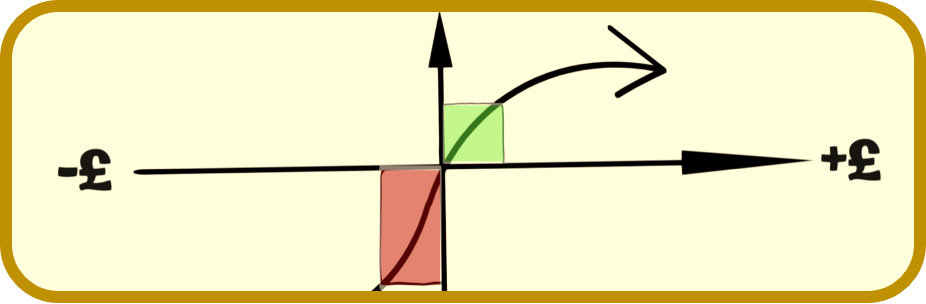
The biggest reason traders fail or give up is … losses.
An aversion to losing is a very natural and sensible one. Why would you want to lose money? It’s basic in our psychology to want to win.
But this natural tendency – left unchecked – can lead us down a whole rabbit warren of crazy decision-making!
How prospect theory is eating your profits
Prospect theory was developed in the 1970s, and won its creators a Nobel prize in economics.
The theory explores the ways we make decisions associated with risk. As traders, it’s crucial that we have some insight into these processes – otherwise, we’re trading blind.
Here’s the kind of decision-making that prospect theory explores …
Let’s say you’re presented with two scenarios and have to choose your decision in each of these two cases …
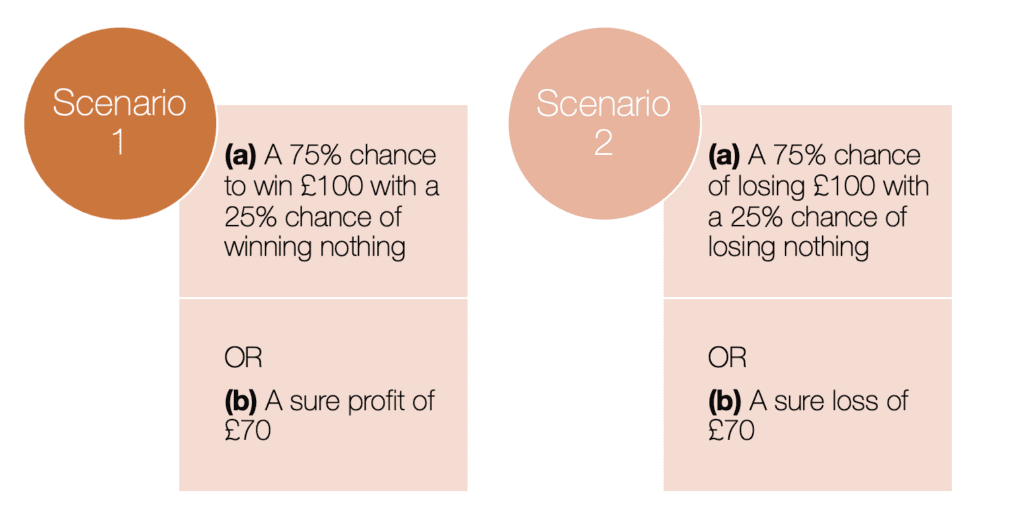
Logic would tell us that a risk-averse person would choose (b) in both scenarios. While someone with more appetite for risk might choose (a) in both cases.
But that’s not what happens.
Instead, most people chose (b) in the first scenario, and (a) in the second.
What’s going on?
Prospect theory shows that people consistently overestimate the likelihood of low-probability events. As a result, we’ve a good chance of coming out of the two scenarios above about £30 down.
We’re drawn to the ‘underdog’, betting big on the 100-1 outsiders, but showing much less interested in the 5-2 favourites.
Losses psychologically affect people more than gains. The pain of a loss is felt much more keenly than the pleasure of a win.
If the probability of success is low, people tend to risk more, while if the probability of success is high, they become reluctant to take risk. It’s obvious that to be more profitability, we should be chasing high-probability wins, yet again and again, we make these bad choices.
So, how does this affect our trading decisions?
Prospect theory messes with our heads in almost every aspect of trading. When emotions are ruling our trading decisions, we’re sucked into ‘gambling’ rather than investing – and we should be alert to this danger at all times.
Here’s just a few of the bad choices we get drawn into …
- Choosing high reward-to-risk ratios that have a low-probability of winning. We’re naturally drawn to a trade that risks just £100 to make £300 … but this kind of 3:1 ratio is very difficult to succeed with. We’re better off taking lower reward-to-risk, but winning more often.
- Jumping out of losing trades too quickly because the open loss on our account makes us too uncomfortable.
- Conversely, holding onto losing trades for too long because we can’t accept that loss and are waiting for the market to come good for us.
- Taking profits too soon because of a reluctance to take risk with those modest gains.
- Giving up on trading strategies because of a losing run rather than holding out despite long-term data suggesting that these losses are a normal part of a profitable strategy. And this leads us to a close cousin of prospect theory …
Myopic Loss Aversion
Myopic loss aversion sees us focus too closely on what has just happened, rather than look at the bigger picture.
So, not only are losses felt more keenly, those that have just happened are even more painful. It means that our already skewed approach to risk gets distorted even further.
How do we hope to make good decisions?
The answer is suprisingly simple, but (when our primitive brains are pulling us in the reverse direction) suprisingly tough to apply. It comes down to …
1: Rules-based trading
By sticking to rules, we won’t get drawn into bad habits of cutting trades short or failing to use carefully managed exit strategies.
2: Long-term view, focusing on edge rather than reward
Good record-keeping is key to shifting your focus from today’s losing trade or a bad week onto your long-term profits.
My trading journal records expectancy as this is a better measure of profitability than looking at your bottom line or your risk-reward ratio. Here are some rather bumpy results we’ve had for Heikin Ashi so far this year …
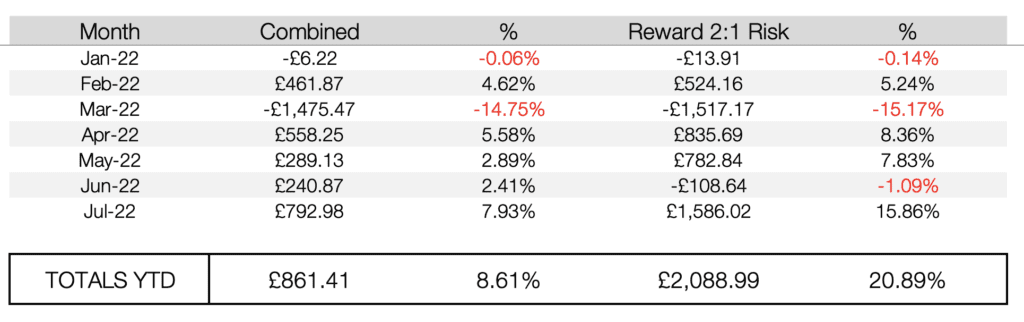
But even through a difficult month like March, the trading strategy’s expectancy figure remained in positive territory.
On my HAV Trading journal, I also include EDGE – another good measure of performance.
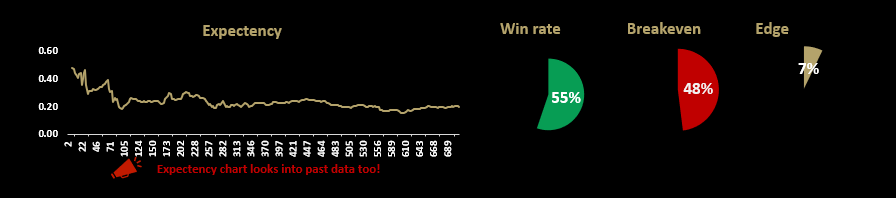
By obsessing over these figures over months and years of data, you’ll leave yourself less brain space to worry about short-term ups and downs.
To enjoy more content and get it faster Follow @TradersBulletin
Related posts:

JOIN US ...
Get full access to members-only resources, plus my weekly email updates ...
I will NEVER share your details for marketing purposes. Privacy policy
Strategies I'm Using
 It has taken 2 years to persuade this market…
- These videos show how to make 24% gains in…
 As you can see from all the data I've…
 Get the low down on the Heikin Ashi Mountain…