Low trading costs: how this one thing can save money AND boost your success rate

I expect we’ve all had enough of people telling us how to save money by turning down the thermostat … putting on a jumper … and buying sacks of porridge oats …
So I thought I’d jump on the bandwagon to give you money-saving tips for trading!
But seriously … this isn’t just about reducing costs. It’s about increasing your chances of success too.
I’m talking about spreads.
Competition between brokers has driven down spread costs enormously over the past decade.
Trade Nation are one of the most competitive, offering a market-leading 0.4 point spread on the FTSE … 0.6 pips on AUDUSD … 1 point on Wall St …
Meanwhile IG charge 1 point on the FTSE … 2.4 points on Wall St … It doesn’t sound like a big difference, but in many markets your costs can be 150%, 200%, even 300% bigger by picking the wrong broker.
It’s all too easy to dismiss spreads as irrelevant to our trading, because they are small compared to the market moves we’re trading.
What’s 40p in trading costs on the FTSE, if we’re looking for 100 points profit?
But when we’re trading with higher stakes and looking for smaller moves, spread costs can creep up on us.
Here’s an example of a set-up on the Nikkei, with an order to BUY if the price drops to 26,237, with a target at 26, 296 (59 points above), and a stop level set at 26,179 (58 points below). It sounds reasonable enough …

The two green lines on the chart above represent the current bid and ask prices. The higher line is the price we buy at. The lower line is the price we sell at. The chart is based on the bid price (the price we sell at).
So, to trigger the trade shown above, the higher line needs to drop to that buy order level of 26,237. But to close the trade, the lower line needs to hit the target or the stop.
Suddenly that target is now an extra 15.7 points away (the spread). While the stop has moved 15.7 points closer!
In the example above, 15.7 points of our 59-point target is being eaten into by our broker. That’s 26.6% EXTRA profit we need to make!
This is an extreme example taken when the Tokyo markets are closed and spreads are high, but it demonstrates how (if we don’t take spread costs into account when we trade) every fraction of a point or pip we pay in spread costs is a demand for the price to move a bit further for us to win … or to nudge us closer to our stop levels.
Let’s look at how it affects a trade with a more modest spread …
Even tiny spreads matter
This next example is trade that won on USDCAD. Again, the chart is based on the bid price …

In this trade, we were going for a profit target of 10.4 pips, with a spread cost of 0.7 pips.
It’s a very reasonable spread cost, combined with a modest move from a scalping-type strategy.
That spread is 6.5% of the move that we’re looking to make.
If we were trading this move with a stake of £20, that would be a profit of £208, and a spread cost of £14.
Paying spreads out of winnings, rather than on top of them
If we don’t think about spread sizes when positioning our entries, our stops and our targets, then we’re falling into two dangerous trading traps.
1 • Asking for moves that are too big
In the USDCAD example above, my stop distance is 10.4 pips, and my target is 10.4 pips, and I might be thinking that my reward-to-risk is 1:1.
However, if that trade wins, the price will have needed to move by 11.1 pips. And a move of 9.7 against me would cause that trade to lose.
If I genuinely want a 1:1 RRR, then I should be considering moving my target in by half the spread, and my stop out by half the spread.
And if we consider what the RRR would be on that Japan example earlier, this would be the equivalent of a reward:risk ratio of 1.7 : 1
2 • Getting our targets and stops on the wrong side of support/resistance
Ignoring spread costs isn’t simply a drain on our profits – it can be enough to turn winners into losers. Especially when they get tangled up with support and resistance levels.
In the image below, I have a sell trade and have positioned my profit target neatly inside the support level at ‘A’ by 1 pip.
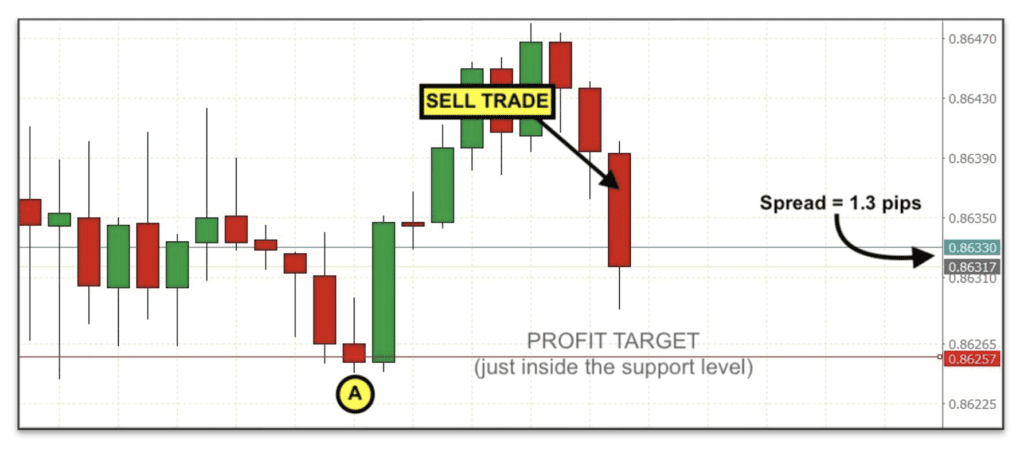
However, the spread on this market is 1.3 pips, which means the price will actually have to move BEYOND that support level for us to get a winner.
If you’re trading directly off charts, as many brokers now encourage, make sure you know if the chart is based on the bid, mid or ask price.
How to beat the spread
Let’s not kid ourselves … profitable trading isn’t an easy thing to achieve. The margins we work within are tight, with big profits achieved through repetition and compounding rather than lottery-style winners.
This means that we need to be mindful of costs – these kinds of marginal gains make an enormous difference over the long term.
- Always know the spread cost on the market you’re trading – be aware that this can change over the course of the day, so be especially cautious if you’re running short-term trades overnight.
- Think of spread costs as a percentage of your target/stop distances
- Avoid high spread costs – we just don’t need to be trading expensive markets
- Factor in spread costs when positioning your stops and targets – remember, you’ll be closing-out buy trades at the bid price, and closing-out sell trades at the ask price.
By thinking about spread costs as an integral part of your trading, you can avoid these pitfalls, making your trading both cheaper and more successful.
To enjoy more content and get it faster Follow @TradersBulletin
Related posts:

JOIN US ...
Get full access to members-only resources, plus my weekly email updates ...
I will NEVER share your details for marketing purposes. Privacy policy
Strategies I'm Using
 It has taken 2 years to persuade this market…
- These videos show how to make 24% gains in…
 As you can see from all the data I've…
 Get the low down on the Heikin Ashi Mountain…