How to trade sideways markets

Trends may be our friends, but when they leave us high and dry … we need to have a plan.
Sideways markets can be a daunting place for traders, especially when we’ve been picking off profits on a steadily climbing equities market.
But, there are still plenty of profits to be made – we just need to know how.
Can’t find a market direction? Play ping pong …
When markets are drifting sideways, we can often define a range that they are moving in. This will be an upper boundary, where they’re hitting resistance and selling kicks in. And a lower boundary, where price finds support and the buyers step in.
Of course, in the text books, a range looks something like this …

And the idea is that we can easily pick up profits by selling at the highs and buying at the lows, right?
It’s a great idea, but if you’ve tried to trade like this, I expect you’ve found yourself spat out of trades – because the reality of trading sideways markets is generally a lot messier …

So, what’s the secret in how to trade sideways markets?
It doesn’t matter if you’re going long or short, what matters is finding a good position for your stop level – this means we can cap risk tight. And if we’ve got a good reward-to-risk, it doesn’t matter if we’re wrong this time, because in the long term, we’re going to win out.
So, what do I mean by a good stop position?
The obvious place for our stops is tucked just outside the range, and to enter as the price is bouncing …
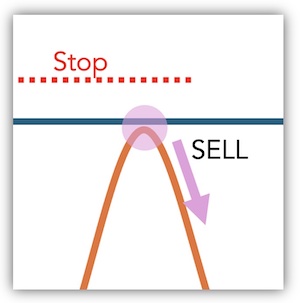
But what actually happens is this …

If we’re using these support and resistance levels for entry and exits, we need to consider the thousands of other traders who’ve had exactly the same great idea …
Much as I like to think I’m special … it’s unlikely that no one else has noticed a price moving in a range.
All this traffic means that prices will inevitably get a little “messy” around these support and resistance areas. These areas will be riddled with trade orders, and we’re vulnerable to stop-loss hunting.
The solution is to find another support/resistance level – one that’s safer than the border to our trading range.
Here’s how we do it …
Yes, a good entry should use price action on a shorter timeframe to get confirmation, and yes, we can also use divergence on an oscillator to back up our trade … But the trick I want to show you here is about getting a great entry, with a tight stop and an excellent reward-to-risk ratio.
These are the only range-trading setups we should consider – the kind of setup that makes putting our money at risk in the market worthwhile.
The trick is to wait for a move above the range – not just a spike through – this should be a close above.

Then, we enter our trade as the price moves back (closing) within the range.
The beauty of this is that we now have a ‘high’ to position our stop level above. This is a nice tight risk, combined with a good potential reward.
As you can see above, this high is then tested twice again before the move down (that second test would be close – depending on how many pips above the high you gave yourself).
And that’s the crucial thing – building the losing trades into your plan. We know we won’t always get it right, but by only accepting the best setups, with smart places to put our stops, we can win out in the long run.


JOIN US ...
Get full access to members-only resources, plus my weekly email updates ...
I will NEVER share your details for marketing purposes. Privacy policy
Strategies I'm Using
 It has taken 2 years to persuade this market…
- These videos show how to make 24% gains in…
 As you can see from all the data I've…
 Get the low down on the Heikin Ashi Mountain…