

How to enter a runaway trend
No one wants to be a sucker, jumping on the band wagon, but equally, just because you’ve missed a chunk of a move, doesn’t mean there’s not more to be had.
Trending markets can run and run – often considerably further than ‘market experts’ think they should, or that value would suggest.
So how can you enter an established trend with confidence?
Here are some questions to ask yourself …
• Are you buying because you don’t want to miss out?
• Are you buying because you’ve been told this is a sure thing?
• Are you buying because you think this’ll go up?
If any of these reasons are behind your decision, then you’re guilty of trading what you think, rather than what you see.
Instead we should be looking at the chart, biding our time, and waiting for the perfect entry.
As we know, trends don’t move in straight lines, so what we want to avoid is getting in at the top of a higher high, just to be followed by a dip that’ll put us immediately into a loss.
What we want is to get in on a pullback, along with a burst of momentum – this’ll give our trade the best start.

Of course, if you’ve deep pockets, patience and a steady nerve, and the trend is strong enough, you can afford to buy on a high and wait it out – but you’ll be taking a gamble. All trends will falter, and all trends will come to an end, so if you’re making poor entries, it’ll catch you out.
So, how do we catch these dips? It looks very simple to do in retrospect, but when the trend is active, these are the three key things we should we be looking for …
1. Trend dip
This is the visual clue that our trend is pulling back. This could be towards a trend line or a moving average.
A trend line will be a line drawn onto our charts, linking a series of higher lows …

Or, for a trend that isn’t forming a neat line, a moving average can be more useful …

These moments when the price interacts with our trend line, or moving average are our wake-up calls. They aren’t enough to signal an entry – they could be telling us that the trend is about to break.
But these are the places where we should be looking for an entry, based on momentum …
2. Building momentum
So, we aren’t jumping in the moment the price touches our support line. Instead, we want to see the direction change, with some momentum behind it.
This means that we’re not getting in at the lowest price, but by pausing, our signal will be clearer and more reliable.
Here’s an example using the Stochastic oscillator to signal that momentum is in the right direction, and is building …
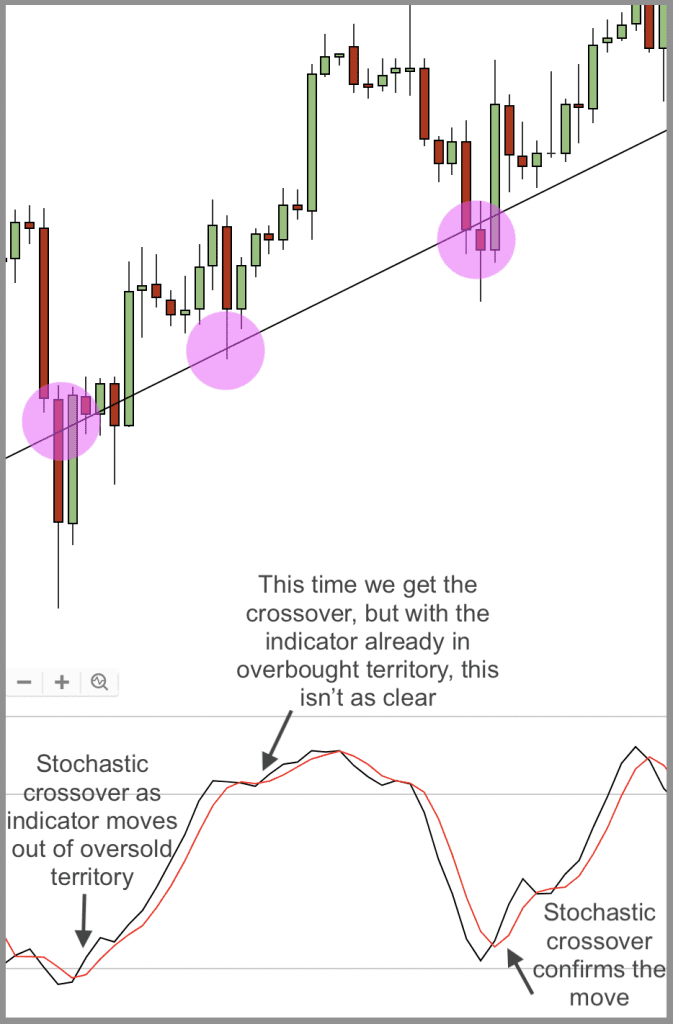
To hone in on the entry here, I’ve zoomed into a shorter timeframe than I was using to view the trend.
3. Candlestick action
An alternative (or addition) to using a momentum indicator is to read the momentum signals directly from the candlesticks.
This involves spotting bullish candlestick patterns right on these support levels, as the price interacts with a trend line or a moving average line.
Again, this involves pausing to wait for the signal.
Looking at the same example, but focusing on the price action, we can see two strong engulfing candlesticks, and one piercing pattern …

Don’t worry if you’re not very familiar with price action trading – you really don’t need to have a wealth of knowledge to spot the most important candlesticks.
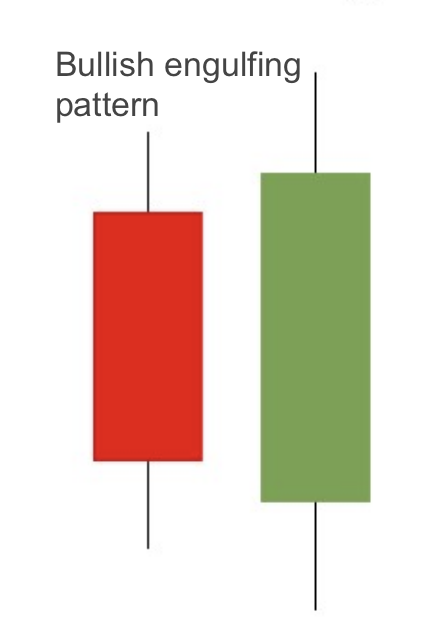
A doji candle formed on the area of support is pretty common – but, in itself, doesn’t signal a change of direction. What we want is to hold on for an engulfing candle – where the body of an up candle ‘engulfs’ the body of the previous down candle, signalling the move up.
The final check …
So, you’ve got an established trend … you’ve watched for a pullback … and you’ve waited for a momentum confirmation …
There’s one final consideration – especially if this is a trend that’s been running and is gathering attention.
It’s easy to tell yourself that you’ll ‘trade what you see, not what you think’ … but in practice it can be hard to recognize our confirmation biases.
Our opinions can affect the way we take facts on board. It’s called confirmation bias.

In any established trend, you’ll have those telling you to jump on board, and those screaming that it’s about to top out. Closing our minds to those external influences and following the technical signs can be tough – it takes a degree of honesty and self-awareness.
Ask yourself: Am I taking this trade because the set-up is right? Or because I think I know what the market will do? Or what I want it to do?
And remember – the market doesn’t care what you think or want!
To enjoy more content and get it faster Follow @TradersBulletin


JOIN US ...
Get full access to members-only resources, plus my weekly email updates ...
I will NEVER share your details for marketing purposes. Privacy policy
Strategies I'm Using
 It has taken 2 years to persuade this market…
- These videos show how to make 24% gains in…
 As you can see from all the data I've…
 Get the low down on the Heikin Ashi Mountain…





1 comment
Anthony Gorringe
Hi Mark,
Thanks for the interesting article of getting into established trends. Good timing, considering that both gold and silver had a rare down day on Friday. Would you say that now might be a good time to get into (or add-to) a gold/silver buy trade?
Thanks
Tony