

Why I’m switching up my trading time frame

A surprisingly easy question to answer about trading time frames is: ‘Which time frame makes the most money?’
The traders who tend to make the most money are those who follow longer timeframes – looking for big market moves over weeks or months.
But – as with most ‘easy questions’ – the answer doesn’t give the full picture. Just because the data shows these traders outperforming others, doesn’t mean that this is the right choice for everyone, all the time.
Before I get to finding the right timeframe for you and the market conditions you’re facing, I’ll just look at what time frames mean …
What’s in a trading time frame?
Your trading time frame is nothing more technical than the scale you’re looking at your charts in. If each candlestick represents a day or a week, you’re trading a longer timeframe. If each candle represents 5 or 15 minutes, you’re trading a shorter timeframe.
Time frames in trading can be like looking through binoculars. Zoom in, and you’ll get the detail but miss the bigger picture … zoom out, and you’ll get the bigger picture, but miss out on the detail.
We may think that the greater detail we get in shorter time frames must be a good thing … but, the reality is that detail can be ‘noise’ – these are the bumps in trading that can send us off track, when we want to be focusing on longer-term moves.
This is why the time frame you trade will relate to the timescale you expect your trade to run for. If you’re looking for a big move over several weeks, you can’t find this kind of signal in a 15-minute chart. Conversely, if you’re looking to snap up 10 pips in the next hour, you won’t find that on a daily chart.
What went wrong for me
I run a handful of trading systems at any one time, and try to give myself a balance of different approaches.
What’s struck me in the last month is how one of my trend-following methods has massively under performed the others.
My long-term trading strategy made just under 6% last month (this was the result of just one trade closed in that period).
My short-term day trading made around 7% in the last 6 weeks.
While my medium-term swing trading strategy lost 6.7% last month.
All trading methods have their ups and downs, and I’m not suggesting we pass judgement on a system based on just one month’s results. But what my medium-term trading came up against was a ‘worst of both worlds’ scenario, where it failed to get into longer moves, because it got buffeted out by bumpy markets, but also failed to catch smaller moves, because it wasn’t flexible enough to see which way the wind was blowing on an individual day.
When these kinds of choppy directionless markets fail to give the moves that longer term methods need – they can be the perfect field for shorter-term profits. And that was exactly the case for me last month.
Trend-following systems NEED a trend to make money … unless they are short-term scalping strategies, where there’s always a trend to be found!
To show you want I mean, here’s a daily chart for Cable last month. I’ve included a couple of moving averages (20 and 50 SMA) to give you an idea of what the most basic trend-following signals could offer …
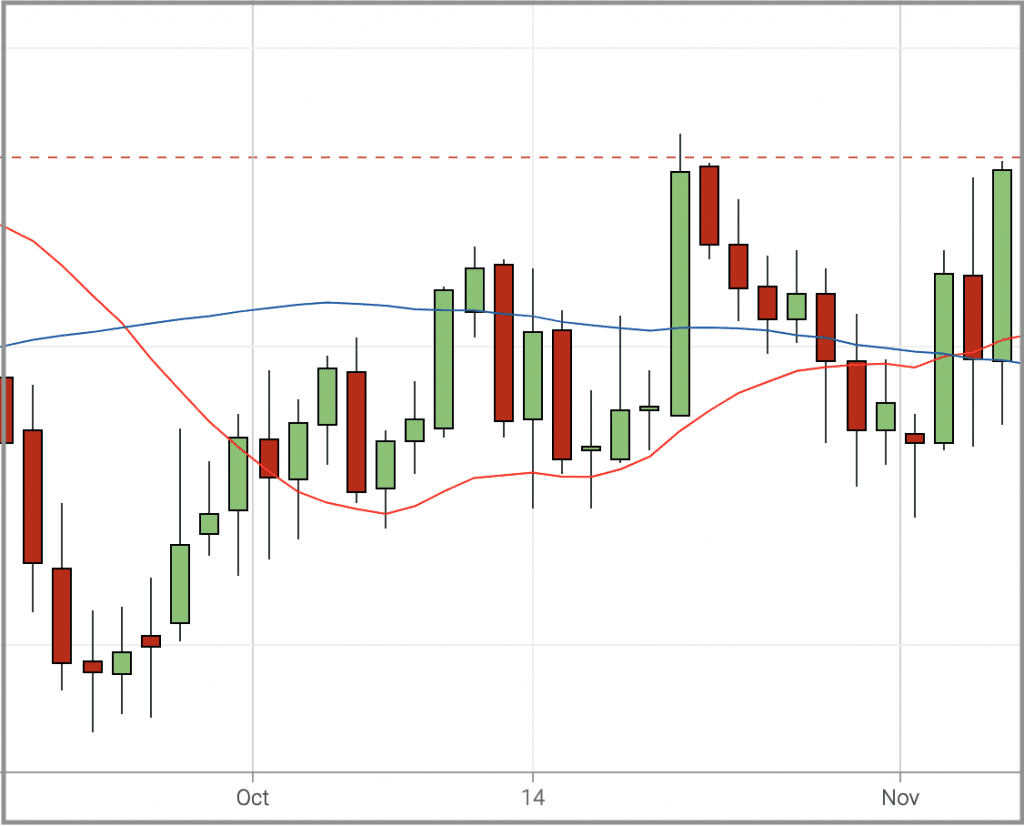
Not much in the way of profit opportunities there.
But then look at just a fraction of the same month on a 15 minute chart (with the same moving averages on) …
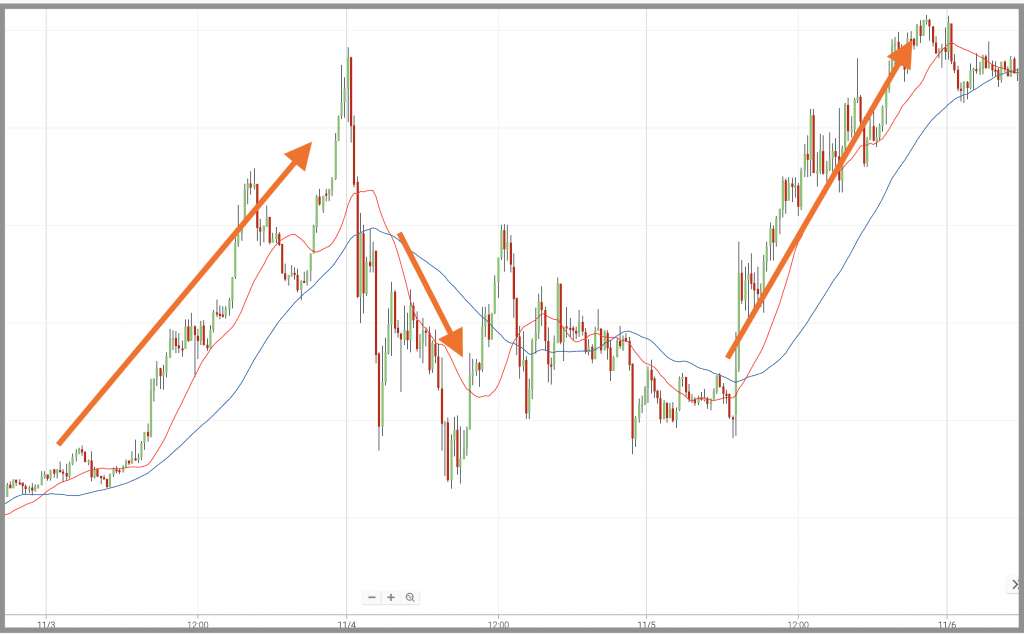
By contrast, there’s no shortages of trending opportunities for the shorter-term trader to potentially jump onto.
How to cover your bases
The problem with short-term trading is that it’s more time-consuming and can be more costly in terms of trading costs. So I’m not for a moment suggesting that we ditch the steady longer term trading methods.
However, by supplementing our long-term trend-following strategies with shorter time frames, we can continue to bring in returns when the long- and medium-term trends let us down.
Shorter time frames also allow us to trade much more, honing our skills, while sticking with smaller risk levels.
And next week, I’ll show you how to combine multiple time frames to get the perfect balance of detail against ‘big picture’.
To enjoy more content and get it faster Follow @TradersBulletin


JOIN US ...
Get full access to members-only resources, plus my weekly email updates ...
I will NEVER share your details for marketing purposes. Privacy policy
Strategies I'm Using
 It has taken 2 years to persuade this market…
- These videos show how to make 24% gains in…
 As you can see from all the data I've…
 Get the low down on the Heikin Ashi Mountain…





3 comments
Susan Fry
Do you think it would be best to stop using the Heikin Ashi trading system for the time being?
Mark Rose
Hi Susan, it’s a fair question, given my comments above! But that’s absolutely not what I think. We can’t predict what’s around the corner in terms of market conditions, and if we’re entering a new phase of the bull market, Heikin Ashi is well-placed for profiting from that. It’s really good at catching swings in a trending market. But it is always good to have extra strings to our bows though, and look at other time frames to trade.
Susan Fry
Thanks for the prompt reply. I am looking forward to your new trading system when you release it.