June 10, 2011by Mark Rose- 1 comment
How to crack the perfect trend line

Last weekend, while having lunch with my teenage nieces, who were wearing fashionably distressed jeans with Abercrombie & Fitch sweatshirts, I made a comment about how my worn-out decorating jeans must be back in fashion.
My wife shot me a look, “My grandfather made exactly the same comment back in the eighties about my ripped Levi 501s.”
I felt about 100 years old.
Back in the days when I wore ripped jeans for anything other than DIY, being “on trend” used to be about the clothes you wore, and the music you listened to, where you chose to hang out …
Now “trending” encompasses what you’re thinking about, what you’re talking about … and what you’re Tweeting about and searching for on Google …
Useful if you want to know which footballer has been cheating on his wife – but what does it have to do with our trading?
What I’m getting at here is the real meaning of the word “trend” – it’s about a general tendency or direction (according to my Collins concise dictionary, anyway).
It is useful to remember this definition when we’re drawing trend lines, and when we’re reading them …
From the text book
All of technical analysis is based on the theory that prices trend in one direction or another. Trend lines are our attempts to make sense of these trends.
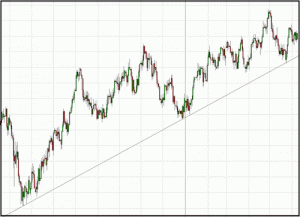
There are basically two types of trend lines: upward and downward. An uptrend line has a positive slope which connects a series of higher lows. A downtrend line has a negative slope which connects a series of lower highs.
A trend line should touch the price at three or more points in order to be valid.
For an uptrend, the line acts as support for the price, showing that sentiment is bullish and buyers are coming in at higher and higher lows.
For a downtrend, the line acts as resistance, showing that sellers are coming into the market sooner on each retracement.
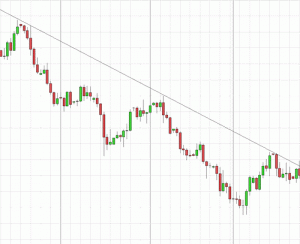
Strictly speaking, if the line is to pass through the lowest or highest prices, it should do just that – hit the tips of the candlestick wicks.
However, life – and the market – is rarely that neat and tidy …
But, before we start breaking the rules with our trend lines, lets take a look at what they are:
• A trend line needs to touch at least three times.
• The more times the price bounces off the trend line, the stronger its support or resistance becomes.
• The steeper your trend line, the less reliable it is.
• Ideally, your touch points should be evenly spaced.
Now that you know the rules, I’d like to remind you of what I said earlier … trends are about a general tendency or direction.
Just because you’ve got a chart in front of you and a ruler, doesn’t mean that we’re looking for scientific accuracy – we’re looking for trends in the behaviour of traders.
Twisting the rules
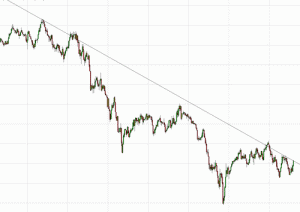
Here are a couple of examples of decidedly messier trend lines …
In this case, the line has been drawn through price “clusters” rather than specific highs on the candlesticks.
And in this example, the trend line ignores the downward price spike on the Euro in March.
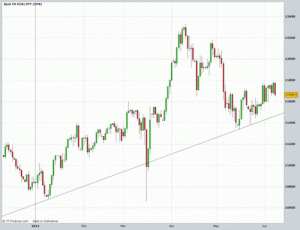
A purist might call these trend lines “wrong”, but the thing to remember with these tools is that they are guides to how the market is trending.
Just because “Ryan Giggs” is trending on Twitter, doesn’t mean that there aren’t other perfectly valid trends going on.
Of course, if you’ve cut a few corners when drawing your trend line, you’ll need to acknowledge that and accept that it has some weaknesses.
Not all trend lines are created equal. But anything that helps you to establish a trend is likely to have a positive effect on your trading.
Until next week,
Mark Rose










1 comment
Bill Kruse
What I find most concerning is the speed and willingness with which S&P has downgraded the States compared to the way they looked the other way for years leading up to and during the credit crunch. It appears they were on one agenda then and a different one now – but what? Is this evidence of the ‘banker wars’ rumours that are doing the rounds?