This is a very effective trading strategy that cuts through the fuss of pattern recognition to get you to the bare bones of price action. Keep reading to find out exactly how to use this simple setup …
The Mother Bar
First up, I want to introduce ‘mother’ ….
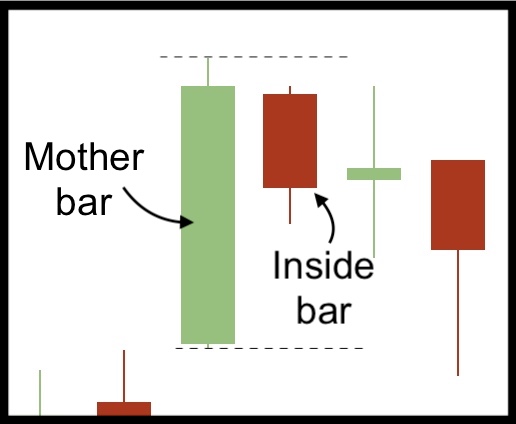
A mother bar pattern is also called an inside bar pattern. We’re looking at daily charts, so this will be an inside day.
It is a two-candle pattern, where the entire body and wicks of the second candle fits within the high-low range of the previous bar.
Inside bar patterns can vary wildly, as long as the second candle fits entirely within the first. Here are some examples …
The mother bar is the bigger candlestick that forms the first part of the pattern. The inside bar is the smaller one, that’s within its range.
The pattern tells us that the market is ‘stuck’ possibly because of indecision, possibly because orders are being cleared out or profit taking.
For those of us waiting for a trend to kick in, it’s a clue: an mother-bar pattern tells us there’s a contraction. And contractions are often followed by expansion. So, a trend day might be coming next.
Trend-following breakouts tend to be stronger after these contractions.
Mother bars are useful short-cut patterns because they are an abbreviation of a more complex consolidation on a lower timeframe. An inside bar on a daily chart, for example, may look like a triangle or another consolidation pattern when you drill down to the hourly chart.
This means that you can see a pattern on a lower timeframe at just one glance, looking at just the last two daily bars.
Finding direction
This trading strategy is about finding an entry into a trend by using a breakout from the pattern.
Therefore, it’s essential that the first thing we do is establish our trend. I’m going to do this in a very simple way using multiple moving averages. On the chart below, I’ve got 15, 30 and 200-day simple moving averages …
We will only consider entering a trade if the price is above or below all three moving average lines. If the price is above, we’ll only be looking for buy opportunities. If the price is below, we’ll only look for sell opportunities.
Finding the setup
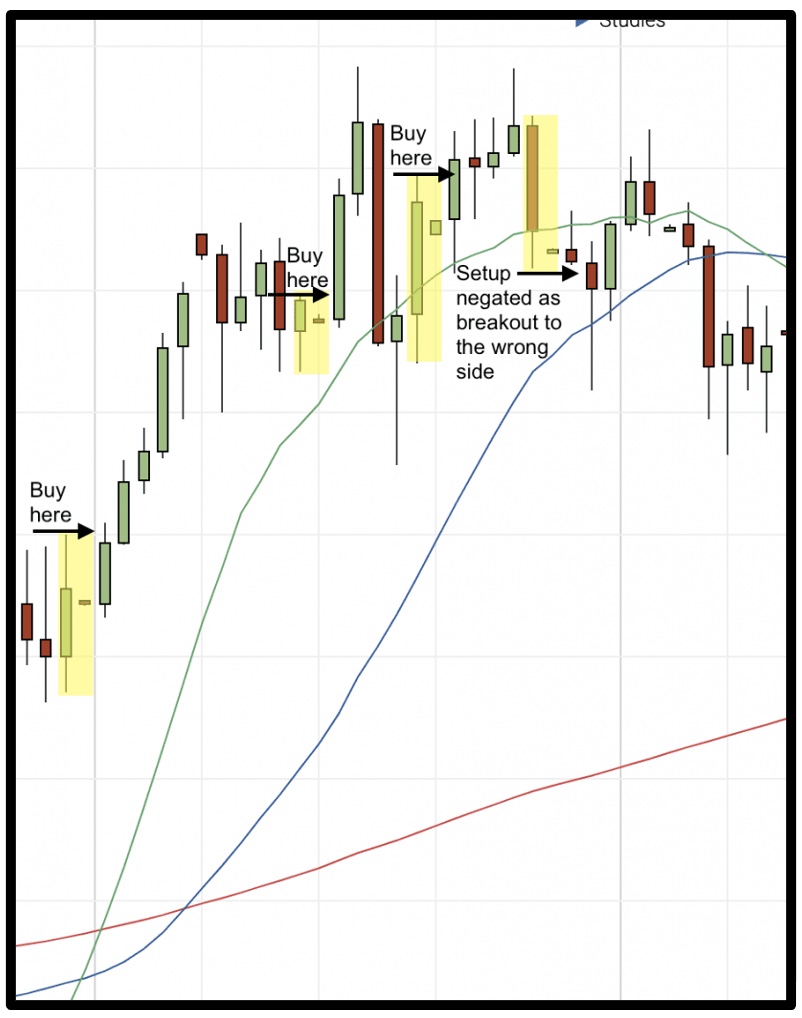
Once we’ve found a Mother Bar pattern that’s beyond the moving averages, we’re looking to enter the market, in the direction of the trend, when the price breaks through the range of the first (mother) bar.
If this was an uptrend, we’d want to buy, when the high of the first candle is breached …
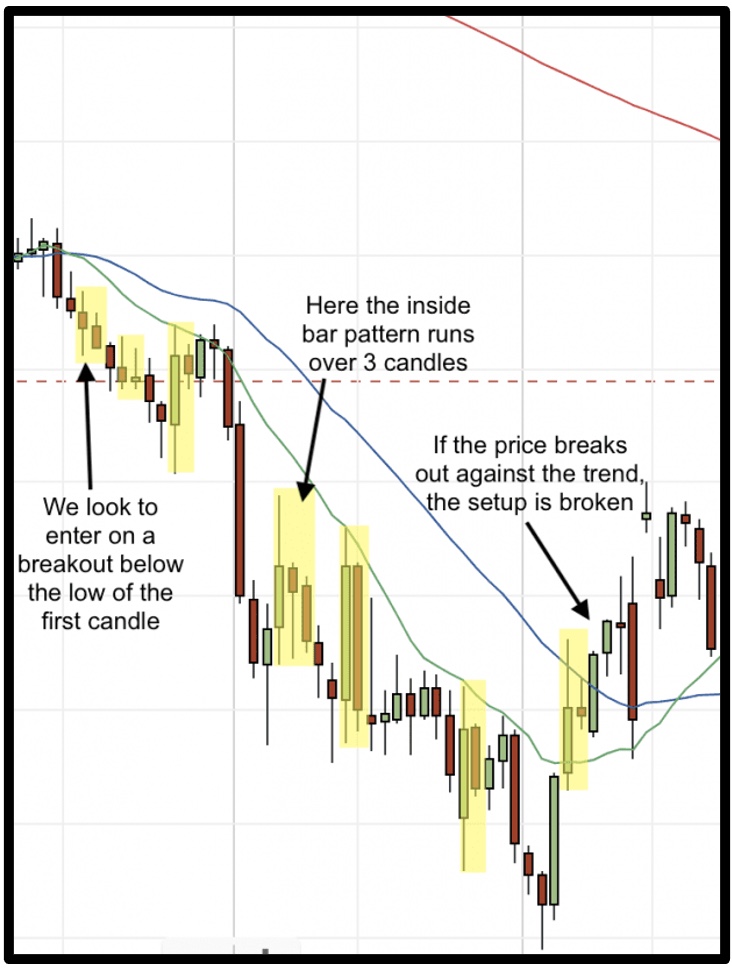
Here are some more examples …
Taking profits
There isn’t a magic profit target for these trades. You could look for a fixed multiple of your initial risk, trail your stop as the trend develops, or use the next obvious support/resistance level. Just remember that a very large mother bar means a correspondingly large stop, so make sure there’s realistically enough room for the trade to pay you for the risk you’re taking.
Mother Bar trading tips
It’s best to trade inside bars on longer timeframes, like daily charts, where a consolidation is more significant.
If multiple inside bars stack up, it’s known as coiling. This is just a longer period of consolidation, and can be followed by a more powerful breakout.
Inside bars can offer good risk-reward setups because we have a clear stop level at the limit of the mother bar. However, beware of looking for 1:1 returns on a large mother candle, as the market may well not have the legs for it. If the reward-to-risk isn’t good enough, sit out and wait for a better setup.
Give the price action some wriggle room by entering the breakout a few points beyond the extreme of the mother bar. Likewise, you can set your stop a few points beyond the other extreme of the bar.
If the price breaks in the wrong direction, be ruthless in cancelling this signal.
Don’t force an inside bar where there’s any ambiguity. If the high or low is equal to that of the mother bar, we shouldn’t be risking our money on an ambiguous signal.
It really is that simple. And the beauty is that inside bars pop up regularly. Have a flick through a few daily charts and see how many you can spot — and, more importantly, what happened when price eventually broke out.