October 1, 2010by Mark Rose- 0 comments
The laws of momentum

Last Saturday, I took the kids to the playground. My youngest son, aged just two years, suffers from what I call the “Jack Russell delusion”. He appears to have no idea of his diminutive size, and approaches the world with the self-image of a WWF wrestler.
So, when he decided that it was his turn to have a go on the zip wire, the fact that it was being used by a teenager, who was moving towards him at 30 mph, wasn’t going to faze him.
The teenager however, had some understanding of the laws of momentum, and gave a pitiful yelp when he saw a toddler preparing to rugby tackle him off the zip wire.
My wife was unimpressed when I returned home with her youngest child missing a front tooth.
And my son was equally unimpressed when I sat him down to explain that it was unwise to stand in the path of heavy, fast-moving objects.
Perhaps he’s too young to grasp Newtonian mechanics.
Arguing with the laws of physics
Momentum is, I learned in school, mass multiplied by velocity.
Momentum, in trading terms, is a little different. But – much like a teenager travelling at 30 mph – you’d be foolish to argue with it.
Momentum indicators can get a hard time from traders, who are frustrated by the false whipsaws and poor timing the often present, but judiciously applying the laws of momentum to your trading can make a big difference to the profitability of your investments.
Going with the flow
Price momentum is all about the rate at which a price is changing.
If the speed of a price change is increasing (accelerating), the momentum is going up. If the speed of the price change is decreasing (decelerating), then momentum is going down.
Note that we’re talking about price change here (the price can be going up or down) – momentum is to do with rate of change, not direction of change.
There is a whole armory of momentum indicators that you can use in trading. I’ll start off with the most basic – the “momentum indicator”.
This measures how much the price has moved over a selected time frame (usually 12 days) – so you’ll take the closing price today, subtract the closing price 12 days ago, and plot your answer on a graph:
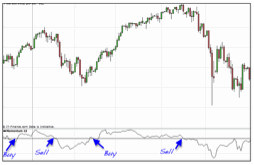
The horizontal line through our momentum indicator is zero. So, when the price is equal the price 12 days ago, we’ll hit this zero line.
And, put in its simplest terms, when the momentum indicator passes through this line, we’re getting our ‘buy’ and ‘sell’ signals. If the price is accelerating upwards, it’s a bullish signal; if the price is accelerating downwards, it’s a bearish signal.
Putting the brakes on
However, taking these as ‘buys’ and ‘sells’ is really an over simplification of momentum. Momentum indicators are better used for confirmation to open or close a trade, rather than buy or sell signals in their own right.
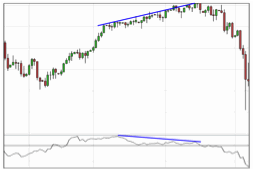
Many traders use the momentum indicator to spot divergences – i.e. where the price and the indicator are moving in different directions. This is a signal that a trend is running out of steam and a reversal could be imminent.
Gauging market temperature
Another momentum indicator is Rate of Change – this measures the percentage change of the current price compared to the price of x periods ago, and is also a guide for determining overbought and oversold conditions.
I’ll take a look at this and other oscillators another day.
The key thing to remember about momentum is that it works best as a confirmation signal – if you’re about to buy or sell, check the momentum signal for confirmation before you put your money on the line.
In this way, momentum can increase the probability of a trade being profitable; it can reduce your overall number of trades; and can reduce the number of whipsaw trades.
All in all, the momentum indicator is not the most sophisticated of analysis tools – it can’t jump through the kind of hoops that RSI and Stochastic oscillators can. But it is simple, and sometimes the simplest view of the market can give us the clearest picture.
Until next week,
Mark Rose
Save