April 15, 2022by M Rose- 0 comments
These are the stop distances you need to use right now

No one likes getting stopped out, but with current levels of volatility, many of us are getting all too familiar with the experience.
If you trade with tight stops, or even moderate stops, you’re likely to have suffered from getting bumped out of trades by wild market swings in recent weeks.
Volatile markets can offer amazing opportunities for traders, but we need to match our trading style to the market mood. Otherwise, we’re just risking our money on whichever twist and turn prices will take next.
Ups and downs
Spread betting allows us to take profits whether markets are going up or down … it’s one of the benefits of this type of trading.
It’s so easy to go long or go short – it’s easy to forget how differently prices behave when they’re going up or down. The reality is that bull markets and bear markets are not mirror images of each other. And many strategies that do well in bull markets, lose hand over fist in bear markets, because of increased volatility.
So, what does that mean for ours stops?
As volatility increases, the stop levels we use in ‘normal’ trading conditions become more vulnerable. This is when we want to look at widening out our stop distances.
This doesn’t mean that you need to increase your risk levels.
Instead, you can reduce position size, and push our profit targets to ensure our risk-reward profile isn’t harmed.
For example, if you were trading with a stake size of £10 and a 20 pip stop and 20 pip profit target …
… you might change that to a stake of £8, with a stop distance of 25 pips and a profit distance of 25 pips.
The potential profit/loss on these two positions is still £200, but the parameters are more forgiving to increased volatility.
How do we judge how far to increase our stop distance?
Measuring volatility changes across different instruments can be tricky.
My preferred way to work this into my trading strategy (if I’m not using key levels) is to base a stop distance on average true range. You can find a very neat method here, using the Keltner Channel.
How wide is too wide?
Stop losses always cost us money. If we traded with no stop loss at all, we would have a more profitable strategy – in theory. In reality, we’d find ourselves sitting for long periods on huge unrealized losses, waiting for prices to come back.
Even wide stops cost us money. But the tighter they are, the more they will hurt performance.
The tighter our stop levels are, the more likely they are to get hit.
I know that sounds obvious … but there’s always a temptation to tighten stops, reduce risk, and protect our downside.
That’s not a bad thing. Stop levels enable us to manage risk at levels we can cope with and they allow us to smooth out our profit curve.
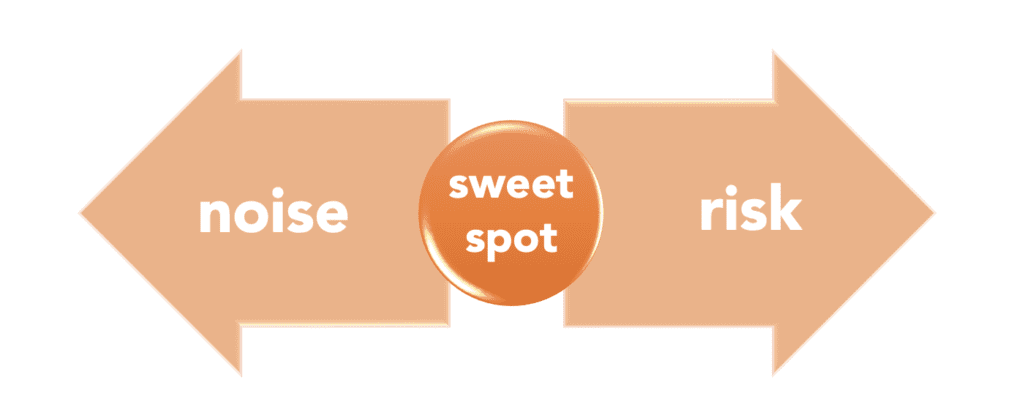
But it’s a balancing act. We need to control risk in some way. But stop levels will hurt performance by giving us losing trades. It’s about finding a sweet spot between, between taking small regular losses, or the occasional huge one.
A well-positioned stop level won’t be hit by natural noise in the market, but will cut your losses if the market moves distinctly against the set-up you’ve got in play.
A nice, tight stop can give us a feeling of security in the market, but trading with stops that are hit again and again is frustrating – a death by a thousand cuts.
The case for wider stops
• Give market room to move
How many times have you been ‘right’ in your prediction about which way the market will move, but been caught out by a little nudge in the wrong direction? It’s frustrating, and if it’s happening a lot, it means your stop is too tight.
Wider stops allow for the natural ‘noise’ of the market – and they give the space to be ‘right’.
• Get more time for positions to play out
A wider stop will naturally lead to trades staying open for longer. This means there’s more time not only for us to be ‘right’ but we can even be ‘more right’ – that means bigger profit targets, collecting hundreds of points rather than tens of points.
• Have less stress
Trading with wider stops means that pin-point accurate timing for entries and exits is less important. This means we can have more time for decision-making. Which, in turn, means better decisions and less stress.
• Handle volatility
Wider stops won’t be rattled but surges of volatility in markets, making them more adapatable across market conditions – whether markets are going up or down.
NB: widening stops must go hand in hand with reduced position sizing, otherwise you’re increasing your risk, which is exactly what we DON’T want to do in volatile markets.
I’ll be opening the doors on my long-term trading strategy very soon – a system which allows you to profit in bull or bear markets, using wide stops, low stakes, and less stress. Please watch out for a pre-launch announcement.
To enjoy more content and get it faster