Futures … options … spot prices … why would we chose one over the other?
First off, it’s important to recognise the difference between futures markets in the real world … and spread-betting futures …
In the real world, a future is a contract, with an expiry date which comes with obligations. By contrast, in the spread-betting world, we are given the opportunity to bet on price fluctuations of a futures contract. No forex exchange takes place … no stocks or commodities change hands.
Spread betting on a futures price is exactly the same process as spread betting on any other instrument – you pick your direction, place your stake, and take profits (or losses) accordingly. But there are some key benefits to choosing these markets over the common-or-garden spot prices, which I’m going to uncover here.
First, a quick look under the hood at what exactly the underlying asset of a ‘future’ is …
Real-world futures
The futures market was born from farmers wanting a fair deal – and a level of security.
Let’s say that a farmer was producing wheat. Rather than just turn up at market come harvest time and try to find a buyer, he’d form a contract with the dealer for a certain quantity on a certain date, for a fixed price.
The futures market was born.
Our farmer could buy seed and fertilizer, and toil the land all year, with a level of security in the payout he’d receive.
Over the years, the futures market grew from just a handful of farm products to include a vast number of tradable commodities, plus instruments like indices, stocks and currencies. And investors began to use these futures markets to speculate on the price of instruments and commodities going up or down in the future.
So, the price of a futures contract will be slightly different to the ‘spot’ price – which is the ‘here and now’ price.
If the market sentiment is that the price is going to go up – then the futures price will be higher. And conversely, if the sentiment is that the price will go down, the futures price will be lower than the spot price.
Some of the higher price in a futures contract is to do with factors other than predicted price rises … storage, for example, in the case of something like gold … or risk, such as weather and political events, in the case of things like cotton or oil …
In reality, most futures investors will sell their contract before it expires – they are interested in the speculation rather than in taking delivery of barrels of oil or tonnes of wheat.
So that’s what’s different about the underlying assets. But what about the futures contracts on our spread-bet platform?
How futures work on your spread-bet platform
Not all brokers offer futures markets. In your average list of instruments available, the default is a spot market, often called ‘rolling dailies’. These are based on the price you’d have to pay if you wanted to go out into the market and buy this underlying asset right now – like the cost of that currency, or of gold, or of a share price.
These spot prices don’t have an expiry date. Instead they are described as ‘good until cancelled’, which means that the contract is ‘rolled’ into the next day at the end of each 24 hour period – hence the name ‘rolling dailies’.
The futures contracts, by contrast, do have an expiry date. The relevance of this is to do with the ‘real world’ futures contracts (i.e. when that contract obliges you to actually take ownership of the asset). But for the purposes of our spread bet, this means that our position will end on that date. Many brokers will automatically roll an open future position into the next month or quarter’s contract – but traders need to be aware of this happening because of subtle price differences.
Futures VS Spot Prices
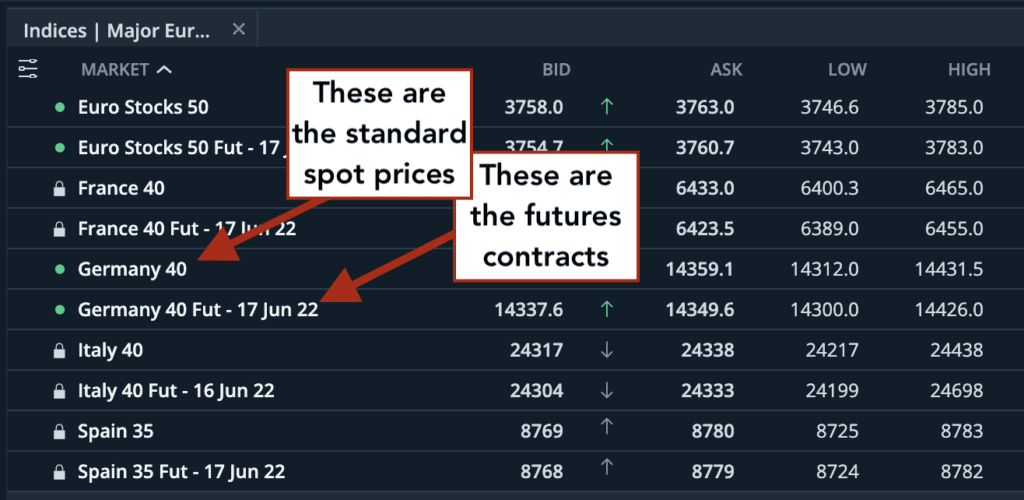
You’ll notice that there’s a price difference between a future price and a spot price for the same instrument. On the example above, showing European indices, the futures prices are slightly cheaper.
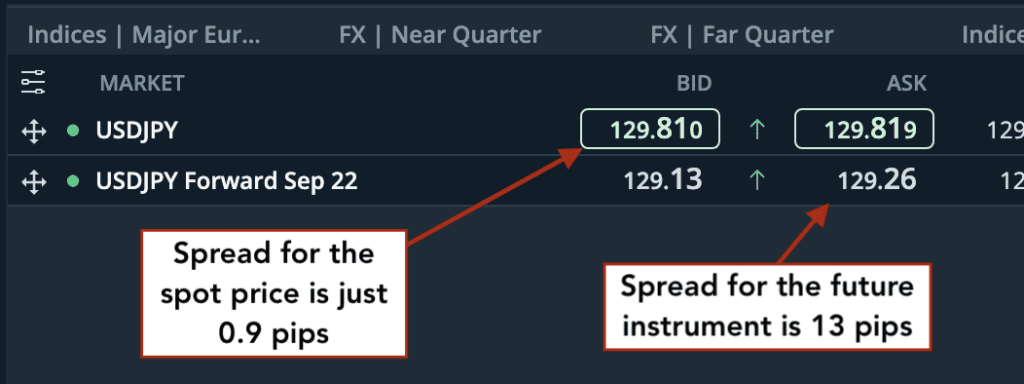
In the image below, showing a forex spot price compared to a September forward (forward contracts are, for our purposes, much the same as futures) … the September contract is significantly more expensive.
This is to do with where investors expect the price to be come September. Generally speaking, we’ll see a larger price difference the further out the expiry date – simply because more time means more can happen. As futures contracts move towards their expiry date, the price will get closer and closer to the spot price. Therefore, when a future spread bet is rolled into the next contracts, there’s often a price ‘jump’ as the expiry date moves out.
What’s so special about spread-betting futures?
So, why do I choose to spread bet on these markets that look much the same as the spot market?
It comes down to price …
The spread cost for the future is always higher. This is the charge we pay to the broker for trading.
Yes, I’m choosing to pay more to trade. Why?
This spread is a single, up-front cost to place our trade. It’s the only charge the broker inflicts on us, until that trade expires – maybe one month, maybe six months later.
By contrast, the ‘cheaper’ spot market incurs a rolling charge every 24 hours, when that contract is automatically ‘rolled’ into the next period. If we’re holding trades open for weeks, even months, these costs add up.
Therefore, by switching longer term positions across to futures markets, we may pay a little more upfront – but we’ve instantly saved ourselves on trading cost. It’s exactly these modest, marginal gains that keep successful traders ahead of the game.