October 28, 2011by Mark Rose- 0 comments
Forex traders: now is your moment in the spotlight
There are certain key moments in the history of the financial markets that stick in our consciousness.
They tend to be negative stories – when many, many people lose money.
The Great Wall St Crash of 1929 …
“Silver Thursday” in 1980, when the silver price crashed …
The Dot-com bubble in 2000 …
Black Wednesday in 1992 …
The sub-prime crisis of 2008 …
But amidst those negative stories, there are always the people who made money.
Stories like George Soros, who made $1 billion by short selling sterling during the Black Wednesday event, when Britain was forced to withdraw from the ERM.
There’s no doubt that we are experiencing such an event at the moment – as the future of the euro is played out.
We’ve seen important events this week – but this is by no means the turning point in this story.
Economical and political history is happening right now – these are the moments that you’ll tell you grandchildren about. But will you be telling them that you lost your pension – or that you made a killing?
I’m not talking about catching a cool $1 billion from the euro crisis – we can leave those kind of figures (and risks) to the likes of George Soros. What I’m talking about is making sure that you are in the best possible position to benefit from the upside – and also in the best position to protect yourself from the downside.
What the future holds
I’ve been a little distracted with my Dow trading of late, and haven’t talked about the forex markets for some time.
A lot of forex traders I speak to are nervous about the crisis in the eurozone, and are filled with questions:
“What’s going to come from the Euro summit this week?”
“How will the markets react?”
“Will the euro survive?”
and of course …
“How can I profit from the outcome?”
The truth is that no one knows what’s going to happen – not Angela Merkel, not the current head of the ECB, Jean-Claude Trichet, and not his successor Mario Draghi.
What I can tell you though, is that the markets rarely stand still for long, and if the markets are moving – there’s a profit to be made.
As forex traders, it’s down to us to ensure that we are best placed to catch those profits.
Forget long-term trends
This month, we’ve seen the beginnings of an up trend on the Eur/USD, and this comes despite flat/negative economic data from Europe … and despite negative reports from the finance meetings.
But I’m far too cautious of this one to start drawing in medium-term trend lines – and certainly not trend lines that I’m prepared to wager my good money on.
This week makes a good example – Tuesday and Wednesday trading was very flat ahead of news from the summit.
Here’s a screen shot I took on Wednesday, showing a trading channel between 1.388 and 1.396.

We can be sure that any piece of news will drive the price out of that channel, one way or the other. All we need to do is set up our trades to catch that move when it happens – short if we have a sustained move below 1.388 (not just a spike through this level) or long if we have a sustained move above 1.396.
And moments after I took this shot – the action began …

A decisive move below 1.3880, with plenty of momentum behind it. And this move continued all the way down to 1.3800, offering up to 80 pips of potential profit.
Managing the risk you can see – and the risk you can’t see
In a volatile market like this, it is more important than ever that you have a firm grasp on risk.
That’s one reason why I’m sticking with short-term positions. Looking for long-term moves in a volatile market means having seriously wide stop losses (and seriously deep pockets).
Now, an important risk-assessment issue that I want to point out is correlations. If you’ve been trading forex for some time, you’ll be aware of the major correlations between different currencies …
Let’s say that you open a few positions in the AUD/USD, CAD/USD and GBP/USD. Unexpectedly, the USD strengthens or weakens against you, and all three of your pairs move in the same (wrong) direction.
Now, if you’re trading Eur/USD, you need to be aware of a correlation which is currently close to record levels …
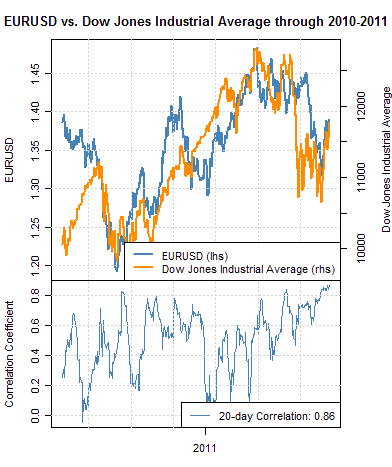
Over the past month, the Eur/USD and Dow have shown a 0.86 correlation – (with 1.00 being perfect correlation, -1.00 being perfect negative correlation, and 0.00 showing no correlation at all).
Why is this important?
Well, if you’re trading equities, you should be aware that a long trade on the Euro is directly correlated to equity markets.
If the Dow Jones is weak, money floods into the safe haven of the dollar (and the dollar strengthens). If the Dow Jones is strong, money deserts the dollar (and the dollar weakens).
For that reason, a short on the euro, is also a short on equities.
What I hope this shows is that there are huge potential profits to be made on the euro crisis, but that you really need to watch your exposure to this market.
If you want to profit from large moves – I recommend the use of trailing stops to protect your downside (more information on trailing stops in the coming weeks).
Plus, be mindful of your other trades, and how they correlate to the euro.