Volatility drag: how to defeat this enemy at the heart of your strategy
In budget week, I don’t need to remind anyone that, the more we earn, the more we give back.
But it’s not just the chancellor who’s dipping into our funds.
There’s another force that’s eating up your investments, often without traders even noticing it’s there.
I often hear comments like, ‘I’m in this for the long term, so short-term volatility and drawdowns don’t bother me’ …
It’s a good, stoical trader’s sentiment … but it’s actually very wrong. Volatility affects us all.
If you’re signed up to my Money-Making Machine strategy, you’ll have already had me banging on about it this week – but it’s crucial to understand the effects of this force on your trading bank, especially if you’re relying on compounding to build your wealth.
Here are some hard truths about investing …
If you have a drawdown of 50%, you need to have a gain of 100% to get back to breakeven.
A 20% decline, followed by a 30% gain … is actually a 4% return.
Even with consistent 10% p.a. gains after a drawdown of 50%, it would take nearly 8 years to get back to breakeven.
Drawdowns don’t just reduce the value of our funds temporarily, but have a deep, long-term impact on the pace and effectively of our compound growth.
This chart shows how much we have to earn back after a drawdown …
It’s sobering to look hard at the effects of drawdowns, but when we then apply those ups and downs to long-term trading, where we may be placing hundreds of trades over a year – the effects become even more stark.
How ups & downs affect long-term performance
Before we look into how to address this problem, I want to really peel back the mask and look at just how ugly “volatlity drag” can be …
What is volatility drag?
The greater the volatility in our returns, the more of a ‘drag’ that has on our profitability.
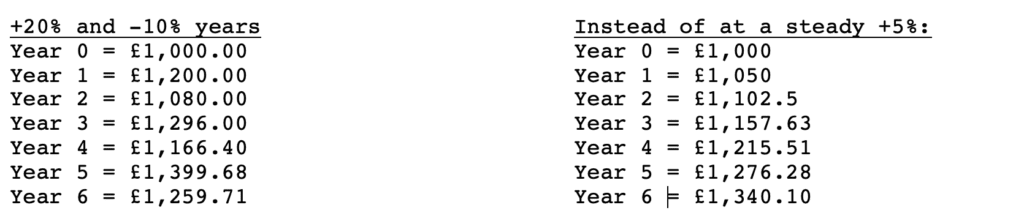
The gist of this is that if you start with £1,000 using a strategy that makes 20% in a good year, and loses 10% in a bad year (with good and bad years alternating), you’ll have an average return of 5%, in theory.
But in practice, you won’t achieve a 5% return, because your results will look more like this …
In fact, you can’t even expect to achieve this, because the distribution of the winning years and losing years won’t be nice and even like this.
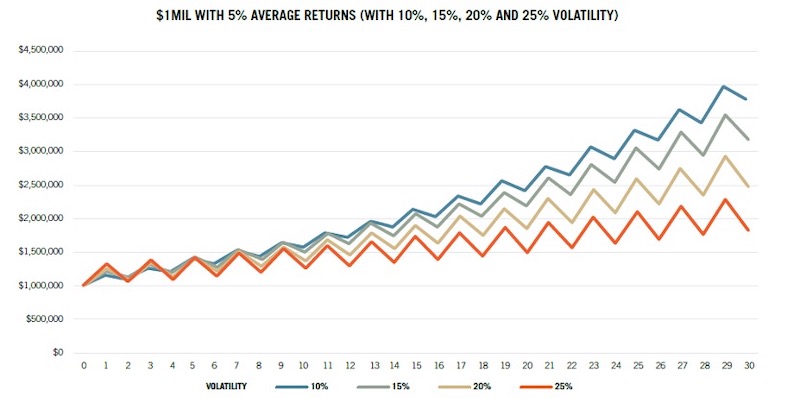
But what’s clear is that the greater the volatility, the greater the drag is has on your profits.
How to calculate volatility drag
Volatility of returns is measured by how far those returns deviate from the average.
Let’s say, in a good year, you make 50%, but in a bad year you lose 30%, and you get exactly half and half good years and bad years. That’s a volatility of 80%.
And it’s an average return of 10% per year (+50% – 30%)/2 years
Then, the calculation to measure the ‘drag’ it has on your returns is v2/2
So, for an 80% volatility, that’s (0.8)2/2 – which is a whopping 32% drag!
Volatility drag calculator
This little tool shows the effect of volatility on a fund – you can enter the average return, the volatility level, and it’ll show the drag and the resulting percentage return.
(Bear in mind that the actual effects of real-life volatility will never match this directly, because the distribution of winning and losing runs will be random.)
So, now that I’ve given you the horror story of the effects of volatility drag … let’s look at how we can dodge its effects.
How to beat volatility drag
The obvious way to avoid volatility drag is to … well, avoid volatility!
And yes, there’s a lot to be said for slow-and-steady investing. But:
The real world doesn’t always give us the option to avoid volatility
Slow and steady isn’t for everyone
Even slow and steady can benefit from added smoothing
The other option, when faced with volatile returns, is to avoid compounding altogether. Take a look at this chart, which shows how we’d do with compounding vs not compounding with different levels of volatility …
But I want to do better than this
I want to harness the power of compounding, even if I am experiencing volatile returns.
Money-Making Machine members will be receiving my detailed information on how to balance compounding with volatility, but here I want to show you the basic tools we have available.
Compound less often: The most aggressive style of compounding will be to adjust your risk/trade after each position is closed. Less aggressive would be to do this weekly, monthly, or even annually.
Throttle your compounding: whatever your winnings, never reinvest more than a fixed percentage each time
Dial down risk: Reducing your risk per trade will also dampen down the effects of volatility
Top-up: Don’t let your bank size fall after losses, but top them up each time, so your stakes only ever increase, and never decrease. This enables you to make back losses more quickly (but can get expensive in a losing run).
If you’re a Money-Making Machine member, I’ll be in touch over the next few weeks with details of exactly how I use compounding. And if you’re not yet on board, you can still find more details here.