June 3, 2016by Mark Rose- 0 comments
7 costly trading mistakes and how to avoid them
I’m currently trialing a brand new system – I’m in month 5 of trials, am around 40% up.
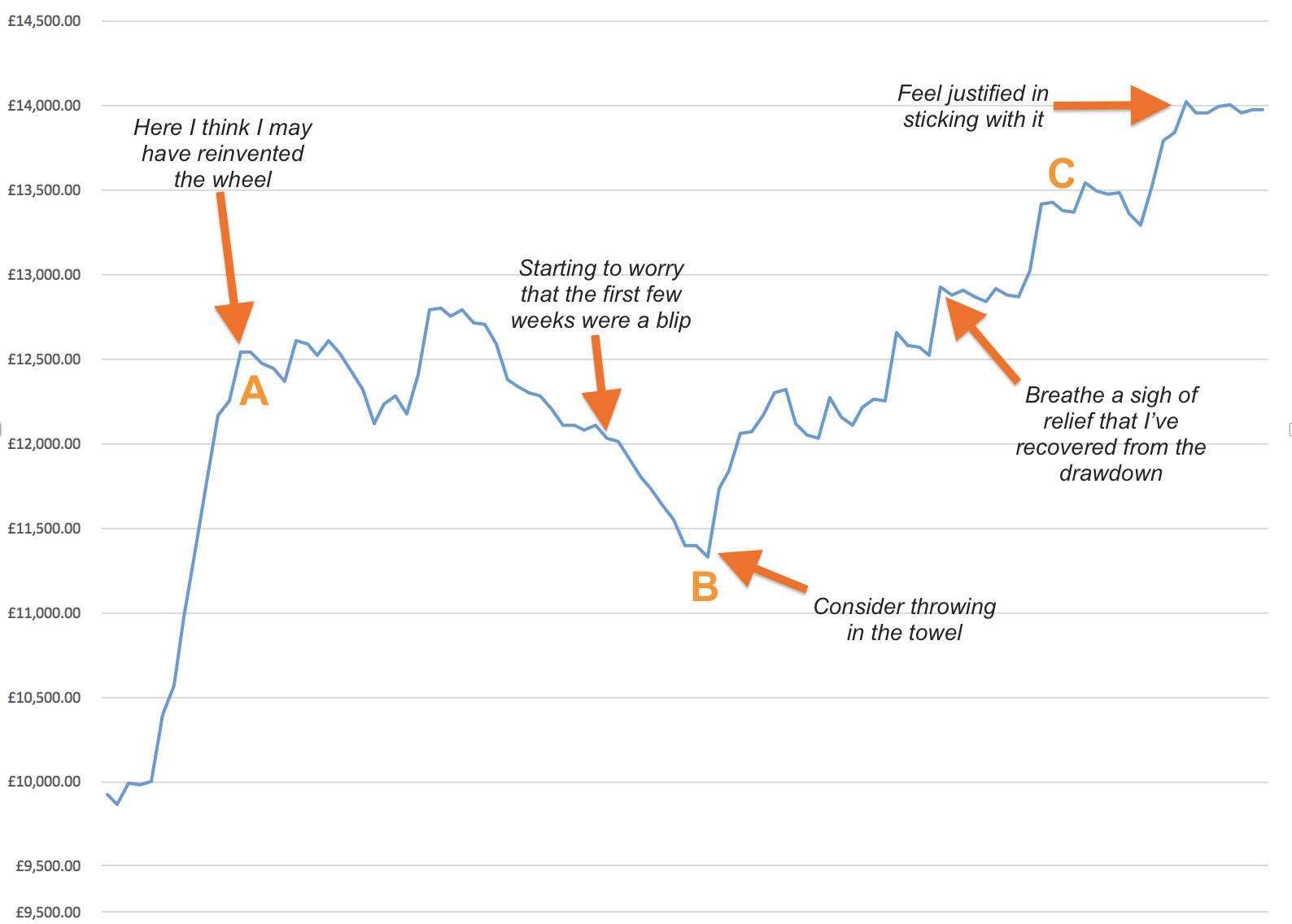
It’s a good feeling, and I’m lucky to have kicked off the trial with a great run of trades to get some serious equity in the bank … but journeys are never smooth, and there is always an emotional rollercoaster to travel. Here’s what my equity curve has done over those four-and-a-bit months …
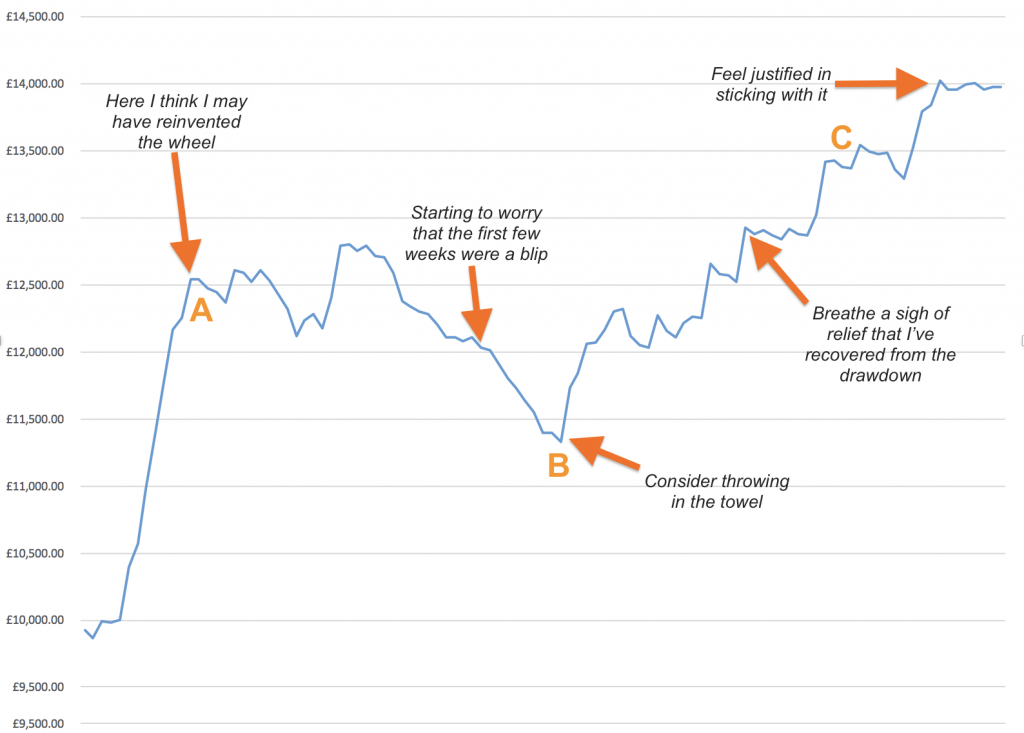
The drawdown you see on the chart above was around 11% – modest compared to the overall 40% gains in that period, and no doubt there’ll be more ups and downs ahead of me.
One of the biggest mistakes traders make is to let these emotions get the better of us … but telling someone to ‘not get emotional’ is about as useful as telling someone who’s been stabbed to ‘stop bleeding’.
We need actual tools to help us avoid mistakes …
7 trading mistakes and how to avoid them
1. Chasing returns
Chasing returns is the popular sport among traders of switching from a poorly performing system into one that’s just experienced an excellent return.
As we know, systems will always have their ups and downs, so the result of this hobby is to miss the ups and catch the downs. In the stock market, it’s known as ‘buying on greed, selling on fear’.
If you look at the chart above, our returns chaser would have jumped in at ‘A’ after that big upward move … got out at ‘B’ … and be considering getting back in again at ‘C’.
2. Having an opinion
I saw two interesting stats about the EU referendum this week.
The first was a poll on what people would vote: 54% in; 46% out.
The second was a poll on the outcome people expected: 81% in; 19% out.
It shows really clearly how our opinions about an outcome are very different to the outcome – when we’re judging how others will vote, we’re looking at polls, and a feedback loop exaggerates the results.
It’s a form of the Keynesian beauty contest riddle
Opinions are dangerous when it comes to judging what the markets are doing – the best thing is to look at what the charts are doing and base your decisions on that. This is where clear technical rules help to keep us on the straight and narrow.
3. Trading against the trend
This is another one where traders just get given bad advice – be contrarian.
Again and again we hear that we should “buy low / sell high” – which leads rookie traders grovelling around the bargain bucket for some unnoticed gem, that no other investor has realised is about to become the next big thing.
Really?
Do you really believe that as a newbie, you’re going to discover the next big thing? And that no other trader has worked out the value of it?
Stop trying to buy at the bottom, and instead look for things that are moving upwards. And concentrate on NOT buying at the top. Make sure there’s still potential.
Likewise, don’t try to wait for the end of a move to exit a trade, unless you’re comfortable giving a slice of those profits back and scrabbling for a sale on the way down! Don’t get too greedy – decide on a profit level that you believe is achievable based on the market.
4. Failing to look at the big picture
So, you’re day trading EURGBP on a 10 minute chart? Do you know what the overall trend is on an hourly chart? And the daily chart?
Do you know what the key levels are that you might be asking your trade to move through? Are you entering buy trade just as the market approaches an area of long-term resistance? Or a sell trade just above key support?
It doesn’t take long to bring up a longer term chart just to check these things. Draw on some key levels at the beginning of the day or week, so you’ve a visual trigger if these important lines appear within your trade parameters.
(It’ll also help you place better stops …)
5. Poorly positioned stops
While we all get our stop levels hit some of the time (stop losses that never get hit aren’t really protecting us at all!) – sometimes we make mistakes and put our stops in the wrong place – where they are very vulnerable to attack from the markets.
A badly placed stop can cause us to be stopped out too early, failing to capture the profit available.
One of the main rookie errors is to place stops according to a set percentage, such as 2 per cent or a set risk, like 20 points.
Many traders are given incorrect advice about this – and there are plenty of trading strategies out there that give fixed distances from entry to stop for simplicity’s sake. It means that with a newbie trader, you don’t have to explain how to find a sensible place to put your stop.
If a strategy has enough of an edge, this kind of method can work. But it’s really not the best way to place stops – we can do a lot better than this.
We should place stops according to what the market is telling us, not what our personal profit goals are. The market really doesn’t give a damn about us! Look for areas of support or resistance, and put a stop level on the far side of this – where it’s safely tucked out of harm’s way.
Then – and only then – look at your risk. Adjust your stake levels according to where you’ve put your stop level.
If you’re risking £200 on a trade, and your stop is 25 pips away, then your stake will be £8 per pip. However, if on your next trade you’ve put your stop 31 pips away, your stake will now be £6.50
If there’s no sensible place to put a stop at a distance where you’re happy with the risk being taken – then the answer is that this trade isn’t for you. Sit out.
6. Focusing only on short-term goals
One of the best ways I’ve found to control the ‘emotional’ side of trading is to focus on longer term results.
No strategy is without bad weeks, and bad months … but by focusing on annual goals and what my bottom line will be by the end of the year, I find I’m much better able to stomach the ups and downs along the way.
And the best tool I’ve found for doing this is keeping a spreadsheet of results. If you aren’t already doing this, you can download mine HERE.
By looking at long-term goals, we’ll have more patience and more discipline. (When times are tough, I’m able to console myself by looking at the long-term performance of my system, and trusting that it’ll come good.)
7. Failure to learn from mistakes
I’ve made a lot of mistakes.
I’ve used ‘blind’ stops, where I’ve just stuck them at a fixed distance from my entry …
I’ve looked at a good week of trading, where I’ve made 10% returns, and estimated that I’ll have made 520% by the end of the year …
I’ve tried to guess market tops … jumped in and out of trading strategies … and thought I knew better than the next trader …
And I’ve lost money doing all these things!
Some of these lessons I learned from the first mistake … and some of them I repeated again and again before I changed my behavior. These days I’m a much more boring trader, but hopefully smarter, and more profitable.
Save
Save
Save