July 29, 2016by Mark Rose- 0 comments
9 must-have trading tricks and tools for success
American economist, Theodore Levitt is attributed with the quote: ‘People don’t want to buy a quarter-inch drill, they want a quarter-inch hole.’
Which is why I expect most of us don’t care what the tools we have look like – we just want them to achieve the task we ask of them with minimum fuss. And yet, again and again, fancy trading tools are thrust on us, that just don’t do the job.
So here, I’ve distilled down the tools and techniques that you’ll need to succeed in the markets – they’re basic, they get the job done … and not one of them needs to cost you a penny!
1. The right broker
Just as most of us are pretty lazy about switching utility suppliers or banks … we also get too comfortable with our brokers.
Brokers know it – and they’ll make you pay for it.
That’s why it’s so important to shop around. No broker is all things to all people – they’ll each have strengths and weaknesses. But the best thing about spread-bet brokers is that you’re not stuck to one of them. Open several accounts, take advantage of all the ‘bonuses’ and offers … and trade in the one that gives the best prices for the market you’re using.
Bear in mind – if you’re trading with a 20-point target, and your broker is charging you half a point in spread more than the next broker … that’s costing you up to 2.5% of your profits. However great a trader you are – you can’t afford to give back profits that easily, unless you’re only trading for the benefit of your broker!
2. A kick-ass spreadsheet
I realize it makes me a huge geek – but, when my trading is on track, there’s nothing more satisfying that gazing lovingly as my spreadsheet of profits!
And when a losing run is making me question getting up in the morning – the same spreadsheet will show me long-term profits, so I have a ‘life line’ to hold on to.
Either way – a spreadsheet recording your results is a vital tool in your armoury. Without it, you might as well be gambling. If you’re serious about making money, you MUST keep track of your trades.
If you don’t have a trading spreadsheet that you’re using, you can download mine here.
3. A glance to the left
At traders, we’re always wondering what’s coming at us from the right of our screens, and those candles on our charts tick by. And for all the technical indicators we can pile onto our charts, the simplest and most reliable way to predict price behavior is to look left … what did price do before?
Past areas of support and resistance are hands-down the best way to judge how prices will behave at these levels next time – these are the areas we get congestion on our charts, and where we can watch for breakouts …

Whether you’re specifically using support and resistance in your trading strategy, it’s still a smart move to draw a few of the most important areas of support and resistance onto your chart – that way when they crop up in the middle of one of your trades, it’ll flash warning lights at you.
4. Compounding
Don’t get me wrong, I like spending my winnings as much as the next person, but if you’re going to build real wealth, you’ve GOT to reinvest.
And the great thing about compounding is that it works just as well for the little guy as for the big hitter – with the same trading strategy, you can double your money in the same time, whether you’ve £500 to invest or £50,000.
Another thing to note about compounding is the huge profit difference that can be achieved by just increasing your returns by 1%. The chart here shows the effects of compounding on trades earning 2%, 3% and 4% …

The 4% trade has the power to turn $100,000 into $300,000 in the space of 30 trades, while the trade with a 2% return has become $180,000 (still, not bad, but worth bearing in mind that extra 1% you could be making by switching brokers!)
5. Time and patience
Obviously time and patience will go a long way when you’ve a successful system, and you’ve unleashed the power of compounding on it.
But time and patience are also important in the day-to-day practicalities of trading. It’s about waiting for the right moment to trade, rather than rushing into a trade, or forcing a signal that just isn’t there.
6. Focused price action
If you’re interested in using price action in your trading, you could read up volumes and volumes on the different candlestick patterns, and the probability of each of them to bring you success …
Or you could focus in on the key areas, and use them to spot the very best opportunities.
There are two vital candlesticks for traders, and if you can spot these two, then I believe you have 90% of the price action knowledge that really makes a difference:
A: The Doji Candle
A doji is a candle with a small body and long wicks. The message is one of indecision – it doesn’t tell us that the market will go up, or go down, but when it appears at a key level, it will give us warning of a reversal.
The two key shapes we’re looking for are hammers and shooting stars …
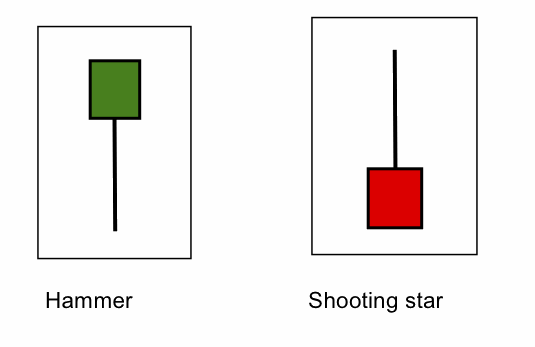
And we want to find these candlesticks at key turning points in the market, where the hammer will give us a bullish signal, and the shooting star will give us a bearish signal …

In the example shown above, the hammer forms right on the level of support – giving us a big hint that the price is ready to make a reversal.
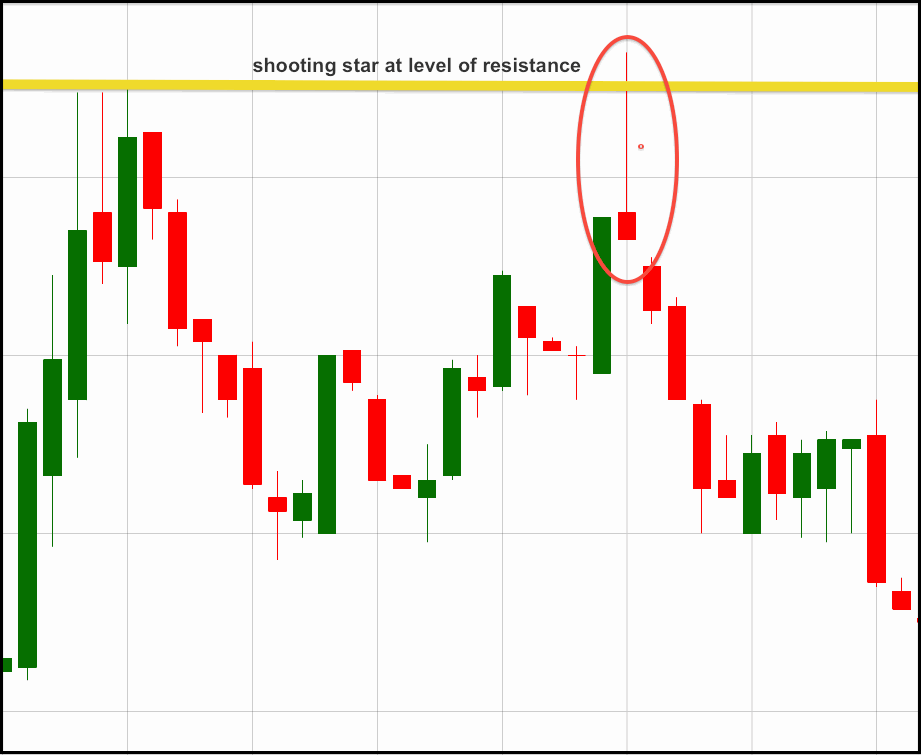
And in the example below, we have a shooting star touching up a historic resistance level – this is a bearish signal that the price isn’t ready to move through.
B: The Engulfing Candle
An engulfing pattern consists of two candles, where the second candle has a different colour to the first, and is larger, engulfing the entire body of the first candle. For it to be bullish, the first (small) candle is red, and the second (large) candle is green. And vice-versa for a bearish engulfing pattern.

This candlestick pattern is a strong indicator of bullish or bearishness in the market, so can give a great clue as to where to get into a trend because it’s about to accelerate away.
7. Moving averages
When we’re in the throws of looking for signals on our charts, it’s easy to lose track of the overall, longer term trends. Without these, we can start trading against the trend, which means the task of money-making is significantly tougher.
If you’re trading with the trend, you’re riding market moves. If you’re trading against the trend – it’s like swimming upstream
To ensure you always know which way the market is moving, all we need to do is find a suitable moving average.
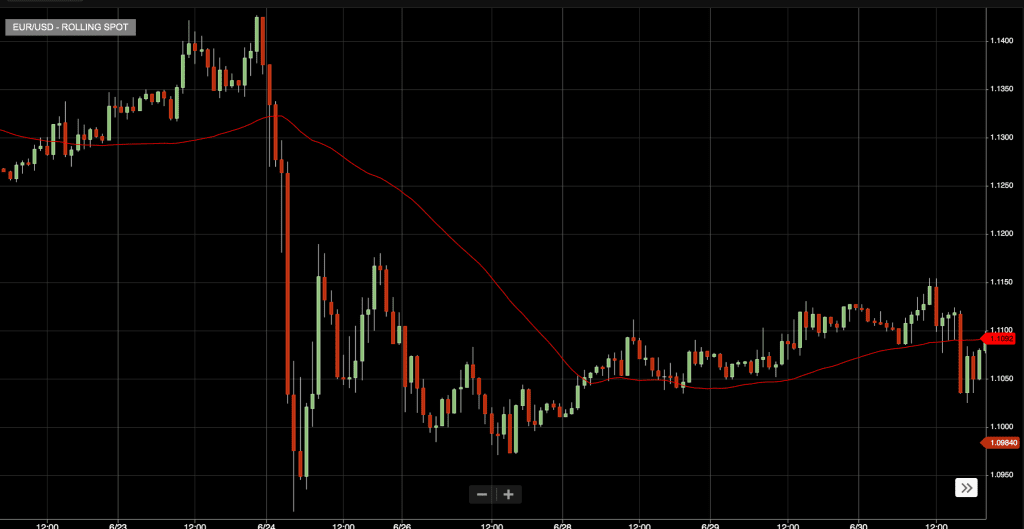
In the chart above, I have a 50-period moving average on an hourly chart. If we say that we’ll only take buy trades when the price is above the MA, and sell trades when it’s below – it’s easy to see how this can make us privy to the best trade opportunities on that chart.
8. Risk management
If I got a pound for every time a trader tells me “I just put on the trade at £1 a point” …
Sensible position sizing isn’t tough to do – it takes seconds out of your day. Without it – you can make losses that are way too big for your fund size AND you’ll make profits too small for your fund size.
Unless you’re working out the right stake for your trades, you can’t take advantage of compounding, so your wealth won’t grow as fast as it can.
If you’re not sure how to do it, you can download the Trader’s Bulletin position size calculator HERE.
9. Rules
The financial markets are not a place to ‘wing it’ or ‘fly by the seat of your pants’ – unless you want a very short career as a trader.
Human beings are naturally rubbish at evaluating financial risk. We make irrational decisions and they have no clear system for picking out what works from what doesn’t work, and become very emotional in their trading.
I’ve written before about how dreadful humans are at evaluating risk. Our brains simply weren’t designed for trading – which is why they need all the help they can get!
And that help should come in the form of clear trading rules which we can follow.
So, if you’re trading without a plan, please don’t waste any more time setting one in place.
Systematic trading follows mechanical rules. These strategies do not need to be complex, and shouldn’t be a daunting prospect.
Instead, they can be a few simple rules that enable you to monitor your trading … avoid emotional decision-making … and to stay on the straight and narrow, through the euphoria of winning runs, and the gut-wrenching losing runs.
One of the important things to bear in mind when you’re choosing or developing a strategy is that you’ll need to be able to apply it consistently.
If your strategy involves hours of technical analysis … or checking stats on dozens of markets – are you really going to be able to maintain that level of work?
If you’re in any doubt about it – keep it as simple as possible.
Save
Save
Save
Save
Save
Save