It’s not just injury lawyers who can profit from whiplash – I’m talking about fast market moves that quickly rebound. These are the events that catch out most traders. But those in the know can bide their time, and wait for the profits. Here’s how …
With global markets in turmoil at the moment, we’re getting used to seeing sudden price swings following news … rumour … and panic.
For the trader, this brings the attraction of collecting fast profits as prices move quickly. But volatility brings risk alongside reward, and jumpy markets are as likely to jump to our stop losses as they are to our targets.
That’s why it’s important to understand the whiplash trade.
Let’s start by looking at a basic breakout trade …
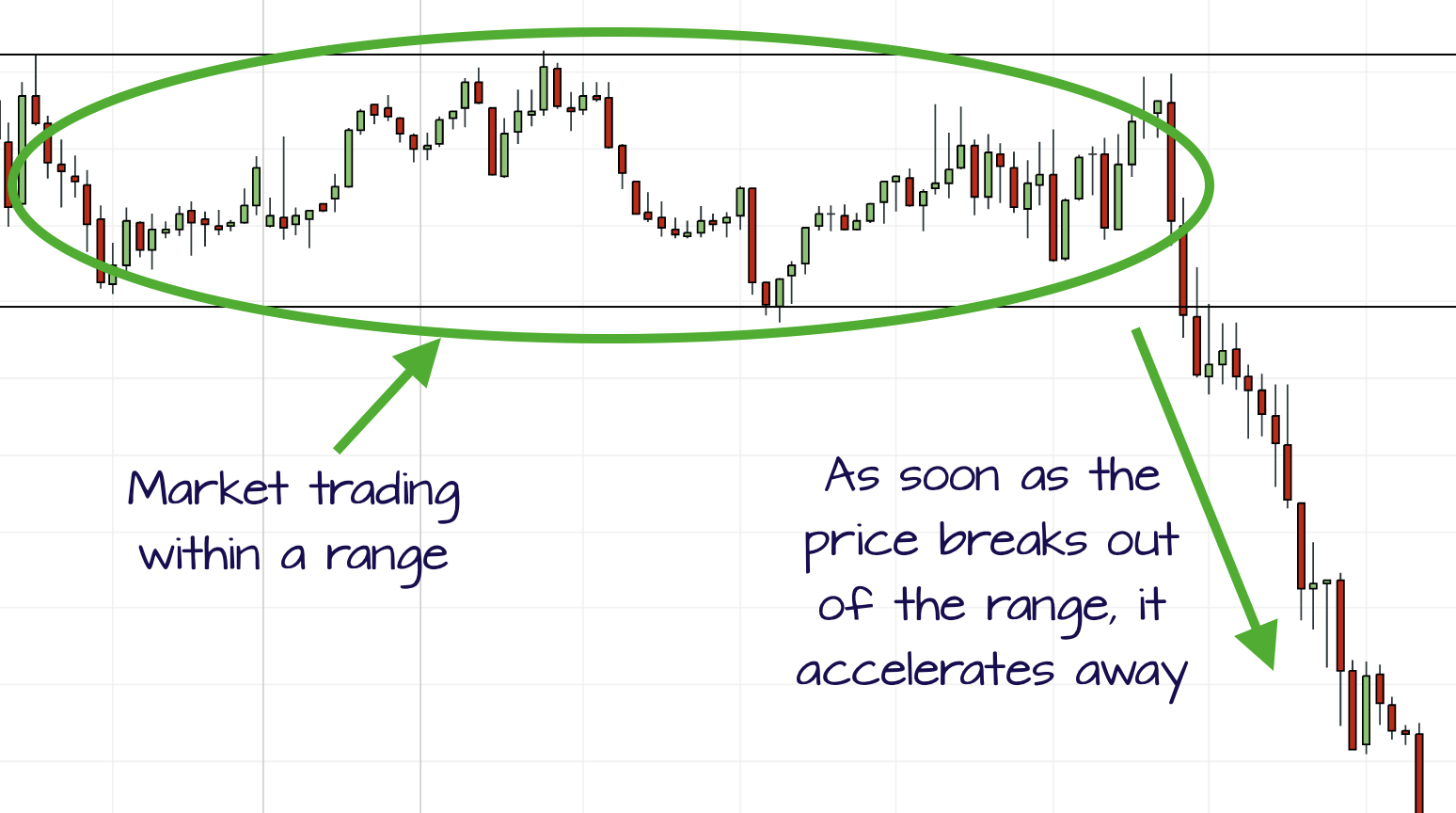
Here the price is stuck in a range. The breakout trader will buy as soon as it breaks to the up-side of this range, or sell if it breaks to the downside. In this case, it breaks to the downside, the breakout trader sells, and profits from that accelerated downward trend.
Sounds perfect, eh?
Step 1: Watch out for a price that’s stuck in a range (no price can stay in a range forever)
Step 2: Prepare for an explosive breakout by placing an order to buy just above the top of the range, and an order to sell just below the bottom of the range.
Step 3: Sit back and wait for the break, and reap the rewards from that explosive move.
What could be simpler?
Of course, a breakout doesn’t have to be from a range … it could be any break through an area of support or resistance, or breaking out of a triangle formation …
So, why aren’t we all stinking rich from trading breakout moves?
Well, anyone who’s tried breakout trading will be all too familiar with the false breakout. This is where prices pierce the resistance or support line, just enough to trigger our trade, and then turn tail.
The other problem with breakout trading is those explosive moves – it’s very difficult to get in at a good price when the market is moving fast. We find ourselves looking at a huge breakout candle, and wondering whether that WAS the move … have we missed the boat?
Fast-moving markets aren’t a good playing field for the small investor. Wihtout deep pockets, we can too easily be bumped out of trades when our stops are hit, or we can suffer nasty slippage on entry prices and exits.
This is where the whiplash trade comes in.
The Whiplash Trade has all the positives of the breakout trade, but is much safer …
Possibly one of the most predictable things in the unpredictable world of financial markets … is how people behave when things go wrong.
Experienced traders are watching this all the time.
When they look at a chart, as well as seeing where the price is, they can also see where all the invisible orders are … the ‘buy’ and ‘sell’ instructions of millions of investors around the globe.
And one of the best places to view this activity is in the playout of a failed, or halting, breakout pattern.
Don’t just look at the chart … listen to what it’s telling you
Here’s an example of a false breakout.
The price broke through resistance (which could have triggered our breakout ‘buy’ trade), then turned tail and fell sharply, right through the support level (promptly losing money for our breakout trader).
What happened here?
That upper resistance level will be littered with orders. When the price nears it, sellers come into the market. But when the price breaks through it, buyers will come in, plus, those sellers will have their stop losses triggered. All in all, that makes for a lot of buying power at the breakout point.
However, that momentum failed to maintain the upward price, and as soon as the price fell back below the resistance level, buyers will be looking to sell, and sellers will be looking to get back in.
The result is strong selling power … and the possibility of a sell-off. Which is exactly what happens.
But breakouts don’t always reverse like this. So, the canny trader is prepared for another scenario …
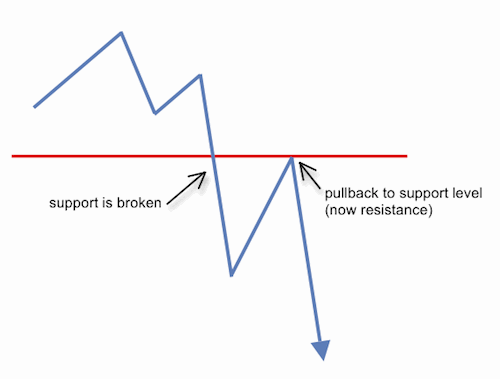
Another trick that ‘failed’ breakouts can play on us is the pullback.
This is where the price pulls back to the level of support that it broke, and then bouncing off that level with momentum …
This is an excellent way to trade breakouts – much, much safer than entering when the initial breach happens.
But there’s a crucial final piece to the whiplash Trade jigsaw
The successful Whiplash Trade hinges on watching the price carefully if it comes back within the area of support/resistance that it broke out of.
This is where the renewed, often explosive move will take off – and watching price action is key.
Look for bullish or bearish candlestick patterns to signal which way the price will move …
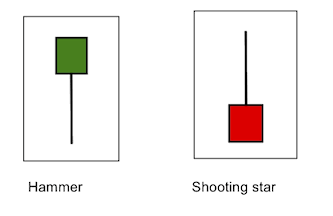
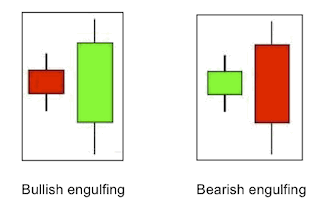
The idea of having to make a judgement on exactly what the candles are telling us will fill many traders with dread. But I’m only talking about being able to recognize 2 or 3 key candlestick patterns: hammer, shooting star and engulfing patterns.
If it appears at an area of support, the hammer candlestick is bullish. It’s opposite – the shooting star candle – is bearish if at an area of resistance.
(If you’re interested in learning more about candlestick patterns, check out this post, and find my price action guide here.)
Here are some of these candles in action …
Here we seen a breakout to the downside, followed by a move back up to the support level that was broken. This support level now acts as resistance, and the bearish engulfing candle is a strong signal that a sell-off is about to happen …
In the next example, we have a breakout to the upside, followed by a pull back to the resistance-turned-support level. Right on this key level, we get two consecutive hammer candles – and sign that the price may turn on this level and accelerate upwards …
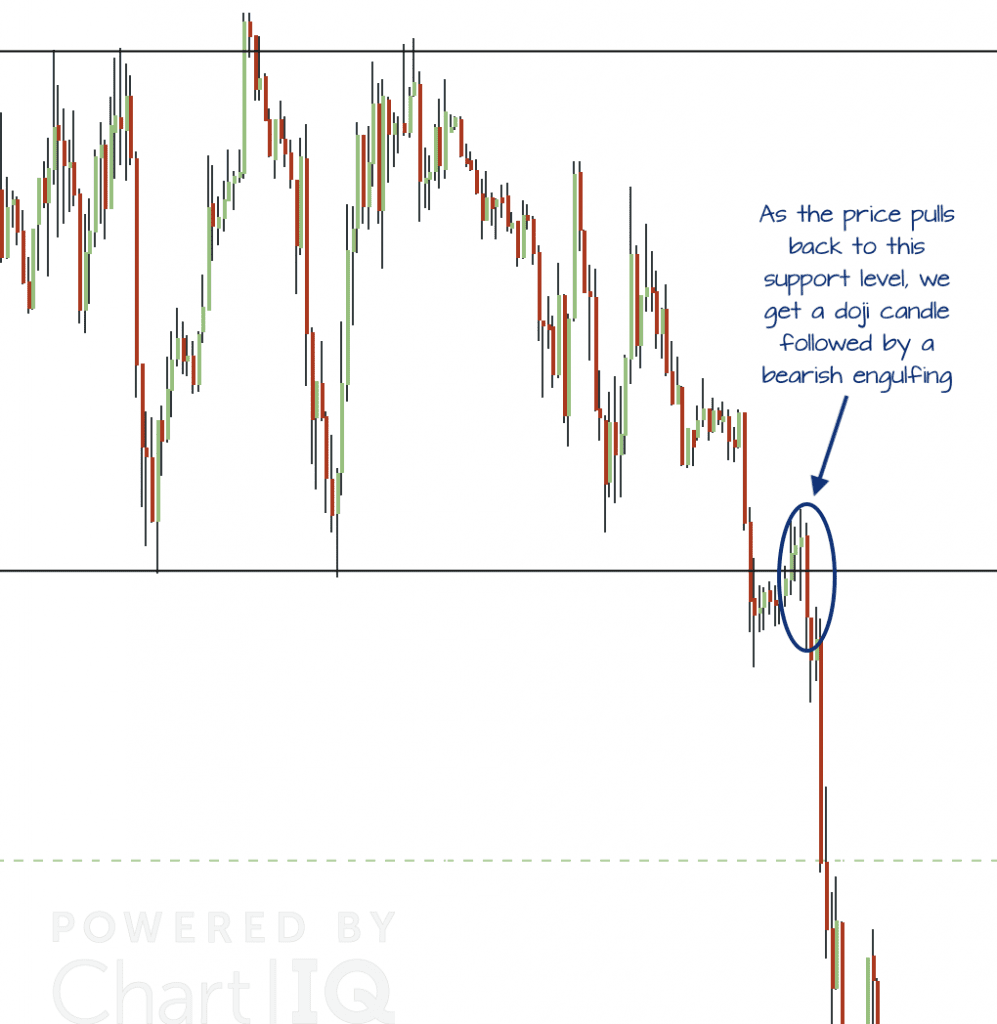
Below is another pullback opportunity, where the price breaches the support level, forming a doji candle, followed by a long red bearish engulfing candle, before the move down really accelerates.
Whiplash mastery
The key takeaway for the whiplash trader is patience. When we see a price moving rapidly, it’s easy to worry that we’ve missed out … that we should be jumping in to try to catch a little piece of that move.
But the whiplash trader will wait for the rebound – thereby getting into a less-volatile market, at a better price. It’s a win-win.
Of course, prices won’t always rebound. But they do it often enough to give us plenty of profit opportunities. Start watching (and waiting) for them …














1 comment
Tracey
Thanks Mark – more great trading ideas for me to try out!