Don’t get me wrong. I’m as big a sucker for a video of a dancing dog as the next person. But I’m not about to swap the smelly mutt that sleeps under my desk for one.
The lines we draw around what we’ll let robots do … and what we don’t want them to do … are always shifting.
And given the response I had to last week’s post on Metatrader – it seems that I’m not alone in wanting to automate more and more of my trading, yet in also having reservations about handing my cash over to robot.
What are Forex robots?
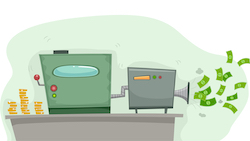
Disappointingly, Forex robots are no good at dancing, or doing any of the things my kids would expect of a robot. In fact, they’re just pieces of software that we plug into a Metatrader account to automate certain processes.
The proper name for these ‘robots’ is Expert Advisors (EAs). I’m not sure who’s idea it was to call them that – but there have been plenty of instances when these EAs have proved to be anything but expert.
The case for robots
A lot of a trader’s work is pretty laborious. Testing levels, monitoring results, tracking performance, placing trades according to precise rules … this is all stuff that, generally speaking, a robot can probably do much better. They are methodical, they don’t forget, and they’re never caught making a cup of tea when the action happens.
Robots also have the benefit of not letting their emotions get the better of them. They’ll stick to the rules whatever.
It seems like a no-brainer. Robots should be able to trade much more effectively that we can ourselves.
What can go wrong with robots?
Over the years, I’ve heard many stories of people losing money using Forex robots. Of course, there are plenty of ways to lose money in the markets – it’s not necessarily the fault of the robot. But a familiar pattern emerges of a robot trading A LOT, and significant sums of money being eaten up very quickly.
The reasons for EAs trading so much can be because they are just able to scan so many markets, so quickly. They can find the trades … so why not take them?
Another flaw with many EAs is in the development process.
Metatrader has a feature that allows you to backtest EAs, and some creators will use this feature to build a trading system that did brilliantly over the last 6 months. This kind of curve-fitting doesn’t really tell us how it’ll perform in live trading conditions.
While backtesting is useful – it is NO replacement for forward and live tests.
So, how do we build the perfect robot?
The issues I’ve had with robots – about their development, and their overtrading – really just come down to how they are built, and how we apply them.
So, there is absolutely no reason we can’t use automation to make our trading lives significantly easier. As long as we aren’t handing our money over to a untested robot with a bad spending habit.
These are my rules for a Forex robot:
a profitable live, forward-tested track record.
a fixed number of trades (and risk) it will take each day, so I don’t wake up to any nasty surprises.
a limit on the amount I may have to pay in spread costs (these can add up if it’s trading out of hours, or obscure markets)
the option to ‘press the button’ to trigger trades. I may be a control freak here, but I like to be the one that opens a trade.
I also want to have an easy way to manually adjust trades if I spot something I don’t like – whether it’s adjusting stakes, stop distances, profit targets.
I’m currently running an Expert Advisor that meets all these demands. I get to press the button at 10pm each night … and it does the rest for me. Making 34% gains in less than 8 months.
Soon I’m going to be rolling this out to testers, so you can expect to hear a lot more about it.
In the meantime, let me know what it is you want from a Forex robot …