

How to profit from double tops and double bottoms – even if they fail
I’d always caution against trading market tops and bottoms. No one knows when a bear trade will top out, or a bull trade hit bottom – and trying to predict these moments is a good way to lose money.
However, there is a way to take advantage of double tops and double bottoms … these are powerful reversal signals, and we can harness that power, without actually committing to a reversal.
That way we can win if we’re right … and also win if we’re wrong …
It’s a great position to be in!
Here’s the set-up …
What we’re looking for is a double top or double bottom pattern.

The traditional way to trade these is to wait for the neckline to be breached and enter a short trade.
This assumes that you’ve called a top correctly.
But we want to make a profit whether we’re right … or wrong.
So, instead of waiting for the neckline, we’re jumping straight in at the first sign of that second top (or bottom).

What’s crucial in our success is how we’re going to play off risk vs reward.
Here’s an example of a trade on the S&P500 4 hourly chart …
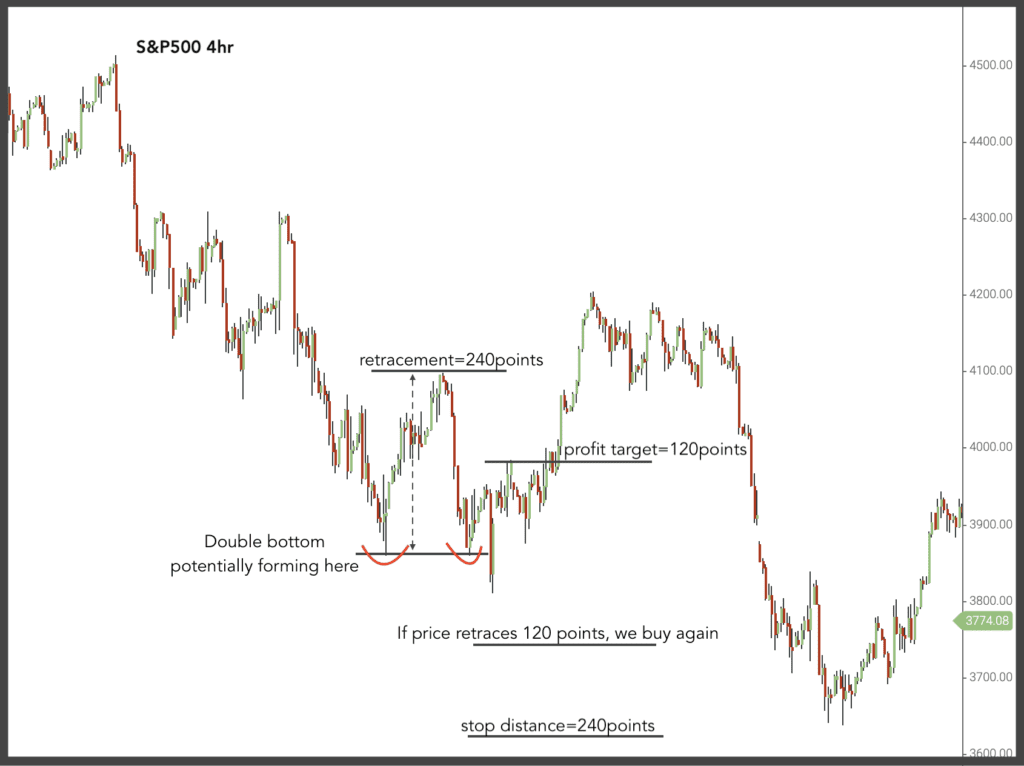
The first thing we do is measure the size of the retracement between our two bottoms – in this case, it’s 240 points.
Our profit target will be 50% of this distance, so we’re just looking for a move of 120 points.
Meanwhile, our stop level will be a full 240 points below, meaning we’re entering with a reward-to-risk ratio of 2:1.
However, we’re only going to enter 50% of our position here. We’re holding back the other 50% to enter if the price moves against us.
If the price moves halfway to our stop level, rather than panic – we buy again. The profit target for our second half of the trade is at our original entry level.
Now we have the potential to make another 120 points on the second half of our trade.
On the example above, we didn’t open the second half of the trade, instead making that 120 points profit without much movement against us.
Here’s another example …
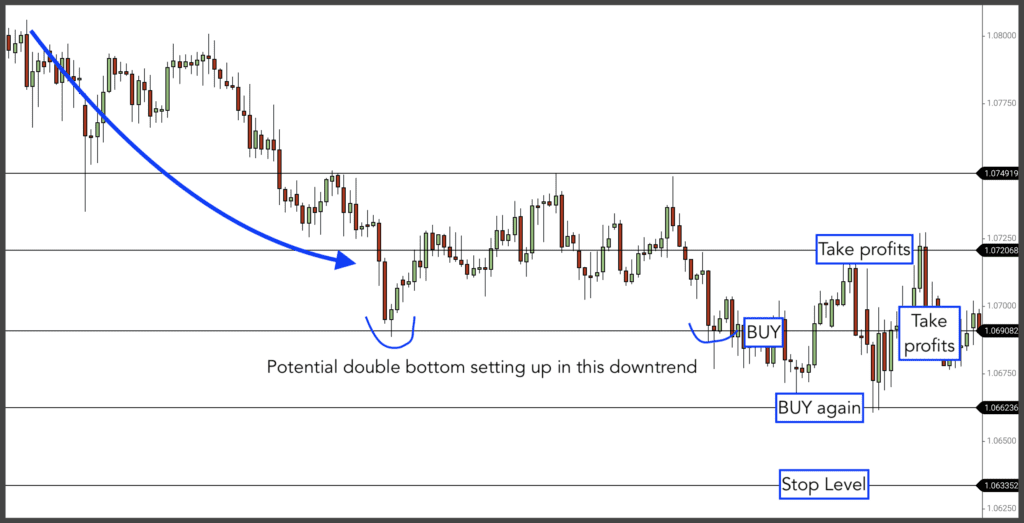
In this example, we have a potential double bottom forming at 1.0691
The retracement between these highs was 58 pips to 1.0749
Therefore, we’ll place our stop level at 1.0633
Our profit target is 50% of the way towards the full retracement.
What happened was that the price moved into a loss, going halfway towards the stop level. At this point, we bought again. Very quickly, this second trade hit its profit target at 1.0691, and later the first half of the trade hit its original profit target.
As a result, both halves of the trade made 29 pips profit.
Beware when splitting trades like this to enter with just half stakes, otherwise we’ll be doubling up on our risk levels.
Why it works
The reason these setups are so powerful and successful comes down to buying and selling power shown in the retracements. Ideally, we want a significant retracement between our double top/bottom – this shows strength of sentiment AND it gives us a good chunk of profit in return for our efforts.
We’re also only looking for a modest move to 50% of that retracement – again, this significantly boosts our chance of success.
Entering 50% of trade at the halfway point to our stop can be seen as controversial – doubling-down on a losing trade. However, this isn’t about panicking because the market has gone against us – instead, it’s a clear plan to balance risk, and boost rewards.
I look forward to hearing how you get on with it …
To enjoy more content and get it faster Follow @TradersBulletin


JOIN US ...
Get full access to members-only resources, plus my weekly email updates ...
I will NEVER share your details for marketing purposes. Privacy policy
Strategies I'm Using
 It has taken 2 years to persuade this market…
- These videos show how to make 24% gains in…
 As you can see from all the data I've…
 Get the low down on the Heikin Ashi Mountain…



2 comments
Graham
Nice idea, thanks, certainly would have worked out exactly this morning on the GER30 15min chart 🙂
Traders Bulletin
Thanks for the feedback Graham – and an excellent example of how it works there on Germany40! Don’t be afraid of waiting for the pullback to get a good entry – that little piece of white space that I’ve marked on the chart here with a star is a godsend to traders.