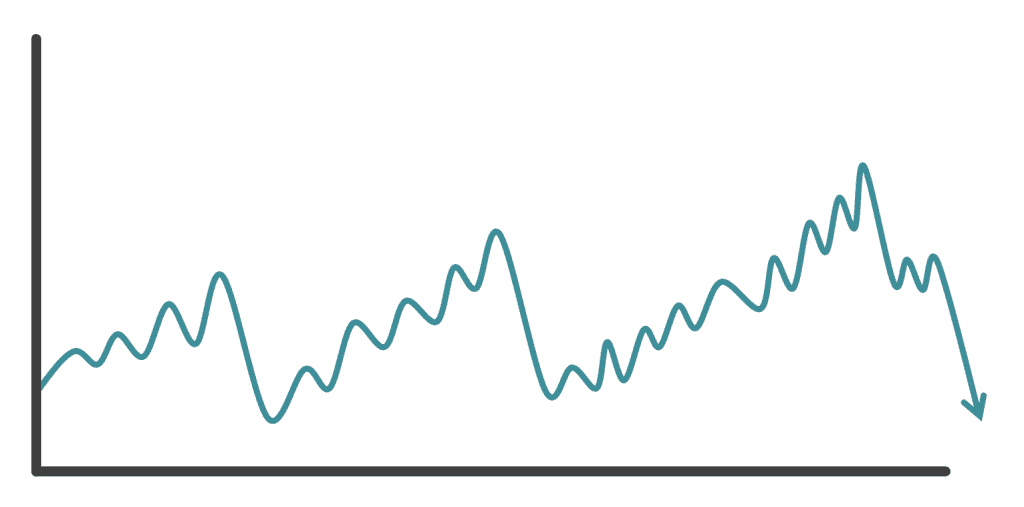
There are those who spend their time winning … giving back all their profits … winning … giving back all their profits.
And then there are those traders who instead spend their
time winning … giving back a chunk of those profits … winning … giving
back a chunk of those profits.
There’s a very subtle difference between the two, and
psychologically, the two behaviours feel very similar when we’re living through
them. However, one of those traders is profitable and running a successful
strategy, while the other is losing money.
With such a subtle difference, combined with the fact that
losses will always be a part of trading – how can we ensure we’re always on the
winning team?
Over the past few weeks, one of my daily trading strategies
has been doing this to me. Gaining ground, and immediately giving back those
gains. It’s a tough ride, even when I know this method made 8% gains in the previous
3 months.
But I expect this kind of bumpy trajectory is something we’ve all experienced at one time or another …
While a bumpy ride is the nature of trading, that journey
needs to be taking us in a positive direction, and shouldn’t be giving us
whiplash.
The good news is that there
are active steps you can take to STOP giving your profits back.
The first thing to look at is what’s causing these
drawdowns? There are a few culprits here …
Your risk levels are off
There’s something wrong with your strategy
There’s something wrong with the market
Let’s start by looking at how you’re managing your risk …
Over-staking will always give
you a choppier ride
Are you increasing your stake size too quickly? When things
are going along quite nicely, it’s too easy to be tempted into bumping up our
staking levels. This inevitably leads traders into hot water.
However, even if you’re carefully compounding with a fixed
percentage, it can sometimes be prudent to put some of those winnings aside in
the good periods, ready to top up in the lean ones.
What we’re doing is applying a throttle to our compounding.
For example, let’s say that you’re trading with £5k and
risking 1% (£50) per trade. You’ve had a good month and your bank is up to
£5,600. However, your rule says that any profits over 10% won’t be reinvested,
but will be put aside. So, your next month you’ll be trading with a risk of £55
per trade (not £56).
After a losing month, you can choose if you want to dip into
that set-aside fund to top up your pot.
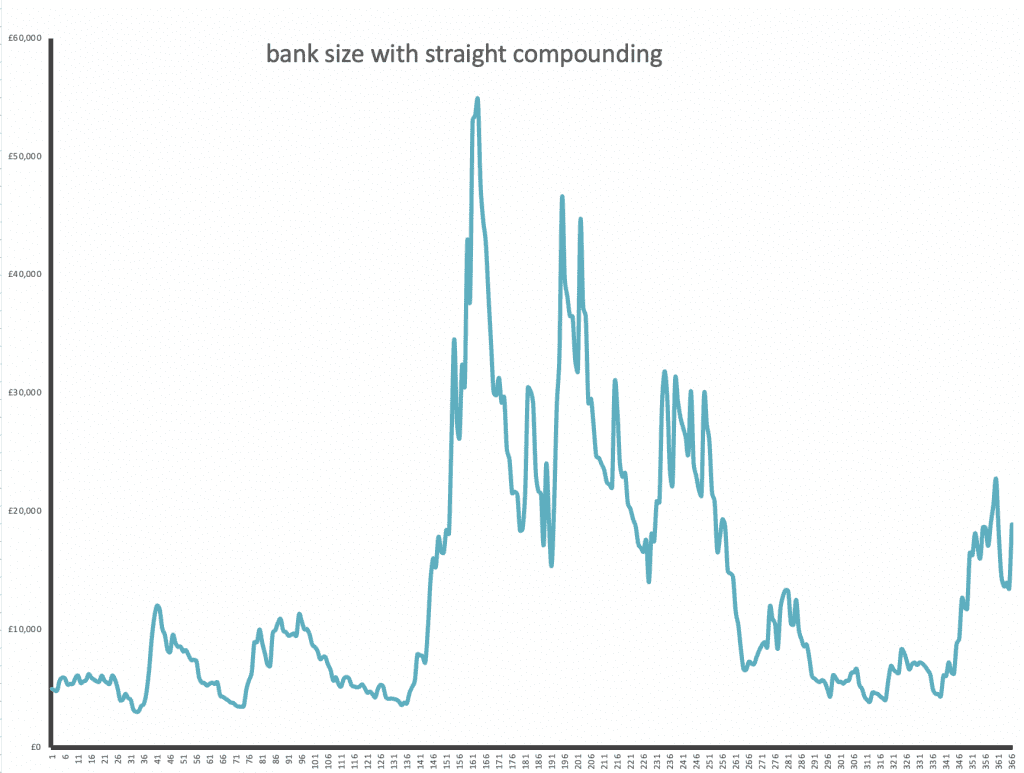
Here’s a PnL chart that I dug out of an old folder that should be called ‘trading I’d like to forget’ …
It’s a chart that too clearly shows my novice-trader greed,
along with the harsh lesson that greed taught me!
I was compounding after every trade with glee, not keeping a
steady risk on my trades (I know – a cardinal sin!) and repeatedly gave back
more profits than I’d made.
It’s an ugly sight.
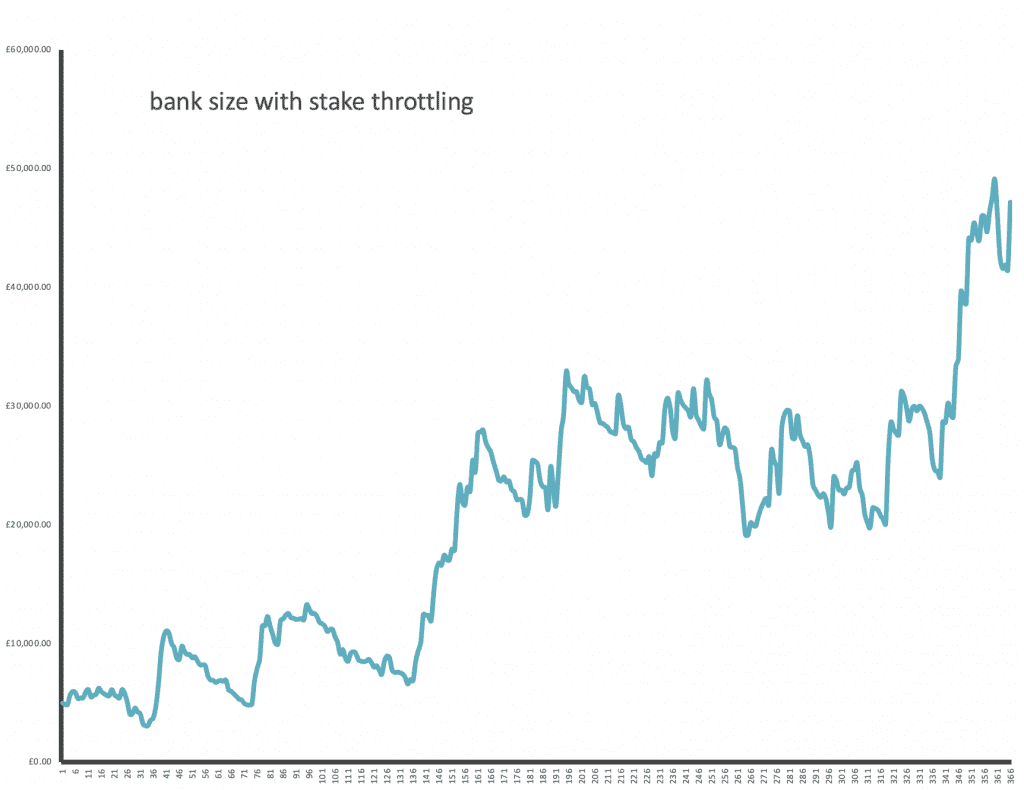
In retrospect, I’ve applied a throttle to my compounding on exactly the same trades, even with the risk levels all over the place, and this is the effect it has on returns …
It’s quite a staggering improvement, even on this very poor
trading record! I just wish I’d had the sense to do this at the time.
What I really want to show here is that by being LESS
aggressive, we can often make more money, and without giving ourselves a
coronary along the way.
Compound investing HATES volatile returns, so by smoothing
things out, it will do its job of growing our money very nicely.
Another way to be less aggressive with your compounding is
to adjust your risk size weekly, monthly or even annually.
So, if your staking and risk levels are sorted, we come to
the next villains on our list …
Is something wrong with your
strategy or something wrong with the markets?
In fact, these two are connected. Most trading strategies
work well in specific market conditions, but fail when markets aren’t
‘behaving’. Choppy, sideways markets are usually the culprit, because we just
can’t get the moves we need to collect our profits.
While I’m afraid I don’t have any solutions to ‘fix’ the
markets, I can give you some quick fixes to get your strategy and the markets
working together, rather than butting heads.
The kind of markets that kill off traders tend to be
sideways, choppy price action with low volatility. So, we need a filtering tool
to flag up these situations – then we
can keep out of these trades.
Here are three options …
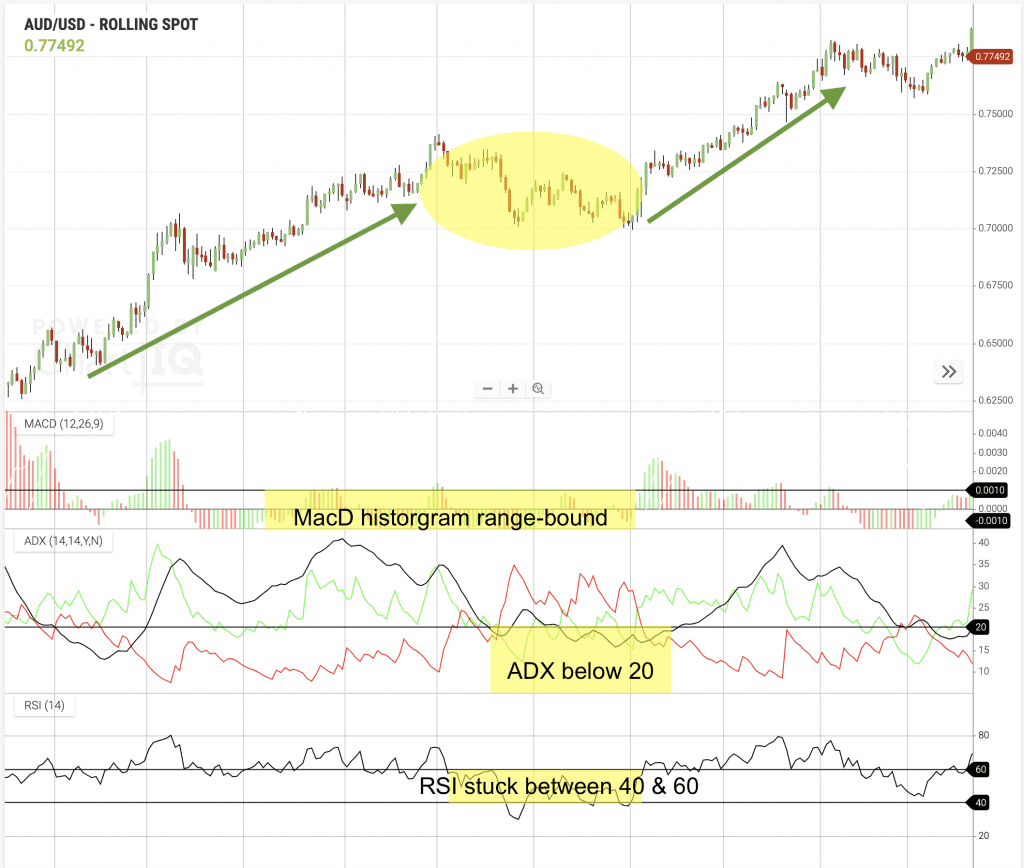
1. ADX: The standard setting is that if the ADX is below 20, the market is range-bound
2. The RSI can also be helpful at spotting faltering
markets. If the RSI gets stuck in the mid-range, we’re in a sideways market.
3. The MACD histogram can be used in a similar way – when
the bars are consistently short, we’re range-bound.
Here are the three of them side-by-side for comparison …
In the chart above, we have a trending market, a choppy bit
in the middle, and the uptrend resumed. (You may find that zooming out to a
longer timeframe gives you a better picture with these tools.)
Each of these tools can help keep us out of trouble. With
the MACD histogram, we need to draw in a channel around the ‘zero’ level (the
exact settings of that will need some trial and error to match it to the market
you’re trading). If the histogram bars are stuck in this channel, it’s a
warning of range-bound markets.
You’ll notice that the ADX indicator has quite a lag, so can
be slow for a warning system. However, when the it moves up after being stuck
at a low level (even if it’s still below 20), this is a good signal that we
should be looking for trends.
But even if these indicators
let us down, there’s an absolutely fail-proof sign that market conditions
aren’t right for us …
… we start losing!
A run of losing trades is a powerful sign that the markets
aren’t suiting our trading strategy right now. And if we’re prepared for this –
it needn’t be a cause for alarm. It just means that we need to swing our
protection plan into action.
This is why drawdown limits can be really powerful at
protecting our money.
I know, after a few losses, the idea of reducing stakes
means that it’ll just take us longer to get that money back. And it’s hard to
fight the feeling that the market ‘owes’ us a winner. But I urge you to stop stressing
about how you’re going to get back to those lovely highs you had last month.
Focus, instead, on how you’re going to NOT lose money.
If you’ve had three losses in a row, stop trading for the
day. The key takeaway is that we want to trade less. Or, at least, trade
smaller – you can half your stakes for the next trade until you get a winner.
If you lose again– half your stakes again.
It may sound glib, but if you don’t want to keep giving back your profits – stop throwing money at the markets! When market conditions aren’t right, even if we can’t see why – batten down the hatches. As we’ve seen – smaller stakes don’t have to mean smaller profits. Smarter trading, and careful risk management will see you through to bigger rewards.