Like all sensible traders, we try to gather
information to help us improve our skills and performance. Some of what we
learn will be genuinely useful, but there are a few rules floating out there
about trading that are out and out false.
Here are 3 trading myths that you should definitely be ignoring …
Trading Myths 1: The more times a level of support/resistance is hit, the stronger it is.
This is one of the primary rules about drawing support
and resistance levels. The more times a level is hit, the more important that
level is.
It’s not nonsense. There’s a logic to the idea that a
market bouncing off a support level repeatedly will build up an army of traders
who are looking to buy each time the price moves to that point.
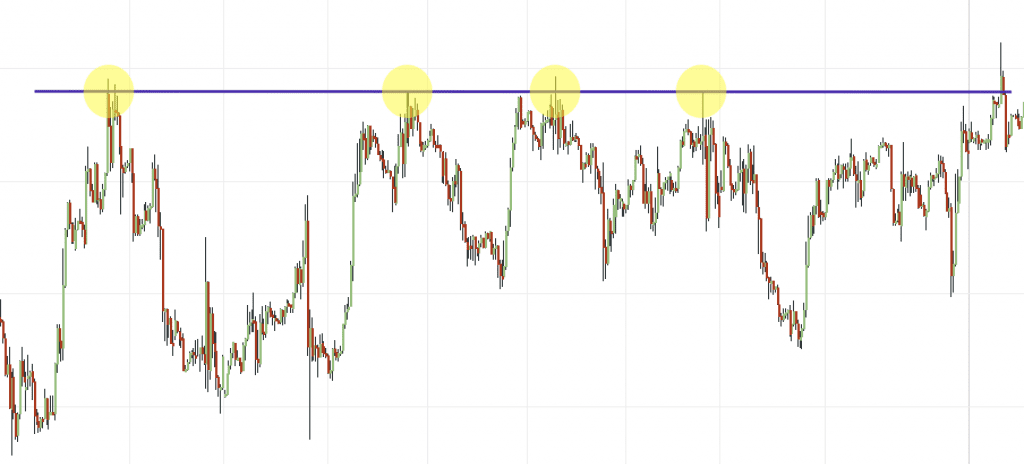
In the example below, we can see the price again and again moving away from the level of resistance, showing that sellers are coming into the market each time it reaches this high.
However, there’s another story at play here.
Each time the price reaches this high, and traders
sell, bringing the price down again, we have what’s called ‘order absorption’.
This means that the ‘sell’ demand is being eaten up each time the price hits
that high. Eventually, there are no sellers left and the price breaks through
the level.
So, each time the price hits a level of support or
resistance, order absorption means that the level becomes less and less
reliable.
One-touch wonders
But what about the levels that have only been touched
very briefly by a spike? Where the wick of a candle strayed? Should we ignore
these as trading errors, where the bots cause some wayward behaviour?
Let’s think about what’s happening at these one-touch
wonders …
These are price levels where there is no
consolidation, no push and pull between buyers and sellers. There is no doubt
at these levels.
In the example below, we see a wayward spike up, while most of the action is happening in the channel below. However, the next time the price touches that high, we see a very rapid and determined downward move …
When looking at support and resistance levels, we
should be aware of the ones prices repeatedly bump against AND the one-touch
levels. Both are very relevant, but we should be aware that multiple touches will
run out of steam, and we shouldn’t dismiss spikes.
Trading Myths 2: To make the most money, trade at volatile times, like market opens
When we see sudden jumps and moves as markets open
around the world, it’s tempting to want a slice of that big move.
However, volatility is a double-edged sword.
The Forex markets are a 24-hour bottomless sea of
liquidity. As one market goes to sleep, the next wakes up, and Forex gurus tell
us that we should be trading the fastest-moving, most volatile times when
traders are arriving at their desks in one of the major sessions.
I’ll fully admit to getting sucked into this myself, on numerous occasions. But the data suggests we’re getting our timing all wrong …
The chart above was compiled by a major Forex broker. It shows
the percentage of traders winning GBPUSD positions, according to the time of
day they are opening that trade.
There’s a marked difference in performance for traders entering
positions at 9am London time (47% of whom were successful) and those entering
at 8pm (with around 56% being successful).
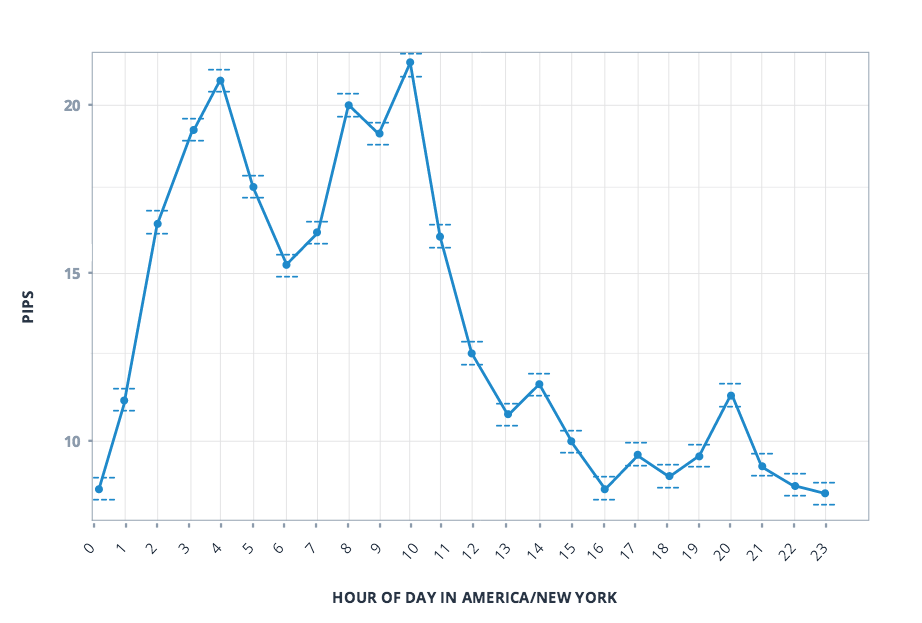
To put this into context, compare it with this chart, showing the average hourly absolute pip move in GBP/USD over the past ten years …
What we can see is a correlation between tighter trading ranges,
and trade profitability.
Those traders entering the quieter, off-peak trading sessions
are significantly more profitable.
Trading Myths 3: Always trade with at least a 2:1 reward-risk ratio
This is a long-standing bug bear of mine.
The principle is that we should never enter a trade
unless our potential reward on the trade (i.e. distance to target) is at least
double the potential risk on the trade (i.e. distance to stop). And you’ll
probably be told that this is the best way to make money – that you don’t even
need to be right half the time to make money!
But trading the markets is not flipping a coin. We
don’t have a 50/50 chance of getting direction right. There are lots of other
factors in getting our entry and exit criteria right.
And one of those factors is the size of the moves
we’re anticipating.
Rather than blindly demanding the market move
two-times our stop distance for a profit, we should look at how far that market
can be expected to move … where are the support and resistance levels?
We also need to balance our reward-risk ratio against
probability – that’s how often we can expect to win.
I’m currently testing a system that claims to have a
probability of 99.5% – that means that it should only lose once in every 200
times! But that’s balanced with a reward to risk of 1:60. It’s an extreme
example, but shows that the reward-risk ratio is just a fraction of the story,
and that methods with a low ratio should never be ruled out.
If you want to find out more about risk-reward, probability and the real measure of success: expectancy, please follow the links to those posts.