April 28, 2017by Mark Rose- 3 comments
4 ways you’re sabotaging any chance to make money from trading

Most traders are liars. We lie about our methods, we lie about our results, and we lie about what we’re trying to achieve.
Confession time?
I’m talking about the lies we tell ourselves …
“Yes, I have clear rules and always stick to them.”
“I won’t count that losing trade, because I probably shouldn’t have taken it anyway, and without it I’d be profitable.”
“I don’t expect to make a fortune overnight.”
I’ve fallen into these traps too … I’ve fudged my rules, I’ve had unrealistic expectations.
In fact, the one thing that really cured my self-deceit was when I began sharing my systems with other traders. If other traders know my rules, they’ll quickly pick me up if I start deviating from them – I’ll always have to keep a clear record of every trade.
And I have to be 100% confident in how robust a system is before I’ll put my money (and my name) to it.
Over the years, I’ve learned that the cardinal sins of trading aren’t things like ‘closing trades too early’ or ‘failing to read price action right’ … they are much more basic than that. And – the good news is – they are much easier to put right.
1. Are you system hopping?
No, I don’t still trade the first method I started out with – my trading methods have changed and evolved over time, I’ve learned more, I have deeper funds, and I have different expectations.
But I don’t consider myself a system-hopper.
A system hopper can NEVER make money long term, because their results will always been filled with drawdowns. A system hopper is looking for the best trading system on the market, so will be drawn to one that’s showing great performance ‘right now’.
However, as we know, profit curves don’t move in straight lines, and even the best systems will be due a drawdown, and a system hopper has a much higher chance of joining a system at those profit peaks … just ahead of drawdown.
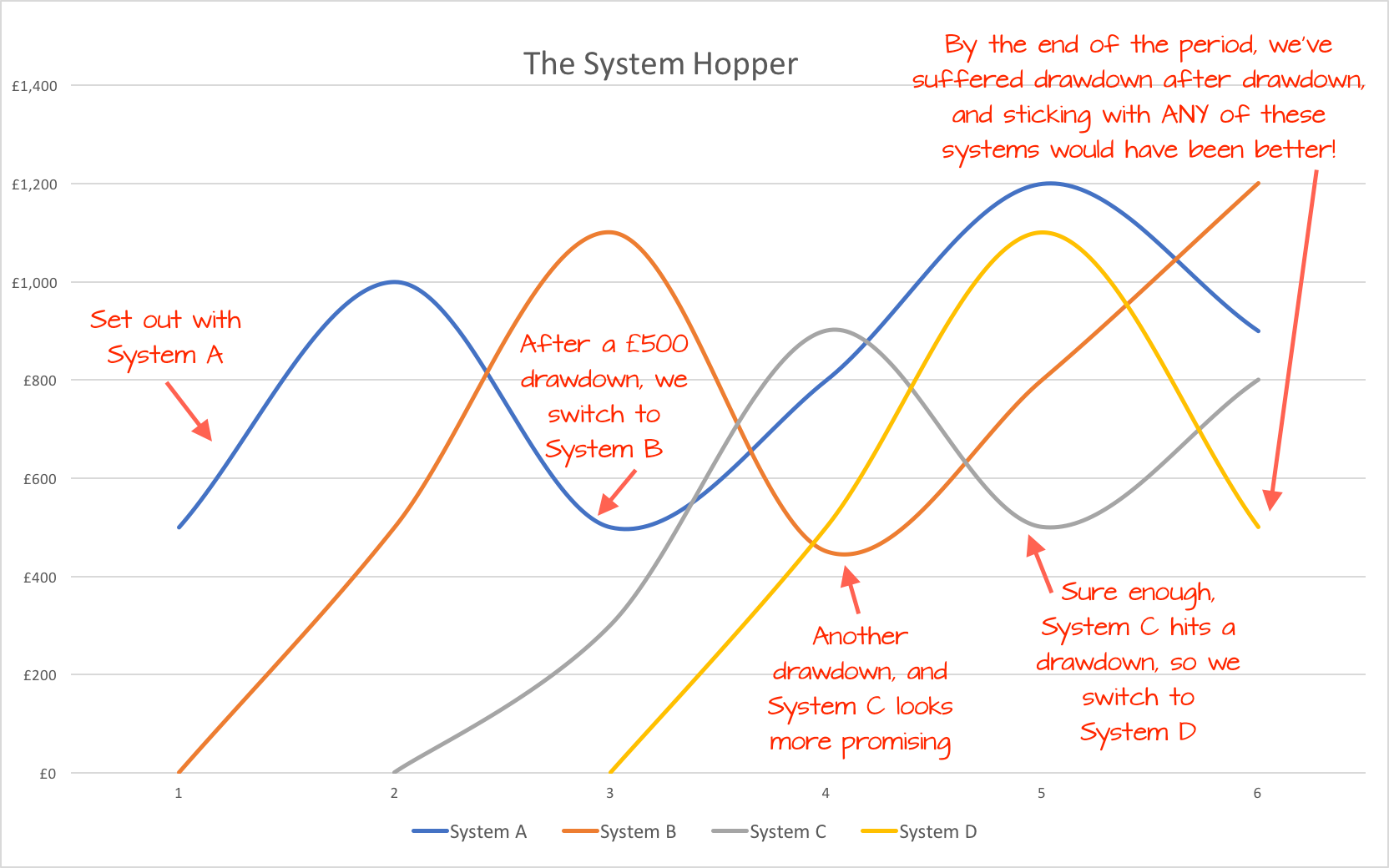
Here’s a chart showing what happens if we switch from one system to another, four times, following a drawdown of £500 …

The results for a method like this will have been closer to a £2,000 drawdown – and that’s from trading 4 different methods ALL OF WHICH ARE ACTUALLY PROFITABLE!
None of us can afford to give money away like this. There are plenty of ways we’ve covered in Trader’s Bulletin to protect your funds during a drawdown – use those rather than having your head turned by the next best thing.
2. What’s your staking strategy?
I know really smart people – people who have traded for a long time – who STILL don’t calculate their stakes properly. Some trades take on two or three-times the risk they should, some trades aren’t making the profits they should – just because they don’t bother to spend 20 seconds calculating the right stake for that trade.
Before you set out, there are three things you need to know …
- What’s the size of your trading fund? This isn’t necessarily the amount of money you have in your trading account – if you have a large fund, I’d positively discourage you giving it to your broker for ‘safe keeping’! But consider how much you’re prepared to risk on your trading.
- What degree of risk are you prepared to take with that money? Will you risk 1% per trade? 2%?
- Are you going to compound your winnings as you go? Or do you want to take your profits off the table and keep your trading fund a fixed size? If you are compounding, how often will you compound? Every trade? Every day? Every month?
Once you have this information, you can calculate the risk you’re prepared to place per trade.
For example, if you have a fund of £2,000, and are prepared to risk 2% per trade, then your risk on a trade will be £40.
If you have a fund of £10,000 and are prepared to risk 1% per trade, then your risk on a trade will be £100.
And the final piece of the jigsaw is to match this to each individual trade.
If your stop distance on a trade is 20 points, and your risk-per-trade is £40, then your stake on that trade should be £2. (I.e. £2 x 20 points = a maximum potential loss of £40.)
This calculation is the work on seconds, so there’s no reason not to be doing this on each trade – it means your risk and rewards will always be in line, and that the power of compounding is working properly for you.
3. How do your records look?
As I said earlier, one of the things that keeps me really disciplined in my record keeping is the knowledge that other traders using my methods expect that of me – and would quickly pull me up if I wasn’t being 100% honest in my results.
I know that I can’t twist my rules or fudge any results – and actively posting results keeps me on track.
Publishing my trading systems has – without doubt – made me a better, more disciplined trader.
Trading as part of a community can have a powerful effect on your profits, so I’d always encourage traders to share their results.
(If you’re not following them already, I do post all my results for strategies I’m using in the comments on the website every week or so, including screenshots of my account.)
(I’ll assume that as a good Trader’s Bulletin member, you’re already using my Trading Journal to track your results.
3. Are you serious about doing this, or just mucking about?
If you find yourself doubting the importance of points 1–3 above, I recommend that you ask yourself if trading is really for you.
If you just want to gamble a bit of money on the markets, without a clear plan – that’s up to you.
But if you really want to build a financial future from the markets, then you must give yourself a chance to make money. And if you’re failing in any of these points, then you’ve sabotaged your success before you’ve even placed your first trade.
To enjoy more content and get it faster








3 comments
Darin
Ok, here I go….No.1 Guilty, No.2 Got this sorted out. No.3 err….working on it. No. 3 (again) Serious!
I’ve system-hopped with the best of them. Getting one’s head around the idea that Forex makes profit over the longer term with lots of shorter term ups and downs has been difficult to say the least. But I’m getting there. The recent HA draw-down had me gritting my teeth ….and carrying on trading as normal and my account has just got back to where it was at the start of the year. Currently sitting on some very nice open profit and looking forward to it moving steadily upwards now.
Re account staking. I’m not sure I’m allowed to say but here goes anyway. I solved this problem when i found a nifty piece of software from a local (Aussie) based trader known as The Forex Guy. A self taught trader (and coder) he has some very useful trading tools available for a cost of course (no I’m not getting a commission…unfortunately) His ‘Trade Panel’ as he calls it loads onto MT4 and (among lots of other things) gives you instant accurate staking sizes according to your % risk and account size for any market you care to trade. Sure is useful. (His stuff might be worth a review Mark)
I’ve also fudged plenty of rules over the last 4 or so years I’ve been trading……and gradually learning its simply a BAD idea. I recently missed the EUR/CHF move on HA coz I closed the trade early after it almost hit the stop….Follow the Rules Darin!!! Anyway I hope the above is useful to someone. And happy trading! 🙂
Richard
But how do you tell a good system from a bad if you’re testing them on 30/60/90-day trials? My test of HA Mountain finished with a profit of £9.01 at the end of the trial period. It’s peak was almost £1500. Which is the true potential of the system? The £1500 profit, £1500 loss immediately after, or the final £9.01?
As a system creator, it’s very easy to put the blame on the purchaser. As a user, it’s very easy to put the blame on the system/creator, while the truth probably lies half-way between the two.
Mark Rose
Hi Richard,
It’s difficult, especially with all the marketing hype you see.
Making money trading is not easy, so you need to trust whoever is providing you the strategy and believe there long term result (which they have to be publishing on an ongoing basis).
If you know they are risking their own funds and that they are accurately reporting the performance, then you at least know the are genuine traders.
It always amazes me how many systems I see where the author isn’t prepared to publish their results, often because in truth they aren’t trading it.
Trail periods are designed to give you the confidence to try a strategy risk-free to see if it fits in with your trading methodology as well as practically fits in with your lifestyle.
How it performs over the trial period should actually be less of a priority.
All genuine systems suffer drawdowns, they are part and parcel of trading. it’s great if during a trial period you see winning trade after winning trade, but you can be sure a drawdown will be on its way at some point, similarly, if you suffer a drawdown during your trial, this doesn’t mean the system is necessarily rubbish.
Unfortunately, too much emphasis is put on performance and this tends to result in system hopping. I have published my result for HA and sent members screenshots of my live account every day. I am 80% up over 15 months of trading.
I will suffer drawdowns and I can’t guarantee profits, but hopefully you can see I am a genuine trader, using a system that has generated real profits over a reasonable period, which isn’t a bad place to start.
Kind regards,
Mark Rose