Let’s play
a little game. It’s one where you’re a government agent in charge of creating
farmland to feed the hungry.
Oops! We could not locate your form.
A new paper
published in Psychological Science this month showed that when participants
were randomly given one of these scenarios, less than half chose to destroy an
acre of forest to feed 500 families in the first dilemma; while nearly 80%
chose to destroy an extra acre to feed 400 families in the second dilemma.
The conclusion is that when given the option to avoid all harm, we’ll take it. But when harm is unavoidable, we become increasingly willing to trade-off for benefits. And the paper shows that this is trade-off continues, even when those benefits are diminishing.
I think we
can see how this thinking has played out in recent months in people’s attitudes
to the Coronavirus pandemic. But it can also be seen at work in our attitudes
to risk and reward in trading.
Obviously,
the zero-risk approach would be to avoid trading the markets altogether … so by
simply stepping into the markets, we are already on that shaky road to pushing
our ‘harm’ in return for diminishing returns.
Watch out
for this – it’s like a built-in psychological self-destruct button on our
trading!
This is why
your risk-reward decisions should never be made on ‘what feels right’, but
instead by a balanced judgement of results.
Here’s where it gets really interesting …
I’ve been
thinking a lot recently about ‘risk-free’ trades. Specifically, the action of
bringing our stops up to breakeven and/or taking partial profits.
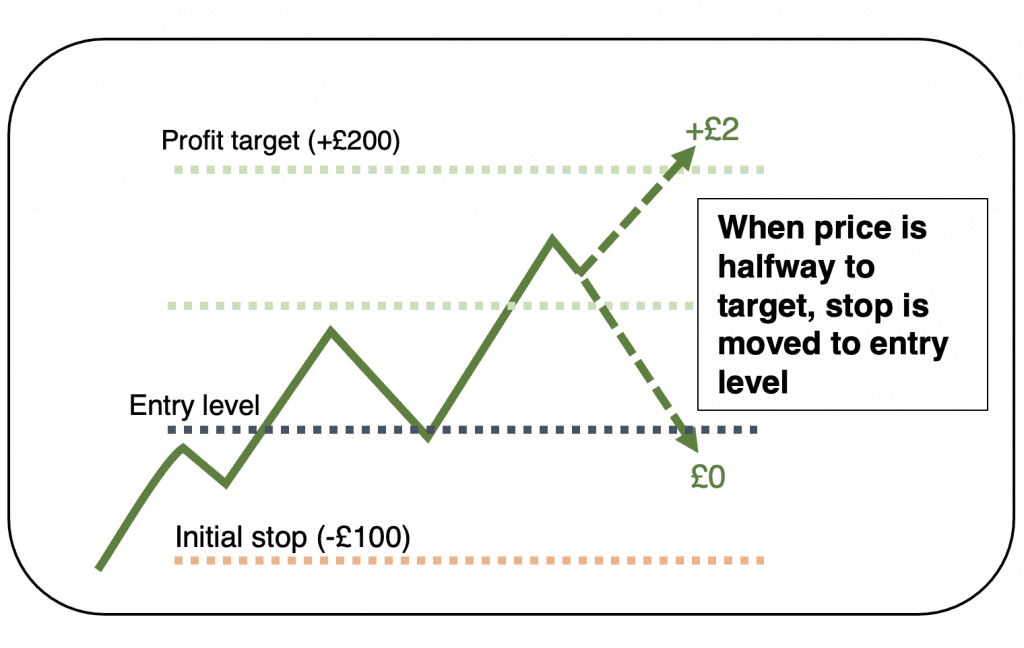
This is the process of getting (say) 50% of the way to our profit target, and sliding in the stop level to our entry price.
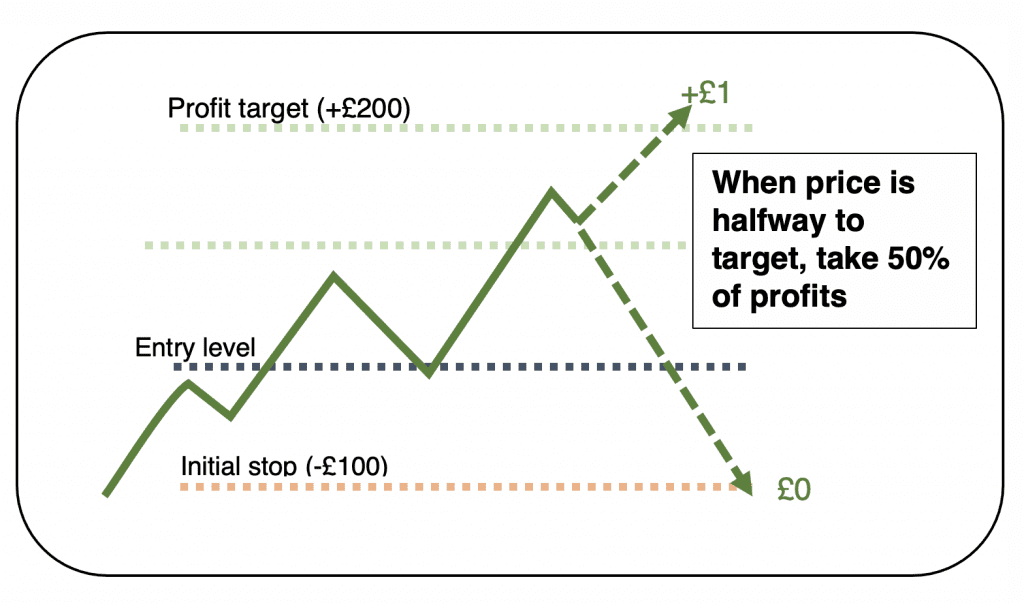
Or, it’s about closing 50% of a trade halfway to a profit target, so, even if the second 50% runs to the stop level, we’ll come out even.
The
standard line we tell ourselves at this point is that we’ve achieved a
‘risk-free’ trade.
I
frequently tell myself exactly this – congratulating myself on the profit
potential of my trade, at zero risk to myself.
This is
absolute nonsense.
Here’s an
example …
Let’s say
that we’ve entered a trade with a 100 point stop distance and a 200 point
target, and we’re risking £1 per point. Halfway to that profit target, we
decide to move the stop level in to our entry point.
Sure, this
means that we’ll exit the trade, either with £0 profit or with £200-points
profit overall. But at the point we move up our stop, we’re already £100 in
profit. So we’re actually shifting our risk-reward to -£100 vs +£100.
Just
because we haven’t closed out a profit, doesn’t mean that it isn’t real money
at risk in the market.
However,
the perception of a risk-free choice is very appealing to most of us and can
lure us into the trailing stop – so it’s important to examine whether or not
this is really worth our while.
Let’s look at probabilities
Let’s say
that we’re choosing our trade direction on the toss of a coin, and make the
assumption that the probability of the price moving up 100 points or down 100
points from any given point is 50:50. (I’ll come back to whether or not this is
an okay assumption to make in a moment.)
In this
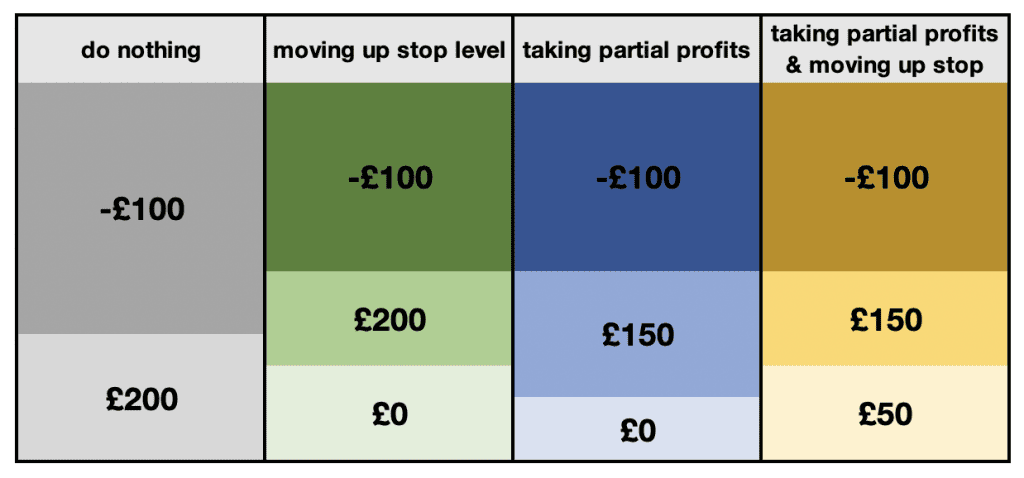
scenario, if we’re looking to profit from a 200 point move up, with a 100 point
stop distance, then we’d have 33% chance of £200 profit; and 66% chance of £100
loss.
If we move
the stop level up though, we’d have 50% chance of losing £100, 25% chance of
making £200, and 25% chance of breakeven.
If we take
partial profits halfway to our target, we’ve got 50% chance of losing £100, 33%
chance of making £150, and 17% chance of breakeven.
If we do
both – taking partial profits AND moving up the stop level – then we’ve got 50%
chance of losing £100, 25% chance of making £150 and 25% chance of making £50.
It might be easier to see those probabilities visually …
The rub is,
when we tighten in a stop level, we’re reducing the chance of hitting our full
target.
There’s an
important factor that gets ignored in this …
How far markets run
All markets
will have an Average True Range – this is how much that market usual moves in
any given time.
So,
depending on how much of a move you’re demanding in your profit target, it’s
less likely to hit outlying levels that close ones.
In short,
it’s always going to be more a stretch for a market to run 200 points than it
is to run 100 points and then retrace.
This means
that the band in that chart above, where I wanted to reach my full 200 point
target – just got squeezed a little.
My point
here is that tightening in a stop distance doesn’t increase the chance of that
stop being hit by the same increment. I.E. if I reduce my stop distance by 50%,
it’s not twice as likely to be hit – the chance of it getting hit is
significantly more than that.
Using
technical analysis and price action can give us much smarter levels to place a
stop, behind areas of support, as the price moves up – these could be less
likely to be hit. But, be very wary of the ‘stop to breakeven’ trade, used in
isolation, as the smart option.
However, there’s another big caveat here …
A big part
of trade management is about managing our own expectations and state of mind.
I don’t say
that flippantly – it’s really important that we keep our heads in the game, and
bring in steady profits, avoiding nasty losing runs.
With that
in mind, the ‘risk-free’ trade is a powerful ally.
It can give
us much more confidence to push for higher profit targets with the second half
of that trade. In the examples above, I’ve looked at moving stops and taking
profits at the halfway point. But this doesn’t have to be the case.
Traders are
notorious for taking profits too early. But by taking partial profits (and/or
sliding up stop levels), we tend to be more likely to hold out for bigger wins.
I’m not about to give up these techniques – I use both partial profits and
trailing stops in my trading. But I’d urge you to really think about what you
have to gain from a so-called ‘risk-free’ trade, and what additional risk
you’re actually taking on.
It may be
worth it – but don’t be blind to the downside.
And one final point … I’m no mathematician, and my understanding of probabilities is very limited. So, if my back-of-an-envelope calculations are flawed, or if you can add more to this debate, please comment below.