October 22, 2010by Mark Rose- 0 comments
How to scale out

This little profit-taking technique is used by many, many successful traders …
yet very few people talk about.
I don’t know why this doesn’t come in under “lesson 1” for novice traders …
Perhaps the philosophy behind it suggests that we’re woolly about our
trade and exit levels.
Personally, I don’t think there’s anything woolly about this technique – it has good risk management written all over it.
What am I talking about?
Taking partial profits.
Take the dithering out of closing a profit
You know when your trade is showing a great profit? And instead of feeling like you’re king of the markets … you’re dithering … do you close out, or let it run for further gains?
With partial profit taking, there is no dithering, because this “human frailty” is factored into your plan. You may not be ready to close out your position entirely, but you want to see some of those profits.
The solution – close out part of that position.
You may close 50%, 30%, 20% – whatever suits your plan. Remember, the less you close out, the more aggressive you are being.
Using this technique to maximize success
Partial profits can be hugely beneficial to the trader. This technique can help to limit your risk and heighten your confidence.
It can increase your percentage of winning trades – if you’re in a winning position, close out half and move up your stop loss, this could ensure that the trade will be profitable overall.
(This won’t necessarily make your long-term trading more profitable overall – but boosting your number of winning trades can help you to maintain a positive attitude to your trading, the importance of which shouldn’t be underestimated.)
Taking partial profits also allows you to catch future price movements and benefit from them. On the downside, taking partial profits can also mean that you’re exposed to future downside – for that reason, it is normally done in conjunction with moving your stop loss in tighter.
Another way that this technique helps you is that it reduces your exposure to the market. I’ve spoken in the past about the dangers of sitting on large unrealised profits. It might sound like a nice problem to have – but remember that those profits are at risk in the market. Taking partial profits means that you can bank that money – or put it to work in other investments.
Protecting profits
Partial close methods allow you to scale out of your position at pre-set levels. When the market hits that level, a certain percentage of the trade will exit – taking “first profits”.
Then you can move up your stop loss – this may be to your entry level or to a support/resistance level close to it – it really depends on the volatility of the instrument you’re trading.
However, it is important to remember that this technique won’t always result in a more profitable trade …
In the example here, the entry level was at 9363, and the first profit target set at 9433 – this is where half of the position is closed out and the stop loss brought up level to the entry price.
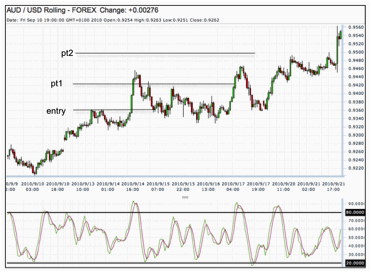
Here the price retraced and stopped the trade out before heading back up to the second profit target at 9495. This meant that 50% of my trade profited at PT1, and 50% was breakeven.
This is the nature of taking partial profits – sometimes we have to pay for the security it gives us by accepting lower returns. It comes back to the old risk-reward vs success-rate chestnut!
Before you apply this to your trading …
While I advocate taking partial profits on trades, there are some important factors to bear in mind.
- Taking partial profits should not be an excuse for sloppy trading. The levels at which you take your profits still need to be predetermined – this isn’t a license to fly by the seat of your pants and “see what happens”. If you have no technical reason to think that a price will keep moving in your favour, then there is no reason to keep that trade open.
- To manage this kind of trading, you may find that you have to open two trades instead of one. Make sure you’re not doubling up on your risk – they should each be at half stakes (or 70% to 30% of stakes, depending on the percentage you’re closing early).
- While taking partial profits should increase the success rate you achieve with your trades, it won’t necessarily make your trading more profitable overall. If the price retraces on you and hits your stop loss, you won’t make as much as you could have by closing the entire trade out at your first profit target. Monitor the effect it is having on your trading – is it working for you?
Remember, the bottom line at the end of the year isn’t everything – if you scale out, it can give you a smoother profit curve, making trading more comfortable and less stressful. And the value of a good nights sleep while your trades are open shouldn’t be underestimated!
To enjoy more content and get it faster