January 15, 2016by Mark Rose- 7 comments
The 7 rules of trade management
So, you’ve placed your trade. The set-up looks perfect – all you need to do now is sit back and wait for the cash to roll in.
Right?
Well, that’s one way to trade.
I love the ease of a set-and-forget system as much as the next man. And set-and-forget is the best way to stop yourself from ‘meddling’ with your trades.
But there’s a fine line between meddling and managing.
If you can manage your open positions effectively, it can bring bigger profits, lower risk – and a more positive attitude to trading.
But allowing us to click on the ‘trade edit’ button opens up a world of possibilities … where all our insecurities about the market can play out in a series of terrible decisions!
So how do we manage in a positive way?
Fortunately, there is a solution – by making your management an part of your trading plan, you can deal with open positions in an active and profitable way.
Here’s how …
1. The set-and-forget stops and targets
First off, trade management doesn’t mean that you don’t use automated stops and targets on your trading platform. It’s always worth setting these, as prices can zoom off very suddenly, giving you no time to react.
Whatever your trade management strategy, always set a stop loss. And I recommend that you also put a target in place.
2. The unexpected news story
A lot can happen between the time you open a trade at the price hits your target or stop. Fresh news stories are hitting the markets all the time – and sometimes they’ll have a big impact on prices. By definition, news is new, so we can’t have accounted for it in our trading plans.
If the unexpected happens and your trade is still open – reevaluate your position. Is the reason you opened this trade still valid? If not, it’s time change your exit strategy – either close out or move your stop and target.
The effects of unexpected news are a good reason to always have an automatic stop loss and profit target in position – that way, we can profit when the price shoots in the right direction, and we’re protected when it moves in the wrong direction.
3. The expected announcements
Some pieces of news, like regular economic announcements will be scheduled, so it’s a good idea to keep yourself abreast of what’s coming up. And we can plan in advance what we’ll do when they come out (be it avoid trading, close out early, or adjust our trade depending on whether the announcement is positive or negative).
Let’s say that we opened a position early in the day on Eur/USD. We expected it to have closed out within a couple of hours, but this one is still running. It’s in profit, but still just 5 points short our target. It’s lunchtime, and the markets are slowing down ahead of a big announcement from the US Fed at 1.30pm. The announcement could give it the impetus to push through our target, but it could equally send the price in the opposite direction.
I decide to forego those last 5 points and take my profit now. It’s not worth gambling the money I’ve got on the table for just an extra 5 points.
4. Trailing stops
I love the idea of trailing stops. The notion that the market will carry on trending in the direction of my trade, filling my account with cash, while the stop follows behind like a faithful Labrador, locking in those profits.
Sounds perfect.
But there’s a problem.
Large market moves, without big corrections, are few and far between. In general, any market will move roughly within the realms of its average daily range.
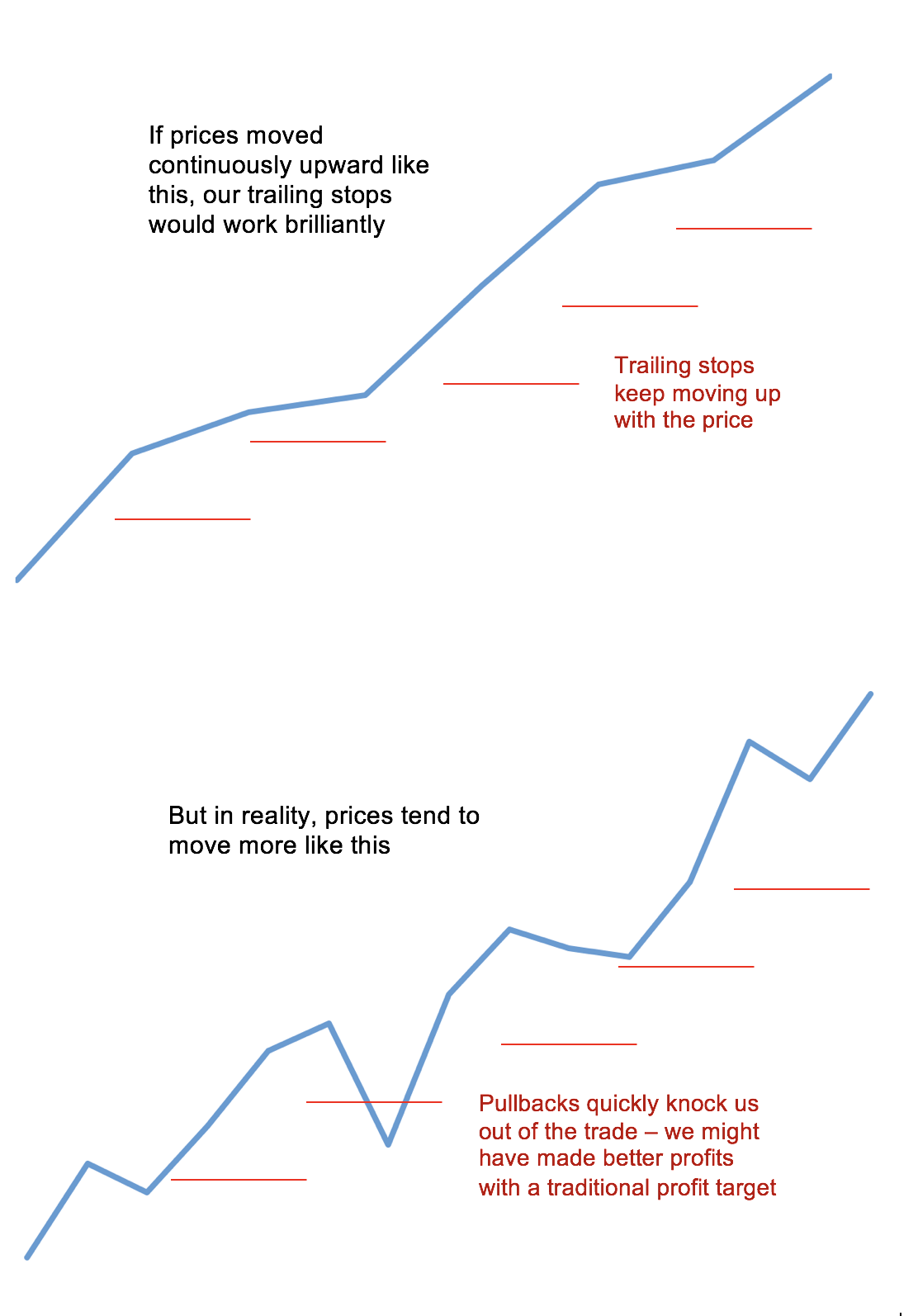
Yes, the trailing stop will, every now and then, give you a fantastic profit on a very low-risk trade. But, more often than not, a trailing stop means giving back some of your profits on a trade.
I’m not saying that trailing stops can’t be used successfully, but I am telling you to use them with caution. Don’t fall into the trap of planning your exit strategy around that ‘one time when the market jumped 200 pips’ – it’s letting the tail wag the dog.

The worst kind of trailing stops are the automated ones on your trading platform – these will blindly follow the price up, and very often get you knocked out of a trade on a minor pullback.
A better way to do this is to manage it yourself. Wait until the risk of a pull back has reduced, and then move your stop manually to a sensible place – based on Fib levels, a recent high/low, or a trend line.
But one of the best things about trailing stops is its psychological effect. Knowing that you can profit from future price moves answers a lot of ‘what if’ questions about our trades – that nagging feeling that, if ‘I close now, the market might be about to make a huge leap in the right direction’. Trailing stops allow us to deal with this in a relatively safe way, and if you have a tendency to leave your trades to run too long, they could make your trading more profitable.
5. Scaling out
Scaling out is another technique that can help you as much psychologically as it can in terms of profitability.
You know when your trade is showing a great profit? And instead of feeling like you’re king of the markets … you’re dithering … what if this is as far as the price is going to run? What if the market turns tail now, and I lose those profits? Do you close out, or let it run for further gains?
With partial profit taking, there is no dithering, because this “human frailty” is factored into your plan. You may not be ready to close out your position entirely, but you want to see some of those profits.
The solution – close out part of that position.
You may close 50%, 30%, 20% – whatever suits your plan. Remember, the less you close out, the more aggressive you are being.
This technique can help to limit your risk and heighten your confidence by increasing your percentage of winning trades – if you’re in a winning position, close out half and move up your stop loss to breakeven, this could ensure that the trade will be profitable overall.
(This won’t necessarily make your long-term trading more profitable overall – but boosting your number of winning trades can help you to maintain a positive attitude to your trading, the importance of which shouldn’t be underestimated.)
Taking partial profits also allows you to catch future price movements and benefit from them. On the downside, taking partial profits can also mean that you’re exposed to future downside – for that reason, it is normally done in conjunction with moving your stop loss in tighter.

Another way that this technique helps you is that it reduces your exposure to the market. I’ve spoken in the past about the dangers of sitting on large unrealised profits. It might sound like a nice problem to have – but remember that those profits are at risk in the market. Taking partial profits means that you can bank that money – or put it to work in other investments.
6. Risk management
If you’re using scaling techniques to actively manage your live trades, you’ll probably be opening multiple orders. Watch out that you aren’t upping your risk levels. If you have to open two orders in order to exit them at two different price levels, make sure that you’re using half stakes and not doubling your risk.
7. Planning
Whatever techniques you’re using, don’t use active trade management as an excuse for sloppy trading. The levels at which you’ll take profits still need to be predetermined – this isn’t a license to trade by the seat of your pants! The use of trailing stops and scaling out can be incorporated into your trading plan. And how you’ll react to news stories or announcements should also be thought through.
Save








7 comments
Jason
Hi Chris, I see Mark has not had time to respond to your query yet so I will try to help by explaining how you scale out of a trade (i.e. take partial profits) with my broker, which is IG.
Let’s say you have a SELL position open in GBPUSD at £2 a point/pip (note that with IG the minimum on FX is £1/pt so you cannot scale out of a trade if you have placed the minumum as you will always be required to leave at least £1/pt to keep the trade open). Once you are say 20 pts/pips in profit, if you now click on your GBPUSD ‘Open’ position the ticket will pop up and you will have a choice to Close Position or Edit. In the Close tab the BUY button will be highlighted (blue) and your original £2/pt stake will be shown in the box on the left. You can then either use the arrow keys to reduce this or click in the box and manually enter the amount you wish to remain Open on the trade (say £1/pt, i.e. take 50% profits)……Now click on the highlighted BUY button and you will have bought back half of your position and credited your account at £1/pt, and left the remaining £1/pt running. Now most importantly, click on the GBPUSD Open position once again, click on the Edit tab and now immediately enter your new Stop level to say breakeven or just in profit (note for quicker execution of this last step you can also do this on IG Charts by hovering your cursor over your Stop line that runs across the chart, a hand will appear, then click and drag your Stop to the new level). If you’re happy with the profits you’ve just banked, and in the knowledge that this trade is now a winner no matter what, walk away and have a cuppa…..or an early beer if it’s Fri afternoon!
Mark Rose
Hi Jason,
Thanks for your explanation on how to do this, much appreciated.
One of the foibles of IG is that you can close out part of your trade if you want to leaving less than the minimum stake open.
So if you’ve traded £1 a point, you could immediately close 90p and be left with a 10p open position. You used to be able to do this on most platforms, but I think IG are about the only platform left where you are able to.
Another option in the scenario above is to open 2 positions with different profit targets and the same stop. Once you get confirmation that the 1st trade has closed for a profit, you can amend the stop on the second (if you want to).
I’m doing a bit of work at the moment about moving stops to breakeven. Personally I like this option as trading should always be about not losing money, but we do know that the tighter the stop the more likely you are to get stopped out.
I think that from a performance point of view, leaving the stop where it is might actually give you better returns, but from a trading mindset point of view getting to breakeven on the second part of the trade is more appealing as this means you will bank an overall profit on the trade.
Regards,
Mark
Jason
Hi Mark, yes you are right about scaling out and leaving less than the minimum stake with IG. I tried it yesterday, opening a trade at £1/pt then closing out £0.9/pt to leave just 10p/pt running!!
This is great news for those just starting out live (money) trading with a small account size and only wanting minimal risk exposure, i.e. you can place the minimum stake of £1/pt and then immediately you see a slight profit close out £0.9/pt, leaving just 10p/pt running to learn the ins & outs of trade management!
Jason
Thanks Mark for the feedback on being able to leave less than the minimum steak open. I had tried this in the past and I’m pretty sure a message popped up to say I couldn’t…..but I will try again!
I know what you mean about moving stops too close too soon, but if scaling out I always like to bring the remaining position to breakeven as soon as possible and then trail at the 21 EMA at -1 bar (or even tighten to the 8 EMA at -1 bar if there’s been a strong move). It is emotionally satisfying and as long as you are watching your charts there is always the likelyhood of closing the remaining position in profit and possibly benefiting from a better ‘re-entry’ price following a retracement back beyond your initial entry!
Chris
Hi Mark, a really interesting, and helpful article. I’m fairly new to trading (and lacking in confidence at present) so do have a question;
I understand the part about manually trailing positions (and in fact will be happier doing that rather than automating it) One thing I’m not sure about though is ‘Scaling out’. I realise that you’re taking part of your profits, thus limiting risk, but I don’t get how you actually do it (i.e. What’s the process? Does it change with different brokers?)
Your thoughts/help regarding this are much appreciated, and keep up the good work with the articles 🙂
Kind Regards
Chris
Laurie
Thank you for another very interesting article covering the salient points Mark. I shall look forward to the forthcoming strategies you mention in your email and thank you for taking the time to cover those 🙂
Mark Rose
Thanks for the feedback Laurie. All best, Mark