
Mobile finance app image

101 trading tips

101 trading tips

As a reader of Trader’s Bulletin, I expect you to know it all already – I firmly believe we’re the smartest trading community out there!

But there’s always room for improvement … so here’s a rather lengthy checklist to ensure you’re not missing anything crucial in your trading …

  • Keep a trading journal – it’s the only way to build on your successes and learn what works and what doesn’t.
  • Add a long-term moving average to your chart so you never forget where the over-arching trend is going.
  • Note major support and resistance levels – a glance to the left of your chart can give you crucial information about key levels you won’t find anywhere else.
  • Practise drawing lines on your charts – drawing support & resistance lines takes a little practice, so get started now.
  • Make peace with your indicators’ fallibility – no indicator is perfect, but if you understand its weaknesses, you’ll be able to spot false signals more quickly.
  • Pay attention to round numbers – these are big sticking points for price action.
  • Compound your profits by reinvesting your winnings.
  • Be patient – life-changing profits aren’t made overnight.
  • Shop around for brokers – there can be huge differences in the spreads they offer.
  • If you only recognize one price-action candle, make sure you know how to spot a doji.
fx signals dojis
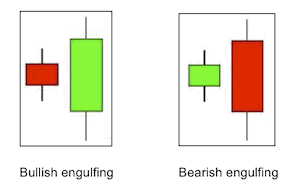
  • If you want to add in a second price-action candlestick to your repertoire – make it engulfing.
  • Discover the power of patiently waiting for the pullback.
  • Consider trailing your stop.
  • Use a drawdown limit which will put a halt on the amount you can lose in a losing run.
  • Be realistic about how much money you can make and how quickly, given the size of your trading fund.
  • Consider scaling out of trades by taking some profits off the table early.
  • Be wary of overbought and oversold indicators – markets can stay stuck in ‘overbought’ or ‘oversold’ for long periods of time before the price corrects.
  • Learn to spot divergence in momentum indicators – it’s a great way to know when to get out of a trade.
  • Use your trading journal to monitor your risk-reward ratio, and keep an eye on its progress.
  • Use your trading journal to monitor your expectancy, and keep an eye on its progress.
  • Beware trading systems with HUGE rewards – they probably have HUGE drawdowns too. This is rollercoaster trading!
  • Find a trading timeframe that suits you, whether that’s scalping on 1 minute charts, or following long-term trends on weekly charts – there’s something for everyone.
  • Beware forex robots – yes, it’s good to use tools that’ll save you money, but make sure you’re always in charge of executing trades.
  • Avoid expensive markets with high spread costs. It makes the job of being profitable much tougher.
  • If you’re trading out of hours, beware spread costs jumping up.
  • Always trade with a plan.
  • Have an understanding of what your margin requirements are so you don’t risk margin close-out.
  • Learn and practice on a demo account (I still use them a lot to test out new methods and ideas).
  • Remember that demo accounts and live accounts use different data feeds, so when you switch to live, keep stakes LOW to ensure it works in a live environment before risking too much money.
  • Don’t trade from just one indicator. Combine two or three different indicators to get confirmation.
  • Don’t stand on the sidelines watching – the sooner you start trading (even with very low stakes) the sooner you’ll start building a solid fund.
  • Have an understanding of the volatility and range of any market you’re trading – how far does it usually move in the time period you’re trading?
  • Know the market hours and costs of the market you’re trading.
  • Have an understanding of correlations if you’re trading multiple markets. Do the markets you’re trading tend to move together, or in opposite directions, or do they not have a correlation?
  • Have an idea of external factors that could move markets. This doesn’t mean becoming an expert in fundamental analysis, but just be aware of what could happen. For example, if you’re trading JPY, check if there are any Bank of Japan big announcements coming up – these can really move the currency, and can give us a nasty fright overnight. Check out www.forexfactory.com for major events.
  • Trust your trading strategy. This doesn’t mean have blind faith, but don’t keep chopping and changing. 
  • Only risk a small percentage of your bank on any one trade. 0.5–4% is plenty.
  • Have a favourite trend indicator.
  • Have a favourite momentum indicator.
  • Don’t trade with a fixed stake size – adjust it according to the stop distance of your trade so your risk is steady, and you should see your stake size grow as your account balance grows (assuming you’re compound investing).
  • Trade less often. Most of us are guilty of over-trading. If we can filter out some of those trades, we can leave ourselves with just the best ones.
  • Be consistent. One of the biggest causes of failure is not being consistent. Time and time again I speak to traders who give up on a system after a losing run – and they end up system-hopping from one losing run to another, missing profitable periods again and again.
  • Don’t overthink it – just follow the rules.
  • Beware market pundits and don’t listen to which way the ‘experts’ say the markets will move.
  • Take your trading seriously – if you treat your trading like a game, you won’t make money long term.
  • Monitor your win rate (i.e. the number of winners you get vs the number of trades you take).
  • Have clear trading rules – and follow them.
  • Include a plan for what you’ll do in a drawdown in your trading rules.
  • Don’t have an opinion (or if you do, keep quiet about it).
  • Don’t blame others for your losses – taking ownership of our mistakes allows us to learn from them. Which brings me to …
  • Learn from your mistakes.
  • Focus on your long-term goals and results. By looking at the bigger picture, you won’t obsess over recent losses (ensuring you’re not risking too much per trade will help with this.)
  • Don’t try to pick tops or bottoms. Markets only occasionally change direction. It’s much easier (and likely to be more successful) if you piggy-back a move than try to predict one.
  • Don’t go chasing profits. If you’ve missed a trade, don’t sweat it. There will always be more opportunities.
  • Only trade with money you can afford to lose. There’s no getting away from it – trading the markets is risky, and even with the best money-management, there’ll be losses.
  • Never trade without a stop level. Even if you’re planning to manage your stop yourself as the trade plays out, include an ‘emergency stop’ just in case you get called away from your trade, or lose your internet connection.
  • If you’re finding your trading stressful, then you’re probably trading too big – consider reducing stakes.
  • If you’re not sure about a trade, just sit out. It’s better to be safe and protect your funds.
  • Remember – you can be wrong more than half the time and STILL make a profit, as long as you’re managing your risk right.
  • Don’t get over-confident on a winning run and bump up your stakes too quickly – stick with a compounding plan.
  • The final lesson here is that there aren’t 101 of these tips (there’s a lot of them, but not that many). Never trust the headline figures – they’re there to suck you in. Dig deeper to find out about risk, fund size and percentage rewards.

And, finally, please add any of your own tips and suggestions in the comments section below …

Leave the first comment

JOIN US ...

Get exclusive access to members-only resources, plus my weekly email updates ...

I will NEVER share your details for marketing purposes. Privacy policy

TradeNationPromotion

Strategies I'm Using