August 28, 2015by Mark Rose- 6 comments
REVEALED: my very best trading tips
Each summer I’m putting together a list of my very best trading tips, gathered from hundreds of posts on the website.
Here are my top, totally free tips to anyone who’s venturing into the markets …
1 • Wait for the pullback / throwback
If you’re trading a breakout strategy, waiting for a pullback will increase your chances of a winner and can get you in at a better price.
So, the price breaks through our key level, but rather than jumping in, we’ll wait for it to retrace back to this level. Sure, it doesn’t always happen, but if we only take the trades where it does, we’ll be a lot safer …
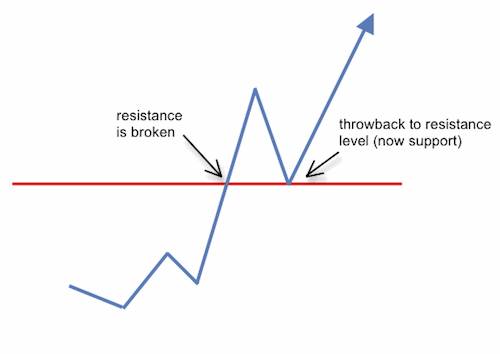
This is a smart way to trade – the only reason more people don’t do it is because they rush into trades impatiently, afraid of missing opportunities. If you sit back and wait for the opportunity to come to you, can spend less time in the market, and have a higher success rate.
2 • Tackle risk head on
People in general – and traders in particular – tend to have a funny attitude to risk.
Most of us regard ourselves as risk-averse.
Most of us don’t go base-jumping every weekend …
Most of us don’t take our holidays in war zones …
Yet we do very strange things, that we know full-well to be risky … like smoking … drinking … eating pork pies … holding mobile phones to the side of our head …
And when it comes to our finances, we can be even more irrational …
You only have to watch a TV game show to know the bizarre risks people will take when they are faced with the prospect of large sums of money.
And we’re forever hearing about traders who’ve had their entire funds wiped out.
Unfortunately, human beings appear to be rubbish at making risk judgments, which is why we should never “wing it” when it comes to evaluating risk.
Make a risk judgment “on gut instinct” and I’ll wager that you’re seriously overstretching yourself.
Instead, we need to have some sensible guidelines – and stick to them.
The standard advice to traders is to only risk 2% of your fund on any one trade. If you’re not currently doing this – then this would be a good place to start.
You can also cut risk by actively managing your positions – pulling in stop losses once your trade has reached a first profit target … or using trailing stops. This kind of trading plans should be monitored in your trade journal (yes, I’m back on that again!), so you can assess what’s working, and what isn’t.
3 • Know how to spot these two candles …
You don’t need to memorize the hundreds of different candlestick patterns out there. As long as you can spot a doji, telling you that the market might be about to turn … and an engulfing, which is a great bullish or bearish confirmation … you’re covered.
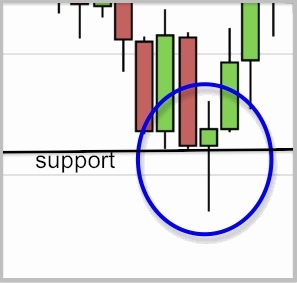
A doji (here in the form of a hammer, with a long lower wick), right on a key level tells us the market might be about to turn.

The engulfing pattern is made up of two candles – the second with a large body that ‘engulfs’ the size of the first candle. They can be bullish or bearish.
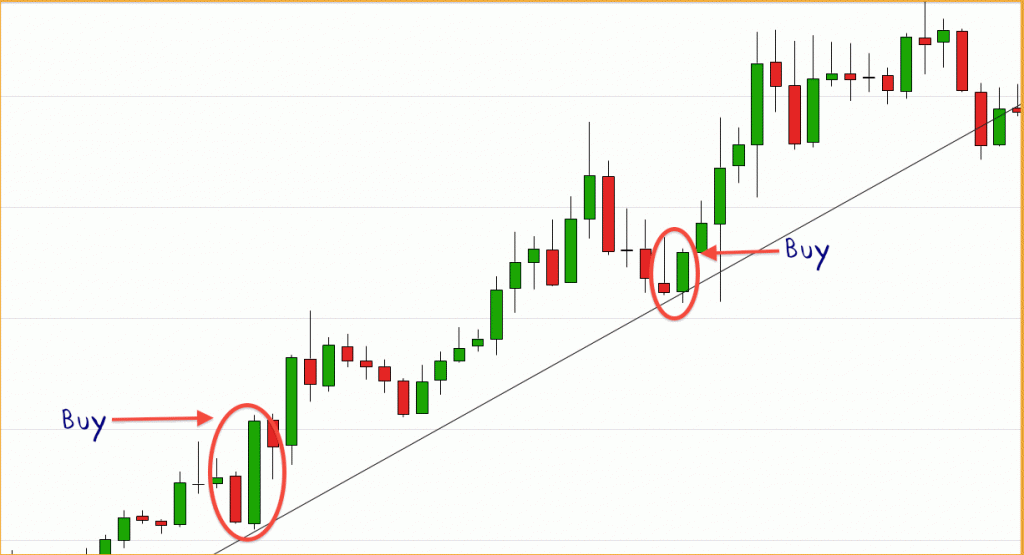
Engulfing candles are great for giving us confirmation of a move.
If you don’t know any other candlesticks, these two will serve you well.
4 • Easy bookkeeping
A couple of minutes spent recording your trades is worth hours of pouring over charts, and will help keep you disciplined and on track. Without these kind of records, you can’t see what’s working and what isn’t.
If you’re not already using the Trader’s Bulletin spreadsheet journal, you can download your copy here.
5 • Use the S&R crystal ball
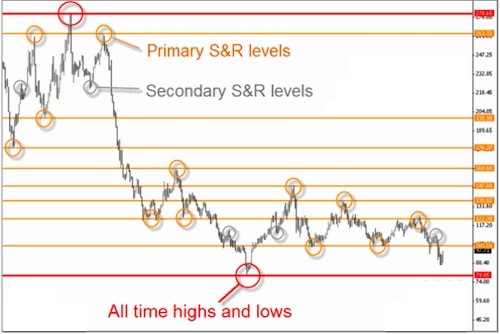
If someone told you that you could access a chart that shows the key price levels that prices are likely to run to or turn at … you’d be mad not to look at it.
Yet, so many traders fail to note key support and resistance levels on their charts. These are HUGE glaring clues about what the price could do in the future – they are the closest you can get to a crystal ball about what the market will do!
All you need to do is check for major support and resistance levels – quickly note them down on your chart, and you’ll automatically be making better decisions in your trades.
6 • Don’t be so predictable with your stop losses
Where shall I put my stop loss? I know, just behind that previous support level – that’s smart.
No one will ever find it there.
And then we wonder why our stops are caught out by big market players.
Again and again, we put our stop losses right around the levels that are magnets for price action.
Try managing risk in a different way – with wider stops, smaller stakes, and more winning trades.
7 • Use a drawdown limit
Don’t keep throwing your money at the market on a bad day. Whatever your trading strategy, there will be times when market behaviour just doesn’t suit it.
Set yourself a daily, weekly and monthly limit on how much you will lose – once you’ve taken that loss, stop trading.
8 • Be a broker tart
It’s easy to get ‘comfortable’ with a broker, but check the costs you’re paying. If another broker is offering the same market, but their spread is 1 point less – try using them instead.
If you’re trading with a 20 point profit target, and are paying out 1 point more than you have to – that’s giving up 5% of your profits. Can you afford to do that?
Shop around for the best deals. Most modern platforms are very simple and intuitive to use – there are all incredibly similar, so it should take long to get the hang of using a different one. I have a range of accounts …Core Spreads … Capital Spreads … ETX … IG … that I’ll happily flip between, according to what’s best for a particular strategy I’m following.
9 • Go easy on your indicators
Don’t waste time searching for the ‘perfect’ trading indicator – it doesn’t exist.
All indicators will let you down some of the time, which is why monitoring results and looking to make subtle adjustments on your trade parameters is how you make an indicator work for you.
10 • Don’t ignore round numbers
Interesting things happen to prices around round numbers. If you ignore this, it could cost you money. If you take advantage of it – it can make you money! If you’d like to find out how, check out these posts.
11 • Compound, compound, compound
You can’t make serious money from the markets without tapping into this nuclear-powered trading tool.
There are different ways to compound. If you compound after every trade, it will have the most powerful effect. However, it’s perfectly valid to compound on an annual basis – or you can keep some of your profits aside to tap into if you have a losing run.
12 • Be realistic
The very best advice I can give to any trader is to be realistic about what you can achieve.
It would be great if we discovered a trading method than never lost – or one that could double our money every month. But real wealth is built by plug, plug, plugging away at the markets, managing our risks, being sensible with our stakes, and compounding our winnings.
Take a look at the kind of returns the best hedge fund managers are achieving (say 30% per year) …
Sure, that may not pay off the mortgage in time for Christmas, but keep working on it, and it could do in the space of a few years.
So much of trading success comes down to taking it slowly – don’t rush into trades. Instead, by waiting for them to come to you, you’ll have a higher success rate, you’ll take less risks with your money … and you’ll have a much longer and more profitable trading career.
To enjoy more content and get it faster
Save
Save









6 comments
peter rogers
Peter here again , sorry I didn`t sign off properly . I`m not too good at this
Very best wishes
Peter
peter rogers
Hi Mark
Please Please Please tell me How an engulfing pattern can occur when candlesticks close and open again
at the same time on forex.
You have enlightened me about so many different aspects of forex , but never discussed this seeming
anomoly .
Traders Bulletin
Hi Peter
Apologies for the delay in getting back to you – your comment didn’t seem to register at first.
I think this is a good example of where ‘text book’ cases cause confusion when applying them in the real world! It does happen fairly often that the open price on a candle is different to the close price on the previous one – just because of how prices are moving and how the broker’s data feed records that. However, when I’m looking for an engulfing candle, I don’t tend to make this a requirement.
So, for example, if we have a red candle, followed by a green candle, if the second candlestick opens at the same price as the previous candlestick closed, but then goes on close above the open price of the previous candlestick – I would classify this as engulfing. I’m sure there are people out there who would disagree with me on this! But I hope that helps clarify.
Paul
Nice one Mark ! Simple rules are the best.
Roy
Many thanks.
I have printed this, and stuck it on the screen.
I guess most of us are familiar with these excellent points, but how many do as they suggest.
A timely boot up the Jacksie.
Roy.
Colin Steele-Perkins
Superb advise both in text and visual charts.
I must let the trades come to me instead of the other way round.