November 22, 2013by Mark Rose- 0 comments
A death cross on the fear index and other terrifying signals
Short of having a Texas Chain Saw Massacre on the S&P … or a Night of the Living Dead on Wall Street … indicators don’t get much more scary sounding than a “death cross on the fear index”. Unless, of course, you threw a ‘triple witching day’ (yes, they really do have those) in for good measure.
So, what is a death cross on the fear index? And what does it mean?
A death cross is when the 50-day moving average drops below the 200-day moving average. It’s a seriously bearish signal, and is normally followed by some equally serious selling.
It does have a flipside: the golden cross, which occurs when the 50-day moving average rises above the 200-day moving average. This is a bullish signal.
So, that’s the death cross. What about the fear index.
It’s been a while since we looked at the fear index in Trader’s Bulletin, so here’s a quick recap.
4 things you need to know about the fear index
1 • The real name of the ‘fear index’ is the CBOE Market Volatility Index, or VIX for short.
2 • The VIX is a figure calculated from a blend of prices for options on the S&P – but effectively, it’s a measure of investor confidence in the S&P in particular, and equity markets in general.
3 • The VIX usually has an inverse relationship with the market. The VIX goes up as stocks decline; the VIX declines as stocks go up. A low VIX means that traders are confident about market conditions. A high VIX means that they are fearful.
4 • The VIX can be used to predict market behaviour over the coming 30 days.
Okay, so now that you’re up to speed on death crosses, and the VIX. Here’s the current picture …
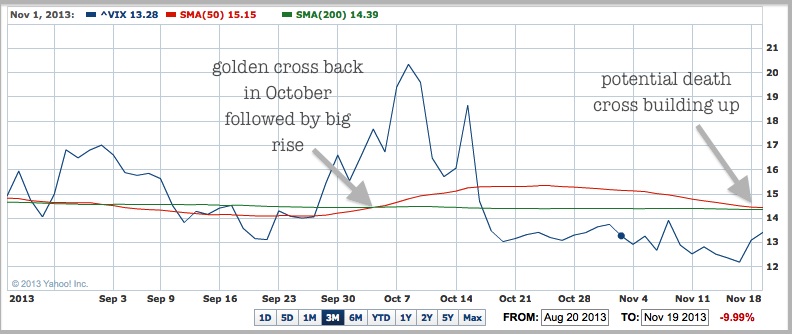
An impending death cross on the VIX could suggest that the index is due another dip.
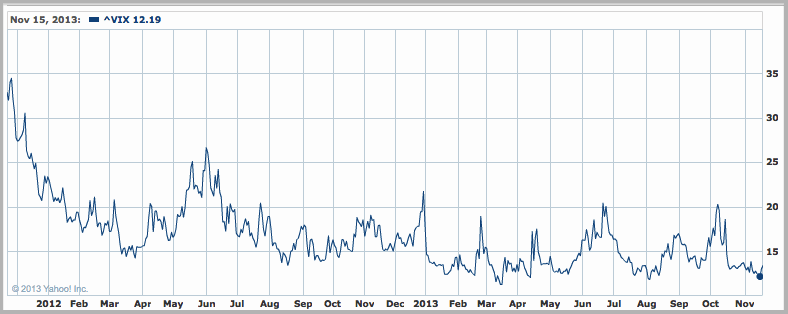
However, a look at the longer-term chart shows that it’s already close to the bottom of its range, so doesn’t have much further to fall …
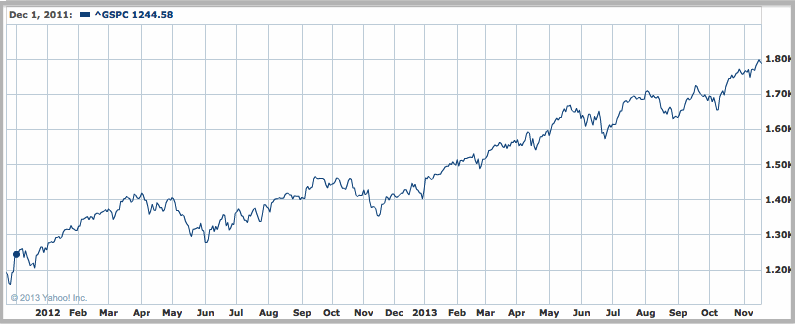
Compare this with the S&P over the same period, and we see that low VIX readings tend to coincide with market tops – and a subsequent decline.
The question is … will we get a death cross on the VIX?
If we do, then the VIX could have further to fall (and indices further to rise).
But if the VIX manages to avoid the impending death cross, and manages to break it’s ceilings around the 14 level, we could see the S&P selling off, or at least pausing to catch its breath.