April 2, 2015by Mark Rose- 8 comments
Lessons from the Las Vegas strip

There are many different approaches to trading … perhaps you spend a lot of time checking up on the fundamentals, reading the financial press and company reports … perhaps you study technical analysis late into the night …
The cleverer we get with our trading, the more likely we are to forget one key fact – successful trading is about playing the probabilities.
The concept of playing the probabilities, or the odds, is one that sits uncomfortably with some traders – they feel that it makes them sound like gamblers.
In fact, it couldn’t be further from the truth.
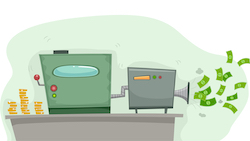
If you have a firm grasp on the odds, you’re not the gambler – you’re the casino.
Las Vegas casinos make their money by maintaining an edge of around 4.5%. That means that out of every dollar that is brought into the casino, 4.5 cents stay there. Some people win big, some people lose their shirts, but on average, the casino makes 4.5%.
The casinos aren’t gambling – they are playing the odds.
They don’t care if someone hits the jackpot on a slot-machine. As long as people are coming in through the door – they’ll keep taking their 4.5%.
So, how do you apply this to your own trading?
You can’t read the future
However good your fundamental knowledge is, or how much you’ve studied your charts – you cannot know what the market is going to do next.
What you can do, however, is judge the likelihood of what the market will do next, and position your trades accordingly.
The market doesn’t care what you “think” – it’ll go ahead and do what it likes.
But if you’ve played your probabilities correctly – the outcome should be in your favour over the long-term.
Successful traders know how to exploit the probabilities of the markets, with the knowledge that in the long-term, they’ll come out on top.
Unsuccessful traders want to “win” every trade, and as a consequence end up chasing their tails.
Stabbing in the dark
The great thing about trading is that we’re not expected to get it right every time.
If we had to put all our money on predicting the outcome of one trade – we’d be screwed.
Instead, we don’t have to make predictions. It doesn’t matter what the outcome of the next trade is … nor the one after that.
Provided we’ve got our probabilities right.
Playing the probabilities will ensure you get it right more often that trying to predict the outcome of individual events.
Stop trying to get it right
Trading requires exactly the same approach.
We need to find the way that will tip the odds in our favour. They don’t have to be far in our favour – just enough to give us that edge that will bring in a profit.
Once we know that the probabilities are on our side, all that remains is to repeat … repeat … repeat …
We need to stop worrying about what will happen “this time”. If you’ve found your edge – it really doesn’t matter if you win or lose “this” trade or “that” trade.
As traders, most of us strive to learn as much about the process as we can. But the more we delve into the process of finding successful trading signals, the easier it is to lose track of long-term probabilities.
Long-term probabilities are all that matter in your trading. Provided they are in your favour – you’ll always be ahead of the game.
Much of my trading life, I’ve endeavoured to find technical signals that will give me a more significant edge, and bigger profits, but the best edge isn’t huge – it’s consistent.
That’s how casinos know they’ll have a steady income to pay the wages – and why they hate anything that could make a dent in that edge.
For traders, it means that we need to stop making predictions, but start playing the odds – be the casino, not the gambler.
To enjoy more content and get it faster
Save








8 comments
Darin
Hi Mark, One again a great, and for me very timely article.
I am currently using Steve Copans Pivot Trader (see comments on the review page) and its been going well, well enough I think for me to cautiously say I’ve found ‘an edge’ using a strategy that suits me. and my lifestyle.
In seeking to maintain my edge over the longer term and reduce short term risk (due to annoying FOMC price spikes), I am looking at spreading my trading across a greater range of tradeable instruments (FX/Indices/commodities), as the strategy allows for this.
In your experience is it a good idea to do this to maintain an edge and improve consistency of profits? I’d appreciate any thoughts you may have on the matter. Thanks. Darin
Mark Rose
Apologies for slow response (I’ve been away on holiday). It’s fine to spread your trading across more instruments, as long as you’re mindful of correlation – you could be effectively placing the same trade two or three times over, which could seriously skew your risk profile.
Darin
Ok Thanks Mark, yes I think that’s what happened when I first used it on all major/minor pairs.
Clive
Darin – been using Pivot Trader too with mixed results, would love to compare results, instruments traded etc
Best wishes
Clive
Darin
Hi Clive, Just a quick response. I’d be happy to exchange info/views on this. I’ll put the info on the review page soon.
David Mitcher
interesting thought
Denis
Hi Mark,What is the edge?.
Mark Rose
Hi Denis, sorry for the delay in replying. A good way to measure your ‘edge’ over the market is to calculate your positive expectancy. This is such an important (and often ignored) aspect of trading. You can find all the info you need to know in this 3-part posting on risk, reward, probability and positive expectancy here: https://www.tradersbulletin.co.uk/category/trading-words-you-need-to-know