December 12, 2014by Mark Rose- 2 comments
3 ways to protect your trades that you may not have tried before
The comfort blanket that most traders reach for when looking to protect their trades is a stop loss. But, as Bulletin readers will know, the stop loss is a very blunt instrument.
So, it’s worth exploring other options …
1. Trailing stops
Trailing stops really sound like such a fantastic idea.
A dynamic stop level, that follows the price as you move into profit, locking in those gains as you go – what more could we want?
This is how they work …
A trailing stop is a dynamic stop loss level that reacts to the price of the instrument you’re trading.
Let’s say that you’ve bought the FTSE at 6400, and put your stop in 20 points below at 6380.
Now, let’s say that the price moves up to 6480, bringing you 80 points into profit.
If your stop loss is a trailing stop, it will move up with the price – so your new stop loss level will now be 80 points higher, at 5460.
(On some platforms, you can set the increments a trailing stop moves in – i.e. it will only jump up after a 10 or 20 pip move.)
That way, even if the price turns against you, you’ve locked in 60 points profit. 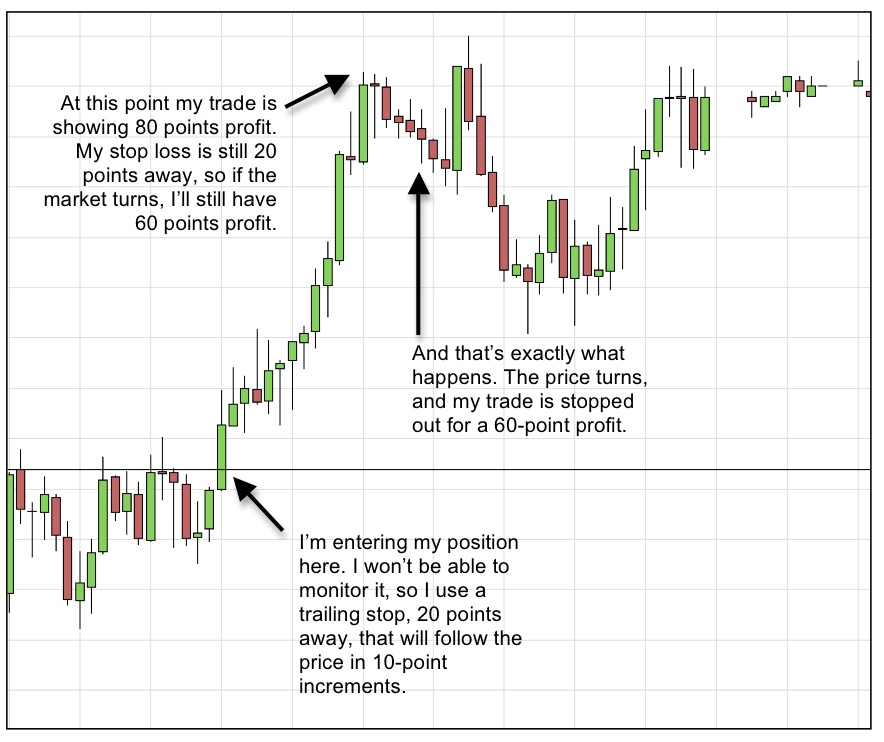
A trailing stop can help us to take advantage of a big move, even if we can’t be around all day watching our screens.
It can also help to protect us from a sudden news story causing the market to turn tail …
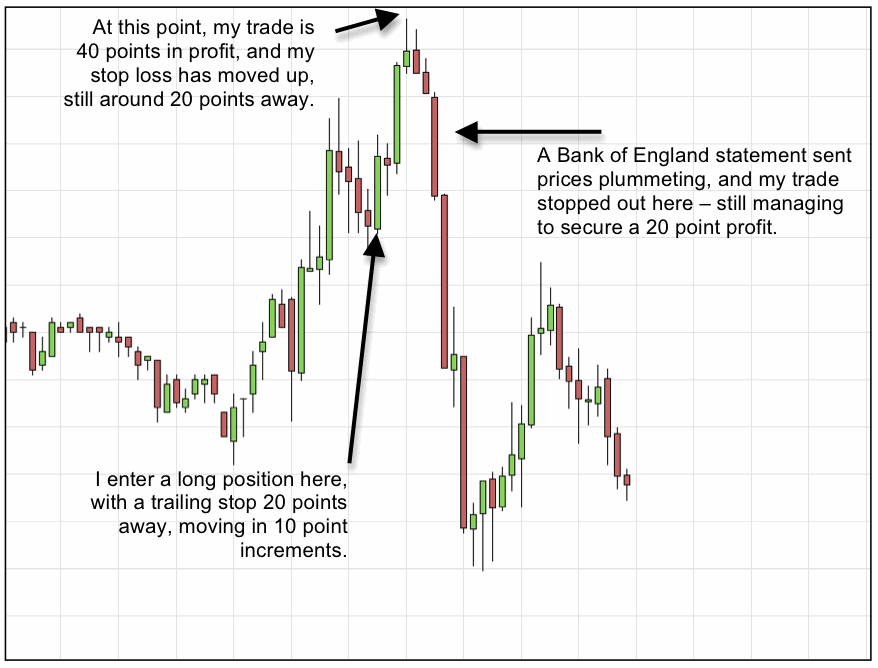
Here, a normal stop loss would have left us out of pocket, but with a trailing stop, we’ve managed to pull in a small profit from a bad situation.
But there’s a problem with trailing stops …
Don’t get me wrong … I love the idea of trailing stops. I’ve used them again and again in strategies. However, every time I apply them – I end up making less money.
So, what am I doing wrong?
The problem is that big, unusual market moves (the kind that gives you 3x the profit you expected on a trade) don’t actually come along very often.
Fortunes are made in lots of small packages –not with big, market-moving hand-outs. If you trade a strategy that is designed to take very small, but reliable profits, then a trailing stop can help you to push those.
But we shouldn’t use trailing stops just to catch the occasional big move – they are just too … ‘occassional’.
2. Binary betting
Many people like binary betting because you know exactly how much you can win or lose. Either you’ll win the full amount, or you’ll lose your original stake (no more).
It gives traders a greater sense of security than other types of trading. However, too often with binary bets, you’re only going to see a return on that stake of between 25 and 35 per cent.
Binaries work something like this …
With binary options, you place a “bet” on a particular price outcome – such as the price will be above by X level, by a certain time. It’s a bit like betting on a horse to win a race … if you’re right – you win … if you get it wrong – you lose your stake (there’s no risk of losing more than your initial stake).
And (this is the best bit) if the market swings wildly in the meantime, your trade won’t get stopped out. There’s no such thing as a stop loss in binary bets – you don’t need one, because you can’t lose more than your initial stake.
But the complaint I have with binary betting is the opposite to the one I had with trailing stops – that your upside
is limited – whereas in spread betting, if you get it right, you can get
it VERY right.
3. Arbitrage
Arbitrage is the fancy-sounding name for buying an item from one market, and selling it to another market at a different price. Let’s say that you buy old records from car-boot sales and sell them at a mark-up on eBay – that’s arbitrage.
Sports arbitrage is the same idea, but in this case, you’re finding two bookmakers with different prices, rather than the car-boot sale and eBay.
What financial arbitrage does is it takes advantage of opportunities to trade what’s essentially the same asset in different ways.
For example, they’ll be looking for price differences between share prices and futures prices, or options, where the arbitrageur shorts the more expensive one and buys the cheaper one – profiting from the difference.
If you’re thinking “that’s all great for hedge funds, but what does this have to do with me?” I don’t blame you.
I used to think that arbitrage was just for the big boys.
However, I’m starting to realize that you don’t need to be as greedy or as powerful as Gordon Gekko to use arbitrage.
And nor do you need to spend any time at car-boot sales.
What can go wrong with arbitrage
The reason that financial arbitrage has tended to be the preserve of big players is that:
a) you need a lot of research to find these opportunities …
b) the price differences we’re talking about are usually very small, so you need big money to be able to make it work …
and c) you need to be confident that you’ll be able to buy and sell at the moment you want to, which means access to high-speed dealing.
The great thing about the opening up of differential markets on our spread-bet platrforms, is that we ordinary mortals can now use arbitrage on a small scale, and at just one click of a button. It’s been my preferred way to trade for some time now – although I still haven’t given up on the good, old-fashioned stop loss too!
To enjoy more content and get it faster







2 comments
ROSEMARY
Pls give examples of a live arbitrage trade. ie is it buy ftse on one platform and sell ftse on another platform?.
Mark Rose
Sorry for the delay in answering this query – I must have missed it. An example would be buying Brent crude yesterday, and selling US light at the same time. The correlation between the two shifted, enabling us to close a profit. I can’t take credit for this – it is essentially the trade taken by Diff Code Oil on Monday, but because of the way Martin does this, it’s all managed within a single trade.
Pure arbitrage, where you’re buying and selling exactly the same thing is rarer – it’s difficult to find disparities like this. In a bear market, many traders will sell the FTSE as a cheaper way to hedge stocks they own (this saves them paying transaction charges on selling and then re-buying stocks).