February 17, 2012by Mark Rose- 2 comments
Ver carbon credits review update
I’ve been looking into my crystal ball again (yep, that’s me channeling this season’s “gypsy look”).
And it’s been giving me some interesting feedback on the commodities markets in general … and in particular, about a certain “new commodity” that I was raving about towards the end of last year.
Back then, I was forecasting this to be the next big boom. And I’m not about to change my mind.
If you got in then, then this is just the kind of confirmation you’ll have been hoping for.
And if you didn’t, fear not – it’s still early enough in this story to get on board.
In a moment I’ll explain exactly how you can get involved, plus give you a free report covering all the facts you need to know about this boom commodity.
But first I want to get back to my crystal ball, and just how reliable it really is …
What I’m talking about is the futures market, which is essentially the market’s prediction for what a price will be at a set time in the future.
Understanding the basics of the futures market
Futures trading began as a way for farmers to get a fair deal.
Let’s say that a farmer was producing wheat. Rather than just turn up at market come harvest time and try to find a buyer, he’d form a contract with the dealer for a certain quantity on a certain date, for a fixed price.
The futures market was born.
Over the years, the futures market grew from just a handful of farm products to include a vast number of tradable commodities, plus instruments like indices, stocks and currencies.
And in this way, investors began to use these futures markets to speculate on the price of these instruments and commodities going up or down in the future.
So, the price of a futures contract will be slightly different to the “spot” price – which is the “here and now” price.
If the market sentiment is that the price is going to go up – then the futures price will be higher. And conversely, if the sentiment is that the price will go down, the futures price will be lower than the spot price.
Some of the higher price in a futures contract is to do with factors other than predicted price rises … storage, for example, in the case of something like gold … or risk, such as weather and political events, in the case of things like cotton or oil …
What the futures market makes of my predictions
So, now let’s take a look at what the futures markets are currently predicting …
First off, we have Dow futures prices, which show the March 2012 levels at 12867, and the December 2012 levels significantly lower, at 12649.
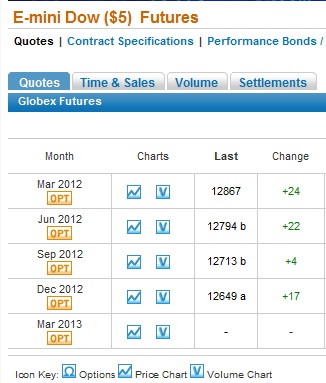
This tells us that the markets are predicting the Dow Jones index to end the year lower than current levels.
Of course, the futures markets can’t really see into the future – they don’t have any extra information about the markets that we don’t have right now. But, they do tell us what analysts are predicting – they may be right, they may not. But it’s the “expert” opinion.
Now, let’s look at the futures price for a “commodity” that’s been getting a few Trader’s Bulletin members (me included) quite excited recently … carbon credits …

As you can see, the February price is 8.12, while the December 2012 price is 8.34, and goes up to 8.72 in June 2012.
For those of us who are already invested in carbon credits, this is great news.
Especially when you consider that we don’t have to pay for anyone to keep our carbon credits safely in their vault until next June (like you do with gold futures) … and bad weather can’t destroy our carbon credit crop!
It may not be a crystal ball – but it can be a real eye-opener.
These prices give us direct information about investors’ expectations about the future price of carbon credits.
And in a moment I’ll explain exactly how you can take advantage of this potential bull market.
But first it’s a good idea to gather some information on the fundamentals behind the story …
How politicians and big business can affect the price
Governments, institutional investors, hedge funds and major corporations are all part of this story. And barely a month goes by without news of them ratcheting up their levels of involvement.
At the end of last month the UK government released plans for continued support of the carbon price to £16 in 2013 and £30 in 2020. Read the full article here
And this month, Barclays Plc and Jaguar Land Rover were part of the largest ever single delivery of VER carbon credits, snapping them up at 11 euros (£9.21) a metric tonne. Read the article
If you’re already invested in carbon credits, then I expect you’re rubbing your hands in glee as this story gathers pace.
However, if you’re new to this market, there are some important things you should know about it …
The best way to get exposure to this market
With all new markets, the tricky thing is working out the best way to “get in”.
You want to make sure you get the best prices … and the type of investment that best suits your needs. (For example, VER carbon credits can be added to a SIPP as a way to diversify your pension portfolio.)
Which is why I’ve been on the case of the team at VER Carbon Trading to negotiate the best entry prices for Trader’s Bulletin members on these products. Through this company, I’ve been able to secure a significant discount on the cost of carbon credits for any Trader’s Bulletin member. (To qualify for this discount, please use the code at the foot of this email.)
I’ve also asked them to put together a special up-to-date report for Trader’s Bulletin members.
Click here to download the full report
This is a very exciting opportunity to get in early on a hot trading story, while prices are still low. This is a longer-term investment than we usually look at in Trader’s Bulletin, but it’s hard to see any other investment with this potential for growth in the current economic climate. Which is why I recommend that you download this free report, so you’re armed with all the facts. Click here
Once you’ve had a chance to look through this, please watch out for my email on Monday, with details of a Q&A webinar on VER carbon credits being run next week.
Regards,
Mark Rose
P.S. Just a quick word about the company supplying these credits … VER Carbon Trading use only UK FSA registered counter parties to execute any trades. All their credits are VCS registered (there are a few bodies out there who validate these carbon credits, and this is one of the big ones).
Please remember that they are also offering a substantial discount to Trader’s Bulletin members. To access this, you simply need to quote this code in any correspondence: VERTHAMES.







2 comments
SUDHINDRA KUMAR
Very usefull insight.
Mark Rose
Thanks for the feedback. Will try to keep them coming! Mark