July 14, 2017by Mark Rose- 5 comments
Day Trading VS Night Trading
Remember when everyone was day trading?
More and more short-term traders are rejecting day trading in favour of night trading.
But why?
Many of us were first drawn to the markets by the thrill of day trading.
Day trading is a million miles away from the traditional ‘value investor’, who buys and holds shares. Day traders are in and out of their positions in a matter of hours, making large profits on tiny price moves, and closing up at the end of the day, ready to go again when the markets reopen.
This kind of short-term approach to investments has its benefits and its problems. The less time your money is in the market, the less time it’s at risk of crashes, or bad news stories. But day trades have to be ruthless – there’s little time for that natural ebb and flow of profits, of waiting for a position to come good. Either it’s hit its target, or it’s a loss.
Day traders tend to hunt down the high-volatility markets, looking for spikes of activity when they can make their biggest profits.
But, over the last few years, day traders have been waking up to a different type of trading. It’s hard to avoid the stats about how many day traders are failing to make a profit at all … and heads have been turned by a different breed of traders, who are doing a lot better …
The night traders.
Again and again, statistics are showing us that overnight traders are significantly more profitable than day traders.
And, with more and more automation, night trading is becoming a real possibility to those of us who can’t keep our eyes open much after 10pm!
Let’s look at some of the stats behind this. Here are charts put out by a major broker, showing the profitability of their traders according to the time of day they are trading, and which Forex pairs they’re following …


While there are some discrepancies between the stats, there is a clear sign of people making more money while both the European and US markets are asleep.
Isn’t Forex 24/7?
The Forex markets are often touted as the market that never sleeps – there’s always something going on, so you can nip and make profits at any time that suits you.
But what the results show is that individual Forex sessions – the New York session … the London session … the Asian session – behave in very different ways. AND product different levels of profitability.
When asked the question: “When’s the best time to trade Forex?”
The standard reply is that you should look for peak activity … like when the Asian and European sessions overlap, or when New York comes online, around lunchtime in London …
This chart shows the opening times of the markets, based on current British summer time, clearly showing those overlaps …

Compare these times to the periods when most traders are losing money, and it’s clear that peak activity does not equal peak profits.
In fact, the opposite is closer to the truth.
So, why are people making more money in overnight sessions?
What is it about the overnight trading sessions, when most US and European Forex traders are in their beds, that’s proving more profitable?
The things that attract many of us to the forex markets – the volatility and the liquidity – can also be our downfall. Just because volatility and liquidity are good things – doesn’t mean that we can’t have too much of them.
While longer term traders are often looking to ride trends, or pick up swings within those trends, the short-term trader is more likely to be trading ranges. And high volatility, along with bottomless liquidity, aren’t likely to help.
Overnight markets tend to have smaller ranges, and be more predictable, with minor spikes of activity as Asian and Australian markets come online. If you want a price that’s likely to stick within your carefully drawn support and resistance lines – then an overnight market is what you’re looking for.
What works in overnight markets …
So, overnight markets are more likely to be range-bound.
And the indicators that love range-bound markets are: oscillators.
Short-term overbought and oversold signals are significantly more likely to be accurate in overnight trading.
Here are results for trading a simple RSI overbought/oversold strategy. The light blue line opens trades at any time of day. The dark blue line will only open a trade after 7pm, and before 11am London time.
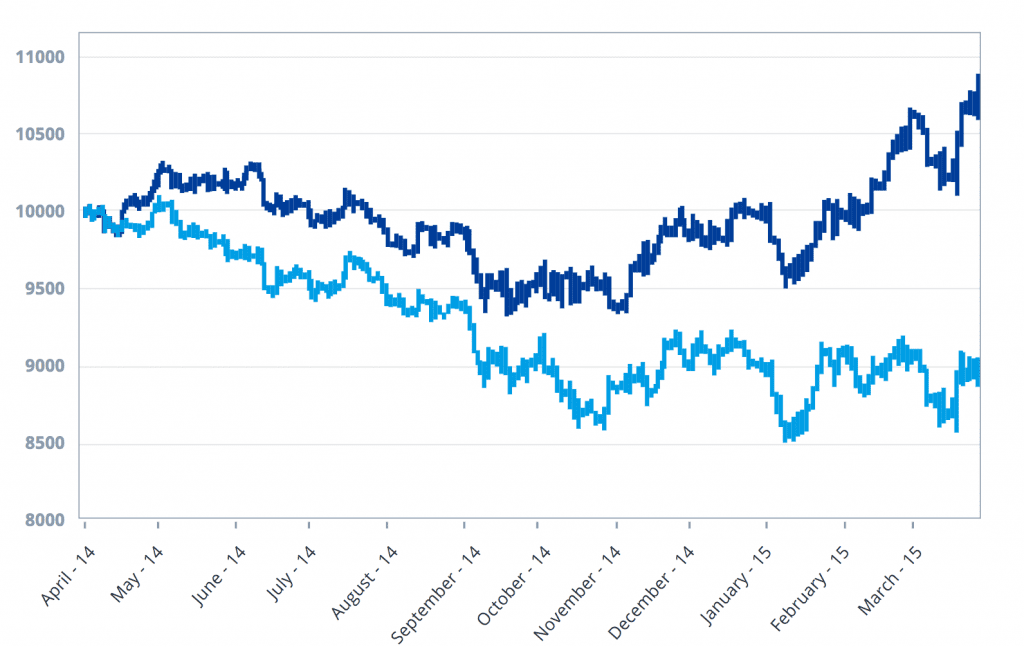
This doesn’t work neatly with all currency pairs, and the one to be most wary of is the Japanese Yen, which is the most volatile over the Asian session – and at the mercy of the Bank of Japan, so I’d watch for any overnight announcements from the BoJ.
How to profit from night trading, without missing any sleep.
For those of us who prefer to spend our nights asleep … there’s no reason that we can’t take advantage of overnight trading conditions, where prices can be more predictable and rewards higher, by using automated stops and targets.
I’m currently working on a piece of software that will actively manage clever little overnight trades for you (sometimes running on through the next day, too). Results so far are very positive, but there’s still some work to do on getting the automation running perfectly.
I hope to bring you more information very soon.
To enjoy more content and get it faster
Save








5 comments
Norah
Brilliant piece. Thanks.
Mark Rose
Thanks for the feedback – glad you found this helpful
Gary
Looking forward to hearing more about “How to profit from night trading, without missing any sleep”
Not able to take advantage of day trading systems at present. Hoping to see some info in the near future
Laurie
A good way to minimise the emotional side of things and I shall look forward to hearing about your new strategy! 🙂
Martyn Young
Sounds good to me Mark, looking forward to your next post