April 19, 2013by Mark Rose- 1 comment
This simple change turned 57% gains into 98%
I got a very interesting email from a Trader’s Bulletin member this week.
Just a quick note to ask if you set any rules for when to stop or alter the way you follow the systems that you review.
I’ve bought a number of systems from your publishing house. I like the fact that you openly review the systems on your site and publish the results warts and all as it were. I follow HAV and diff code oil and have recently signed up to the trial of diff code Europe …
So back to my initial question, for a system such as this; do you set any additional rules. For example; if we lose more than 2% of the trading pot for 2 consecutive months then I will stop trading or if we lose on 4 consecutive trading days then I will step back and monitor. Just not sure how you would advise approaching it. I appreciate that we have to accept the losses as graciously as we do the profits, but I should have thought that some rules to govern what level of losses would be considered … as abnormal ought to be clarified. Reducing stakes is difficult as I’m nearly always at or close to the minimum stake size ….
It’s a really pertinent question – a take on the age-old problem: “How can I be certain that my horse is dead if I haven’t flogged it?”
As traders, we will probably all have slightly different answers to it (as our pain thresholds will be different), but we should all have an ‘exit strategy’ for when things go wrong.
First off, let’s get something straight – unless you sprinkle your trades in fairy dust, and ride to market on a unicorn – your trading strategy will not win all the time.
Generally speaking, the higher the returns you’re seeking, the more volatile your results will be – i.e. the more ups and downs you’ll experience.
More often than not, a losing run causes traders to abandon a strategy. And our trading careers begin to look like a series of failed relationships, cast aside at the first sign of trouble, as we move onto the next one …
There are a couple of serious problems with this kind of trading …
First, we’re wasting our time and learning nothing from our failures.
Second, we’ll find ourselves lurching from one losing run to the next. If we give up on a strategy following a losing run, and then pick the next strategy because it’s having a good run … statistically, we’re likely to catch all the losing runs, and miss the winners.
So, what’s the answer? Should we carry on with a losing strategy, refusing to admit defeat, throwing good money after bad?
That’s no solution either.
What we need is a plan of action …
If we rely on our gut instinct to tell us when to cut and run – we are guaranteed to make a bad decision. We naturally remember the pain of losses more keenly that the joy of winners, and we tend to over estimate how much we’re going to make.
If you’ve made 2% return in a month – nothing’s broken.
If you’re standing still for a few months – again, nothing’s broken.
But, if you’re taking loses that are becoming uncomfortable, then action is required.
We need to identify our point of pain – so we can take measures to avoid reaching that point.
To do this, we use a drawdown limit.
This might be a limit to how much you can lose in a day … in a week … in a month … a year … or all four.
As an example, I’ll explain how I’ve used this in my daytrading …
By applying this very simple rule to my trading strategy, it meant that recorded returns over a six-month period leapt from 57.25 per cent to 97.75 per cent.
It’s an incredibly simple trick to apply, and I recommend you take a look at using it in your own trading.
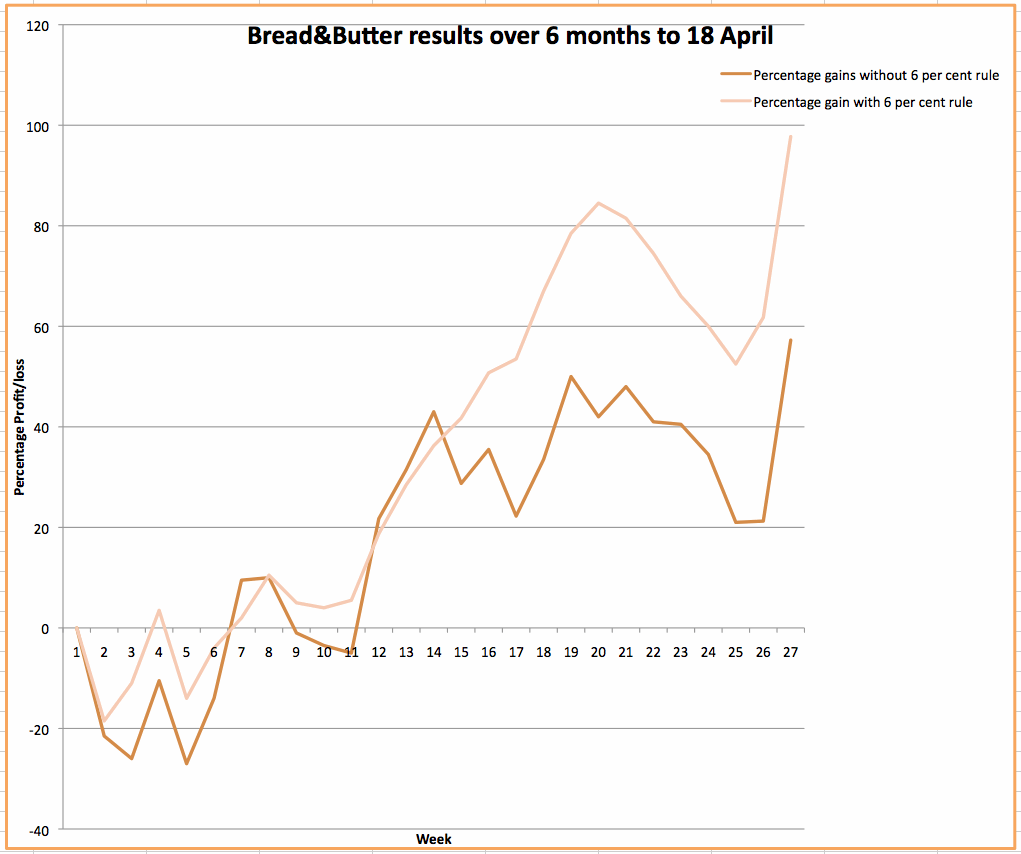
You can see it on the results chart below (the heavy orange line shows what results would have been without this rule applied; the lighter orange line shows what they become with the rule applied.)
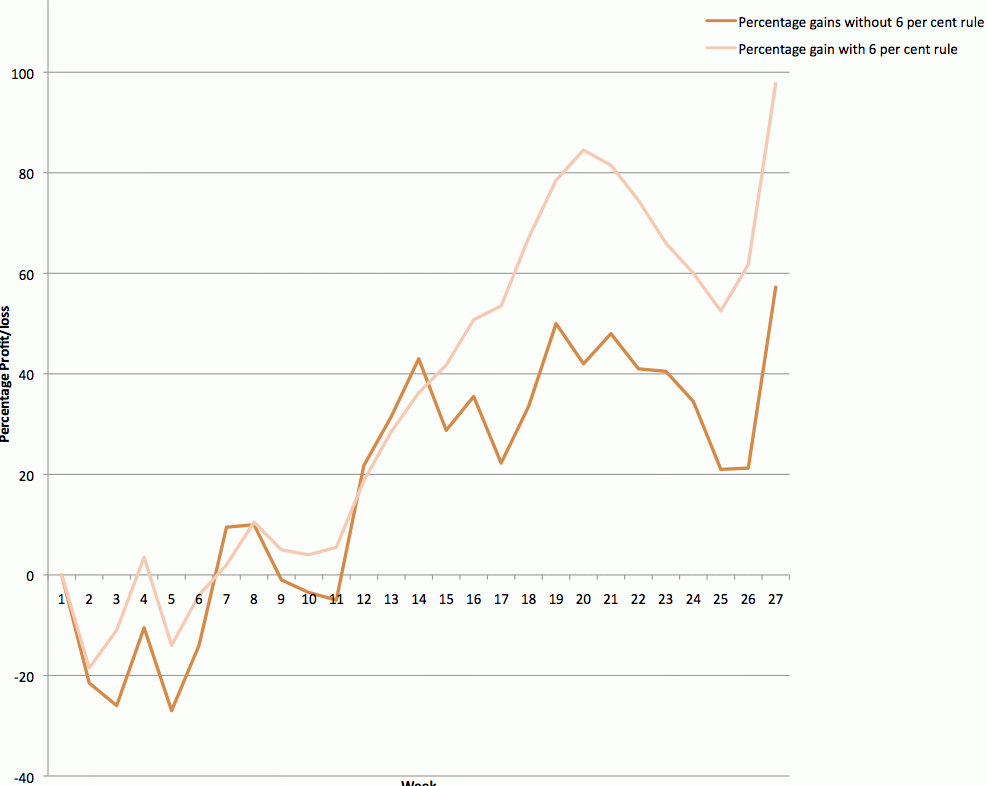
Of course, a 57% gain in 6 months isn’t bad, but I’m sure you’ll agree that 98% is going to give you a warmer glow! And, even better, this simple rule takes no time or effort to apply (in fact, it actually means that you’ll spend less time trading).
So, how does this magical rule work?
What I call “the 6 per cent rule” is nothing more complex than a daily drawdown limit. If my trading fund experiences a 6% drawdown in a day, then I’ll stop trading for the rest of the day.
When we’re having a bad day in the markets, it is natural (for most of us) to want to make back those losses. If we’ve had a couple of losses, we feel that the market “owes us” a winner … or that by probability, we must be due a winner … then we hit a third losing trade, and we’re even more convinced that a winner will be along next …
Does that sound familiar?
Unfortunately, the market has absolutely no concept of what’s fair … or what your carefully calculated probabilities reckon should happen …
The market doesn’t give a damn about you or me. It just does its own thing.
And, chances are that if we’ve had a few losing trades in a row, then rather than being “due” a winner, in my experience, we’re more likely to get another loss. Why? Well, because some external factor at that time has caused the market to behave in a way that simply doesn’t suit our strategy. For example, if some piece of news sends the market into a very strong trend for a day or two, our signals struggle to keep pace, and I get a high percentage of false signals.
And these are exactly the kinds of days when my 6 per cent rule saves my neck – and prevents me from giving back the substantial profits I’ve built up on the good days.
So, on a good trading day, I might grow my trading fund by 5% … or 10% … or even 22% …
But, by contrast, a bad day can never be worse than 6% (except in a few cases where some slippage takes us over this, or if overlapping trades means that I creep over the 6% limit).
Of course, there will be days when the 6% rule works against me – days when I’m 6% down, but could have earned back those losses by carrying on trading. But the chart at the top of this email speaks for itself – clearly getting out of the market when the going gets tough is working to my advantage.
Managing drawdowns is a very important part of trading.
A nasty loss is not only tough to come back from in financial terms, but it also knocks us psychologically, and puts many people off trading altogether.
Some kind of drawdown limit – be it daily, weekly, monthly, or a combination – is important to keep your trading on the straight and narrow. Drawdown limits give us protection from unusual market conditions, and also from ourselves when we get into a negative funk, and start “revenge trading”!
Many traders reject drawdown limits, because they worry that they’ll miss out on winning trades, but we should be looking for smoother equity curves, because (in the long run) they make us more money. If you want statistical proof of this, check out this post on what volatility does to compound returns.
So, what do we do when we hit our drawdown limit?
Your drawdown limit shouldn’t be set at your point of maximum pain – we don’t want to get that far. Instead, we’ll close down our trading when we’ve taken a set number of losses that week or month. But it’s important that we keep monitoring performance, even if we’re not live trading.
The next week (or month), we’ll put ourselves back into the market … if we hit our drawdown limit again, so be it. Trading this way will naturally give you more losing weeks or months than you would have otherwise (because you don’t give yourself the chance to make back profits) – however, it will avoid those big losses that are so difficult to come back from.
Again – it’s about smoothing out our equity curve.
Being an active non-trader
When taking losses, a successful trader will be looking for ways to eliminate those losses in future – ways to boost performance. I’m not talking about knee-jerk reactions, but instead about testing strategy enhancements that will boost performance.
If a strategy fails, it’s all too easy to throw it on the scrap heap and start afresh. But the best systems are ones that have grown and developed as market forces change.
Of course, sometimes the markets will change so remarkably that a trading method stops working altogether – but this doesn’t happen as often as we might think. It’s far more likely that a shift in volatility, or timing means that we need to either ride the storm, or adapt to a new normal.
Successful trading is a curious mix of being doggedly persistent, yet accepting that we can’t fight the markets – we have to adapt to it and work around it.
With that in mind – I’d urge you to check out the results that Martin Carter is achieving with his new Diff Code Europe system – 119% gains since July.








1 comment
Merv
Hi Mark,
Excellent topic, draw-down limits. I ALWAYS apply a draw-down on my daily / weekly trading, and on a few days am I pleased I do !! . For me, it’s all part of trading discipline. Have a defined plan, and trade your plan. In my view a draw-down limit should ALWAYS be part of your plan.
Regards,