The inside bar trading strategy I’d like to show you today requires a quick glance each morning and is all about the price being squeezed between two levels.
It’s highly
effective, and also rather lazy – cutting through the fuss of pattern
recognition to get to the bare bones of price action. Just keep reading to find
out exactly how to use this simple setup …
In my last post we looked at how to successfully identify a market trend. So this week, I want to show you a little price-action trick that’ll enable to perfect the moment to jump on board that trend.
What I like
about the inside bar strategy is that – rather than waiting around looking for
a pattern to form on shorter timeframes, you can just check once a day. Perfect
for energy-efficient trading!
The inside bar pattern
The inside
bar is a two-candle pattern, where the entire body and wicks of the second
candle fits within the high-low range of the previous bar (sometimes called the
‘mother bar’).
Inside bar patterns can vary wildly, as long as the second candle fits entirely within the first. Here are some examples …
Inside bars
are short-cut patterns, because they are an abbreviation of a more complex
pattern. If you’re seeing this on a daily chart, it means that on the hourly
chart, there’s a triangle pattern. If you’re seeing this on an hourly chart, it
means that on a 5 minute chart, there’s a triangle pattern.
It’s a
short-cut for a consolidation pattern that you can view in a longer timeframe –
meaning less chart watching.
Inside bar trading setup
The inside
bar pattern is a breakout setup, and the most successful way to play a breakout
strategy is within a trend.
So, let’s put the 3 moving averages onto our chart that I talked about in my last post. That’s the 15, 30 and 200 simple moving averages …
Here we
have the price below the 200SMA, with the 15SMA below the 30SMA – that’s our
cue to look for downtrend breakouts.
There are
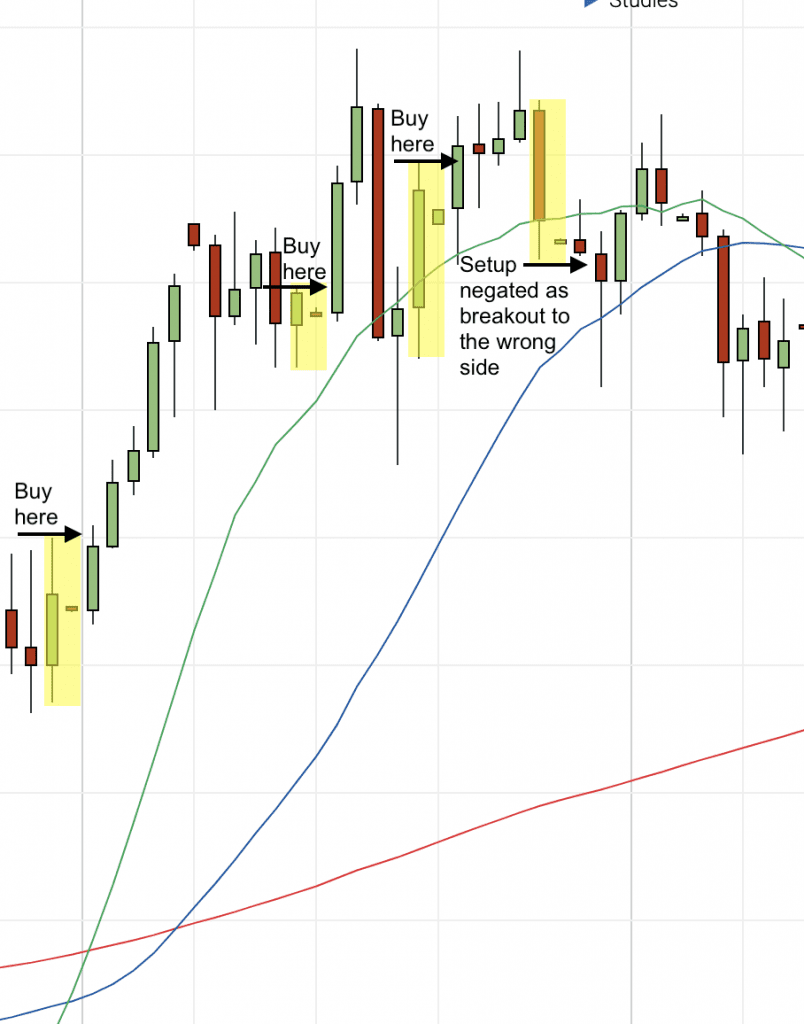
numerous inside bar trading opportunities on this chart. Once we’ve found an
inside bar setup, we’re looking to enter the market, in the direction of the
trend, when the price breaks through the range of the first (mother) bar. So,
in the case, we want to sell when the low of the first candle is breached.
If this was an uptrend, we’d want to buy, when the high of the first candle is breached …
Why inside bar trading is so powerful
I’d like to
take a look under the hood at the inside bar.
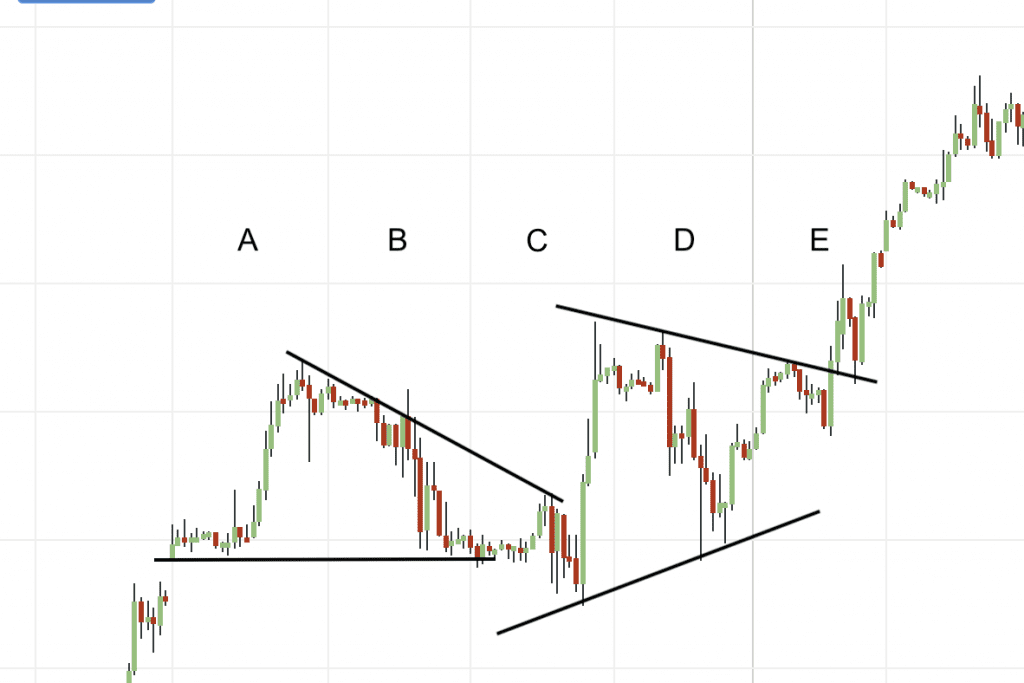
Here are two consecutive inside bar setups. The first fails to give us a trade entry. The second is successful …
On the chart below, we can see each daily price action (A–E) shown on an hourly chart …
The first
setup occurs on days A&B, so on day C, we’ll be looking to buy on the high
from day A. However, before the high can be reached, the low of day A is
breached and the signal has failed.
The next
setup comes two days later, with a new inside bar setup, with day C as the
mother bar, and day D as the inside bar. This time we get the breakout on day
E, and a successful trade.
The hourly
chart shows all this unfolding as two separate triangle consolidation
formations.
What the
inside bar setup does is remove all that complex analysis on the hourly chart,
and instead offer a dead simple setup that can be found just once a day. By
filtering out all this fluff and noise, we can see the real price action much
more clearly.
Inside bar trading tips
It’s best to trade inside bars on longer timeframes, like daily charts, where a consolidation is more significant.
If multiple inside bars stack up, it’s known as coiling. This is just a longer period of consolidation, and can be followed by a more powerful breakout.
Inside bars can offer good risk-reward setups because we have a clear stop level at the limit of the mother bar. However, beware of looking for 1:1 returns on a large mother candle, as the market may well not have the legs for it.
Give the price action some wriggle room by entering the breakout a few points beyond the extreme of the mother bar. Likewise, you can set your stop a few points beyond the other extreme of the bar.
If the price breaks in the wrong direction, be ruthless in cancelling this signal.
Don’t force an inside bar where there’s any ambiguity. If the high or low is equal to that of the mother bar, it doesn’t count as a true inside bar and we shouldn’t be risking our money on it.
It really is that simple! And the beauty is that these inside bars pop up regularly. I recommend that you have a go at spotting them on your charts, and see just how much money they could make you …