April 11, 2025by Mark Rose- 5 comments
How to hone your trading intuition into a razor-sharp tool

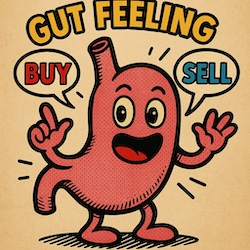
The idea of “going with your gut” should ring all the alarm bells and have all the red flags waving for a trader.
I often warn traders away from placing trades based on a “hunch” or a “gut feeling” – we need to be disciplined and logical. The mantra tells us not to get emotional … always stick to your rules … trade like a robot …
Mechanical trading
A lot of the time, I strive to be 100% mechanical in my trading. I have fixed rules, and I’ll stick with them, whatever my ‘gut’ is telling me. The reason for this is that I have members using these rules-based systems, and I know just how irritating it is when your strategy developer starts adding in after-the-event provisos … like ‘I didn’t take that trade because, blah, blah …’
I want to be accountable to members.
But when it comes to my own day trading methods, well, I can get a little flexible with the rules …
Listening to your hunches
Many of the world’s most successful investors put a huge amount of faith in their gut feeling … but I’m pretty confident that these highly knowledgeable, detail-focused individuals aren’t just blindly following hunches.
The notion of picking a trade according to a ‘feeling’ you have is just too vague – it’s akin to placing trades according to the movements of the planets, or holding a pendulum over the financial pages to choose a stock (apparently people really do do this!)
Instead, I want to look at exactly what this ‘gut feeling’ is – you may be surprised – often, it’s a lot more rational than you might think.
And I want to look at how you can hone your ‘hunches’ so they get it right more often, and test them to see how well they’re working (as you would with any other indicator).
“When you’re an investor, you can look at the quantitative and qualitative elements of an investment, but there’s a third aspect: what you feel in your gut.”
Kevin O’Leary
So, what is that nagging feeling in our gut trying to tell us?
Hunches might be telling us something that our regimental rules just can’t see in the markets – some nuance that we haven’t taken into account. So, perhaps we shouldn’t dismiss these hunches without understanding what they are – what feels like a hunch, can often have a lot of logic built into it.
The trick with hunches is that – according to a study at Rice University – it’s safe to trust your gut … as long as you’re an expert.
The study they ran showed that expertise vastly increased the accuracy of gut reactions. And that experts using their intuitions were around 20% more accurate than those using analysis alone.
Good hunches – the kind of hunches that are successful – don’t come out of thin air. Instead, they are based on years of experience at compiling information available and rationalizing that information. A good hunch also understands the things that you can’t know – the part of the story that is the risk.
And risk is always a part of any trading decision.
“Intuition does not come to an unprepared mind.”
Einstein
Many successful traders rely on this “gut” feeling. George Soros is one, “I rely a great deal on animal instincts. When I was actively running the fund, I suffered from backache. I used the onset of acute pain as a signal that there was something wrong with my portfolio. The backache did not tell me what was wrong, but it did prompt me to look for something amiss.”
Why do we need instincts in our trading?
Anything that’ll add to our trading edge is important, so if listening to our guts can boost performance – we should pay attention.
But intuition is also closely tied to the skill of rapid decision making, and relies on having all the facts laid out before us: that’s what the rules are, what data we do have, what data we don’t have, and what the risks are …
With these in front of us, fast, intuitive decision-making comes easier.
On the one extreme we have the trader who is too impulsive, doesn’t follow a strategy and relies solely on hunches to get him in and out of trades. This trader is emotional and allows fear and greed to lead his decisions.
At the other extreme is the trader who is logical, who analyses every trading decision, taking different factors into account … checking different timeframes … waiting for confirmation of signals … and ultimately dithering for so long that he’s missed the trading opportunity.
The ultimate state that we want to reach is where we can make rapid decisions that are based on the information we have available. These decisions may look and feel like “hunches” – but our hunches have data already “built in” to them.
So, how to we harness the power of intuition in trading without breaking our trade rules and ending up with something very wishy-washy?
My trick for testing my gut feelings is to score my trades as I place them.
I’ll give my trades a score out of 5 – this is based on my feeling about this trade. It could be about how good I think the set-up is … whether I feel the market is ‘right’ that day … a pattern I’ve spotted in another timeframe on that instrument … or any other gut feeling that doesn’t fit with any of my trading rules.
That way, when I come to track my performance, I can see whether the trades that scored a 5 did any better than those that didn’t.
Keep this up over the long term and you’ll probably see a pattern emerging – don’t get put off by the times you get it wrong – you will be wrong, a lot. But adding this intuitive level to your trading can tip the odds a little more into your favour, and anything that improves our edge (even by a fraction) can have a big impact on our profits.
And don’t let others tell you that your trading hunches are esoteric nonsense. Instead, they’re about genuine trading knowledge and experience, but the stuff that’s tricky to pin down into hard-and-fast rules.
I’d love to hear your experiences with intuitive trading – please share them in the comments section below.







5 comments
Tony
Hi Tim,
Sorry to have to tell you this, but I think you’ll find that “gotten” is actually a very old English word going back hundreds of years that generally fell out of use in this country (usually replaced by “got” – not an especially attractive word either) a couple of hundred years ago, but remained in use in America. There are quite a few such words that originated in this country, fell of favour here but remained in use in the US, that we now erroneously consider to be “Americanisms” eg “oftentimes”, “the fall” (for autumn), “furlough”,and “sidewalk”.
Incidently, we still use words such as forgotten, ill-gotten, begotten, and mis-begotten!
Tim
Please don’t use the word ‘gotten’ – it’s a hideous americanism which has no place in the english language.
Laurie
An interesting article as always Mark 🙂 Thank you.
I’ve always thought of this as a sort of strategy for advanced traders or for someone who has a natural gift for it.
Another one to consider then 🙂
Mark Rose
Hi Laurie, while it’s true (if ironic) that intuition works best if you’re an expert, we’re all building our knowledge all the time in the market, and get ‘gut feelings’ based on that wealth of experience. It would be a shame not to tap into it.
Davey
Great article Mark – really like to think that the nagging feeling I get in my gut when I trade is more than just wind!!! Am going to try your suggestion and see how my well my gut trades!!