May 23, 2014by Mark Rose- 0 comments
A simple precaution to stay safe in the summer markets
One hot weekend and we’re reminded that this is summer … and summer is the silly season not only for politicians and dodgy pop anthems, but also for investors …
The old adage goes ‘Sell in May and go away, don’t come back until St Leger day’.
The idea is that investors should sell their stocks and switch to cash investments, getting back into the market in autumn. St Leger’s day is actually the second Saturday in September, but the ‘wise money’ (if money that bases it’s investment plans on old rhymes can really be called ‘wise’) doesn’t get back in until the end of October.
The weird thing about this old wives tale is that there’s a lot of research that backs up the idea.
The stock market traditionally does better over the winter than over the summer. It’s one of the very few simplistic market-timing devices that actually appears to work.
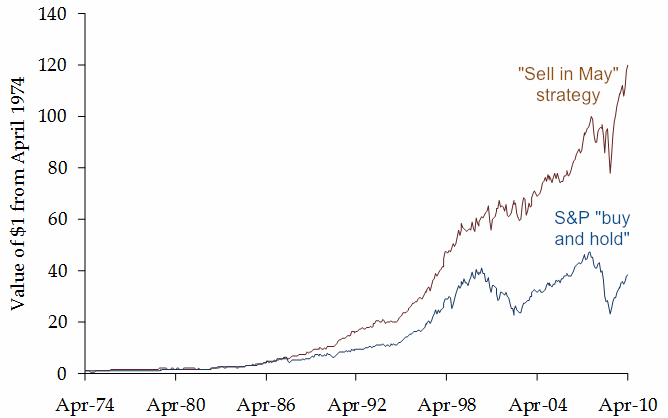
Most popular market indicators are thrown at traders with little or no statistical evidence to back them up. And that’s what makes the ‘sell in May’ different – this isn’t based on some anecdotal evidence. This isn’t even looking back over the past 20 years …
Its effect is significant over 317 years worth of back-testing!
A risk-reduction exercise
So, what does the rule tell us to do?
Dead simple, really: you hold shares, you should buy into the equity markets after Halloween, and get out of them at the end of April. In this way you take advantage of the market gains during the winter months, but substantially reduce your risk by being out of the market for 6 months of the year.
If you’re wondering what you’ll be missing out on in the summer months – the answer appears to be: “not much”. According to the 2005 edition of the Stock Trader’s Almanac, the six-month period beginning in November gained 10,599.68 Dow Jones Industrial Average points in 54 years. The remaining six months, from the beginning of May through the end of October, lost 588.44 points in the same period.
What 317 years of trading experience
can tell us
The first major scientific study into this effect was done back in 2002 at a New Zealand University by Ben Jacobsen. This found the effect to be strong in 36 out of 37 developed and emerging markets. And in 2012 Jacobsen published further evidence: looking at 317 years of results from the UK market – that’s basically the entire history of the UK equity market – he’s found that the winter months (November–April) consistently outperform the summer months (May–October).
Of course, it doesn’t work every year – notable exceptions are the oil embargo of 1973–74, the dot-com bust of 2000–01, and the financial crash of 2007–09 – no market signal can be right 100% of the time.
However, the longer the investment horizon, the stronger the indicator became: the Halloween indicator beat the market in 71% of all two-year periods since 1693; in 82% of all five-year periods; and in 92% of all 10-year periods.
The chart below shows end-of-period wealth (not including dividends) for the buy-and-hold strategy and the Halloween strategy (selling in May; buying back at Halloween) for the period of 1693 to 2009.
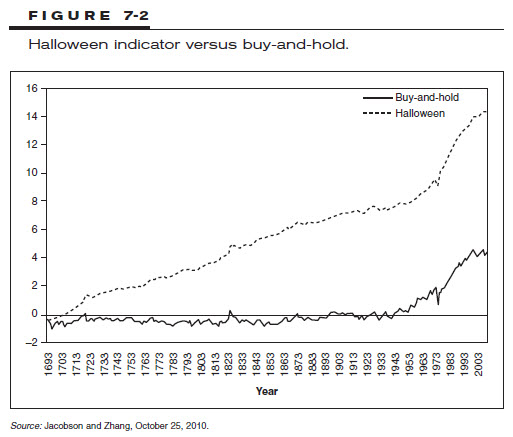
The contrast is impressive, but why does it work like this?
There are theories, but no one has come up with a definitive answer. Some people talk about the holiday season, and how fewer traders are around. As a result, volume is thin and so extreme movements are more likely.
This may explain volatility over the summer, but how could it explain falling values?
That may be seen in crowd behaviour: when shares are rising, we tend to see small daily rises over a long period; when they’re falling, we often see sharp one-day falls. And, it’s possible that when trading is thin on the ground, these sharp falls are steeper, and tend to escalate into more panicked selling.
Or it could be due to end-of-year bonuses, and first-quarter reports helping to lift stocks from November to April, while portfolio “housekeeping” subdues them May through October.
The problem may be in the data we have …
Alex Dumortier over at Motley Fool has kindly done some sums for us, going back 86 years on the S&P, and (importantly) has included dividend payouts and the relative return you’d have seen in cash.
The differences are less impressive that you might have expected: if you’d sold in May and bought back in October, you’d have made an average annual return of 8.4%. If you bought in May and sold in October, you’d have made 5.1% average return. And if you’d just bought and held – you’d have seen 10% return.
The crux of the matter is that we just don’t have the data to draw a conclusion on this.
Sure, 86 years is a long time – but it’s only 86 instances.
And the headline figures quoted in Ben Jacobsen’s study over 317 years of FTSE data don’t include dividends.
We could spend hours and hours crunching the numbers and looking for an optimum date to sell our stocks and a perfect date to get back in, but I’m not convinced that this would be time well spent.
There’s no doubt that the markets are more bullish over the winter than over the summer.
There’s also no doubt that buying and selling all your shares each year can be a costly exercise in commissions.
Here are three potential options, two of which allow us to use the “sell in May” principle without actually selling
1. We can take defensive spreadbetting positions in the market to ‘hedge’ the shares we own with a bet going the other way in the same sector.
This could be done by directly hedging your positions with a bet going the other way in the same sector.
2. Or it could be done by simply taking a more bearish approach to the market in your general trading.
Currently, equities are still showing a series of higher highs, with a positive trend, although there’s plenty of sideways activity – it could be setting up for another leg higher, or for a sell-off as buyers fail to get a significant boost into new territory. I’m not suggesting that there’s a price collapse coming to the equities market, but if we’re looking to take short positions on retracements, rather than long ones, then your shares will be naturally hedged.
3. If you do release your capital from the markets over the summer, I’ve got some excellent investment ideas coming up that won’t rely on which direction the overall markets are moving in. Please watch out for more information next week on the reduced-risk system that I mentioned at the top of my email today.