November 25, 2016by Mark Rose- 0 comments
The surprising truth about set and forget trading
Last weekend, my youngest decided to make a giant Crunchie bar. He’d seen how to do it on Youtube, and determinedly cooked up a diabetic feast of golden syrup, sugar and bicarbonate of soda. The bubbling potion was then left ‘fizzing’ on the side in the kitchen to set.
Cue … older brother walks by … sees a bubbling, sugary goo … and does what any sane 11-year-old would do … sticks in a spoon for a taste …
Immediately the entire honeycomb mixture collapsed flat, and he was caught red-handed (and sticky fingered) trying to hide the evidence.
The art of set and forget
Sometimes things need to be left to mature … and fiddling with them is the worst thing we can do. And that goes for trades as well as the non-crystalline structure of honeycomb.
Yet, at other times, a completely hands-off approach can leave us vulnerable in the market, when we should be acting to protect our funds and our profits.
How do we know when to fiddle … and when to set and forget?
The first question to ask if we want to work out whether our trades need ‘managing’ is … why are we interfering in our trades?
Generally, it’s likely to be one of the following concerns:
- Worries about losses getting bigger
- Worries about giving back profits
- Worries about upcoming news events or data announcements
- Taking on too much risk
- Trading in markets that are too volatile
All these are genuine, sensible concerns for anyone who has money sitting at risk in the market … and all can be addressed.
Taking on too much risk
If your trades are causing you stress, then it’s very likely that you are staking too large for your risk appetite. There is no fixed risk profile that you should be trading with – everyone has a different approach to risk, and a different appetite for it. If others are risking the 2% per trade, but you prefer to risk 1/2% – that’s fine.
Don’t try to cut risk by simply tightening stops. If the stops your strategy requires are too wide for your comfort, then perhaps it’s the wrong method for you, or perhaps you need to be trading on a smaller, less volatile market.
For example, you may be able to trade comfortably on Eurostoxx (which has a 45-point daily range) with a 50-point stop. But try the same strategy on Wall St (which has a 150-point daily range) – and you’ll very quickly get your stop knocked out by the natural scale and volatility of the market.
Smaller, less volatile markets allow us to trade with lower stop distances – and hence (if you’re trading with minimum stake sizes), you can keep your risk nice and small.
Upcoming news events or data announcements
Yes, life is short … but it’s not so short that we need to trade through the news. There will be other profitable opportunities out there, so we don’t need to take on the stress and the risk of highly volatile periods (unless, of course, you enjoy that kind of thing!)
Worries about giving back profits
In general, traders are guiltier of fiddling with their winning trades than their losing trades. Human nature leads us to “sit” on our losses – ever hopeful that they’ll come good. While open profits are just too tempting to snatch off the table.
My Heikin Ashi Mountain traders will be very familiar with this feeling – and I’ve mused on this dilemma at length with them. And I’ve come to accept that my strict “no touch” rules aren’t for everyone.
While it may mean that we end up with a smaller profit come year end, there’s a lot to be said for cashing in a profit of £500 as you go into the weekend!
AS LONG AS this doesn’t push you out of long-term profit, and over into a loss over the long term. The only way to monitor this is to track your results, and see where the best place to take profits is – both in terms of the bottom line, and your comfort levels.
Worries about losses getting out of hand
Traders in general are more prone to letting losses run than cutting them short, but it is important to give our trades room to breathe.
Knowing where to cut losses comes down to two important factors:
- What is the expected movement on this instrument? Is the pullback on my losing trade just part of normal play?
- Have events or price moves negated the signal that got me into this trade in the first place?
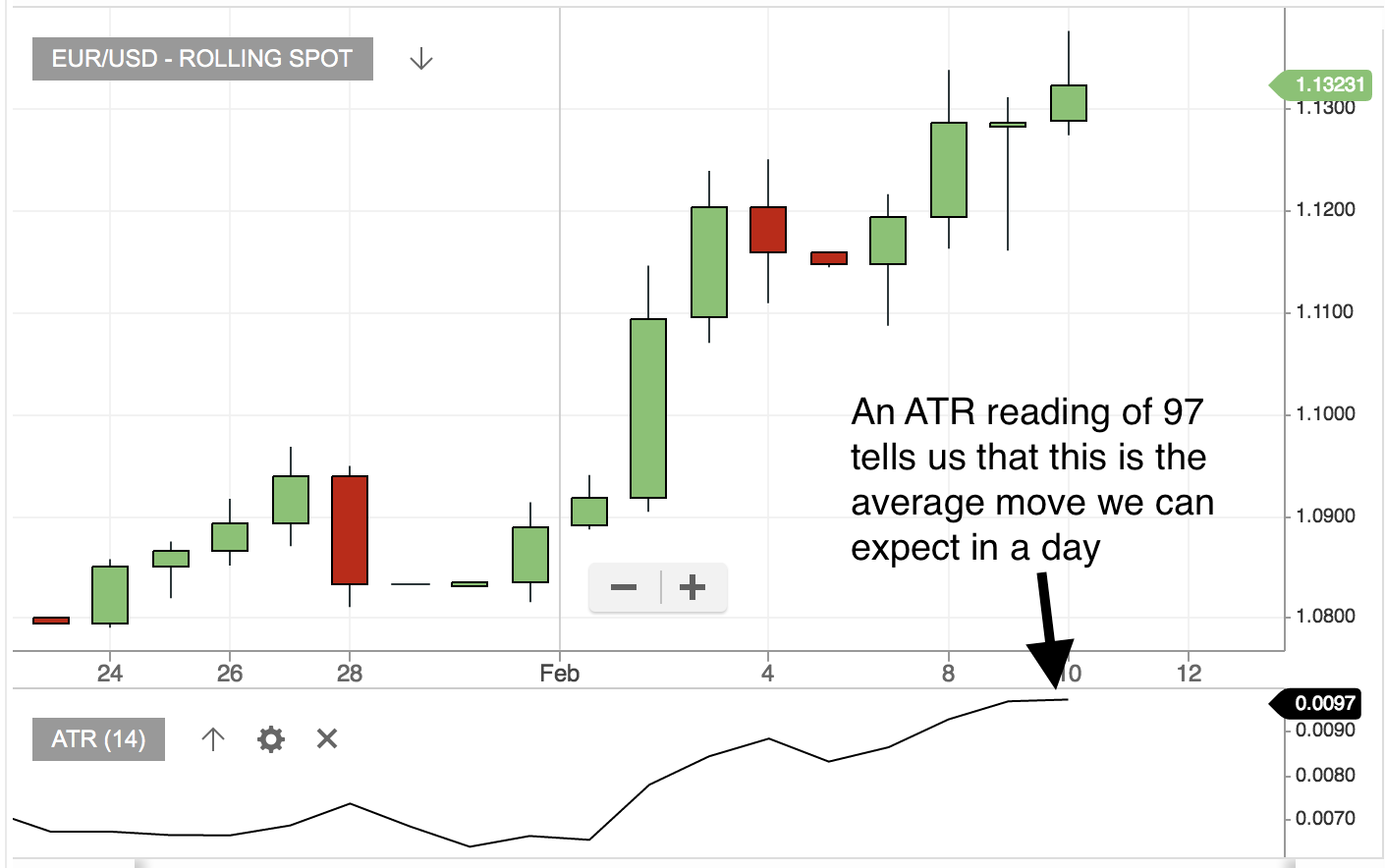
The first question can be answered by looking at the average range on that market. The easiest way to do this is to use the ATR indicator – this measures the average price range over a set number of candles (14 is the norm) …
Knowing what the ATR is for the daily chart of the instrument you’re trading is a very valuable little gem of information!
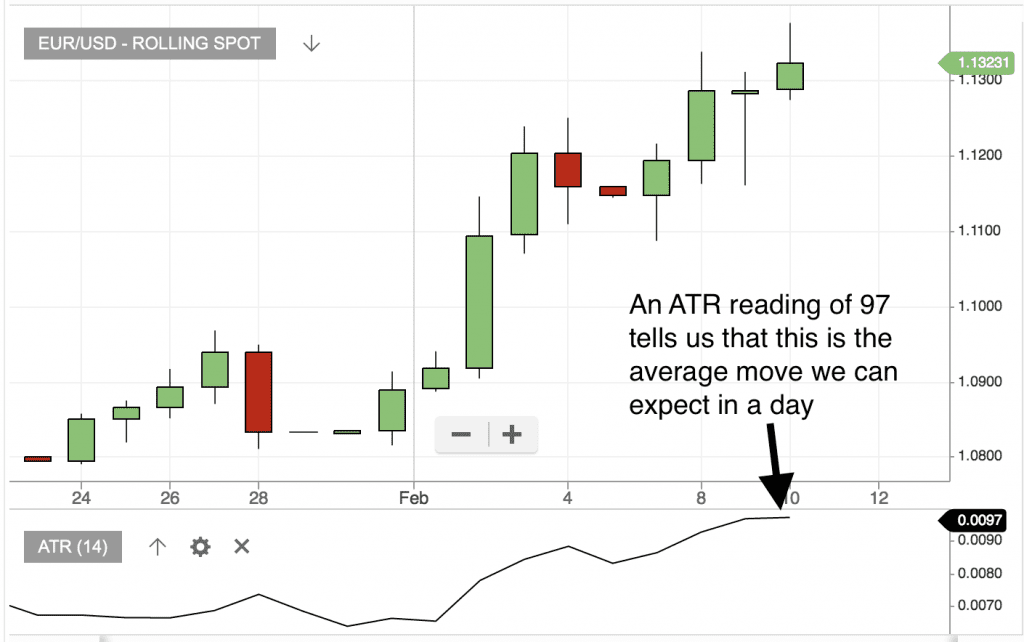
Add to this information the amount of time you expect your trade to be open for – are you looking at several weeks … several hours … or somewhere in between?
Now you can use this knowledge to judge whether the distance the market has moved against you is normal ebb and flow of prices, or a more decisive move.
The second question really depends on what your entry signal was, and what you’re expecting to happen. But, these are definitely criteria that can be added to your trading rules – so there’s no excuse for fiddling. This should all be part of your strategy.
The crunch
I’m a big fan of hands-off, ‘set and forget’ trading methods. Not only does it free us up from the temptation to fiddle with our trades … it also means we can get on with other things – I wouldn’t like to add up the hours I’ve spent ‘watching’ my trades. There has to be no pastime more fruitless!
But if the temptation to fiddle with your trades is getting the better of you – it probably suggests that something is missing from your trading rules, or simply that you’re trading too big. Remember the reason that most of us are driven to trading – we’re looking for a better way to make money, that frees us from the daily stresses and grind of a 9–5. So, if trading is adding stress, and having you tensed over your computer keyboard … might be time to rethink …
Save
Save
Save
Save