May 27, 2011by Mark Rose- 0 comments
The truth about turtle traders

I’ve heard it said often.
In fact, I’ve even said it myself …
“Trading isn’t rocket science.”
Well, of course it isn’t.
Yet, the statistic I hear banded around again and again is that 90% of traders fail. They lose their money, or simply give up.
So – trading can’t be that easy.
Can you learn how to trade?
Naturally, there is a fairly large area of ground between “child’s play” and “rocket science” – and this is the area that the 10 per cent of successful traders are occupying.
So, how do you ensure that you’re one of them?
Can you learn to be in that 10%, or are you born into that 10%?
Back in the 1980s, a famous commodities speculator, Richard Dennis, set out to answer precisely this question.
He’d be having an ongoing dispute with his long-time friend Bill Eckhardt about whether great traders were born or made. Richard believed that he could teach people to become great traders. Bill thought that genetics and aptitude were the determining factors.
In order to settle the matter, Richard suggested that they recruit and train some traders, and give them actual accounts to trade to see which one of them was correct.
Remember the movie “Trading Places”? Well, it was a bit like that.
Hiring Turtles
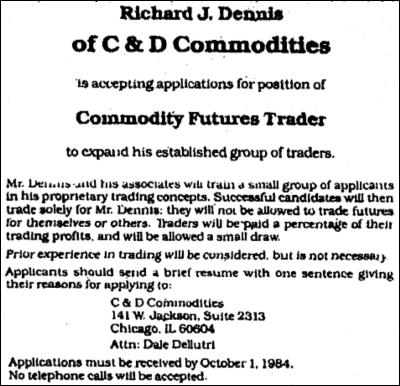
They took out a large ad advertising positions for trading apprentices in Barron’s, the Wall Street Journal and the New York Times. The ad stated that after a brief training session, the trainees would be supplied with an account to trade.
Since Richard was probably the most famous trader in the world at the time, he received submissions from over 1000 applicants. Of these, he interviewed 80.
This group was culled to 10, which became 13 after Richard added three people he already knew to the list. They were invited to Chicago and trained for two weeks at the end of December 1983, and began trading small accounts at the beginning of January. After they had proved themselves, Dennis funded most of them with $500,000 to $2,000,000 accounts at the start of February.
The students were called the ‘Turtles’. (Mr Dennis described it to someone by saying, “We are going to grow traders just like they grown turtles in Singapore.”)
The Turtle Traders became the most famous experiment in trading history because over the next four years, they earned an average annual compound rate of return of 80%.
Where the Turtle experiment falls down
Richard had shown that with a simple set of rules, he could take people with little or no trading experience and make them excellent traders.
But, if we look at this carefully, it is very far from being scientific.
For a commodities trader, Richard Dennis was being very naïve about his statistics …
He started off with 1,000 applicants, and weeded it down to just 13 (three of which he selected himself) – it’s not exactly a random cross-section of the public.
He was already filtering out the people who he felt didn’t have the aptitude for his methodology.
In fact, there’s currently a publicity campaign being run by an ex-New York city trader who claims to be replicating the Turtle experiment. This guy got 8,000 applicants, and filtered them down to 10.
In short, neither of these experiments can prove that natural aptitude has nothing to do with trading success.
There’s no doubt, in my mind, that some people take to trading more easily than others.
Some people are better at picking out patterns than othersare naturally very disciplined. Others (myself included, I’m afraid), have to battle with themselves, constantly keep a check on their emotions – and repeatedly kick themselves for their failures!
But that doesn’t mean that we can’t succeed in trading – provided we have the right mindset and the right kind of education …
And one of the best ways to stay on the straight and narrow is with this mentor-style education that Richard Dennis offered to his apprentices back in 1983.
Over recent months I’ve been looking at a trading system that offers this kind of “hand holding” approach to traders.
It’s a strategy that’s been doing well, and is getting great results for its members. In part, I believe this is because of its sound methods, but I also believe that it’s got a lot to do with the approach of its creator – he doesn’t just hand out a set of rules and leave traders to fend for themselves.
I’ll bring you full details next week, so keep an eye out for my email.
Until then,
Mark Rose