January 28, 2022by M Rose- 0 comments
The real reason you’re in trading drawdown

Is your trading currently in drawdown? Do you feel like you’re always in a loss?
Here I’ll reveal the real reason you’re in drawdown (I think it will surprise you), and I’ll show you how to fix any drawdown pain …
The shocking reality about losing trades
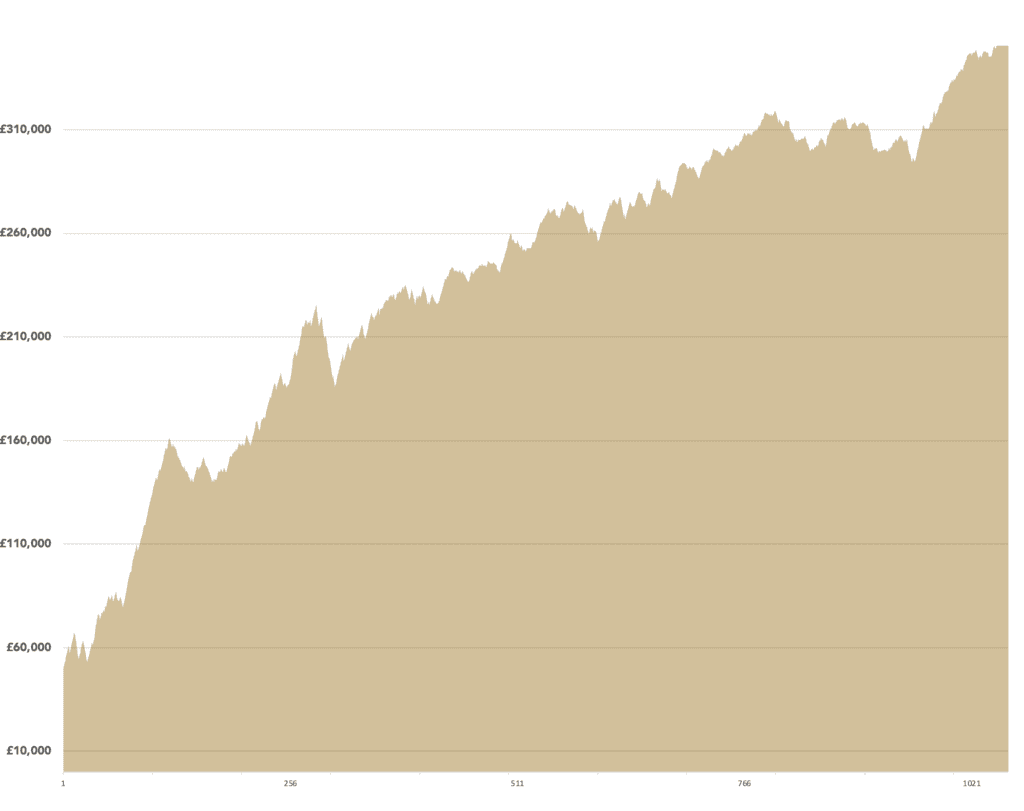
This week I’ve been putting together a tool to help members track their performance. The obvious first choice for a visual aid is the P&L chart, which looks something like this …
Pretty good, right? £50k to £350k in just over 1,000 trades.
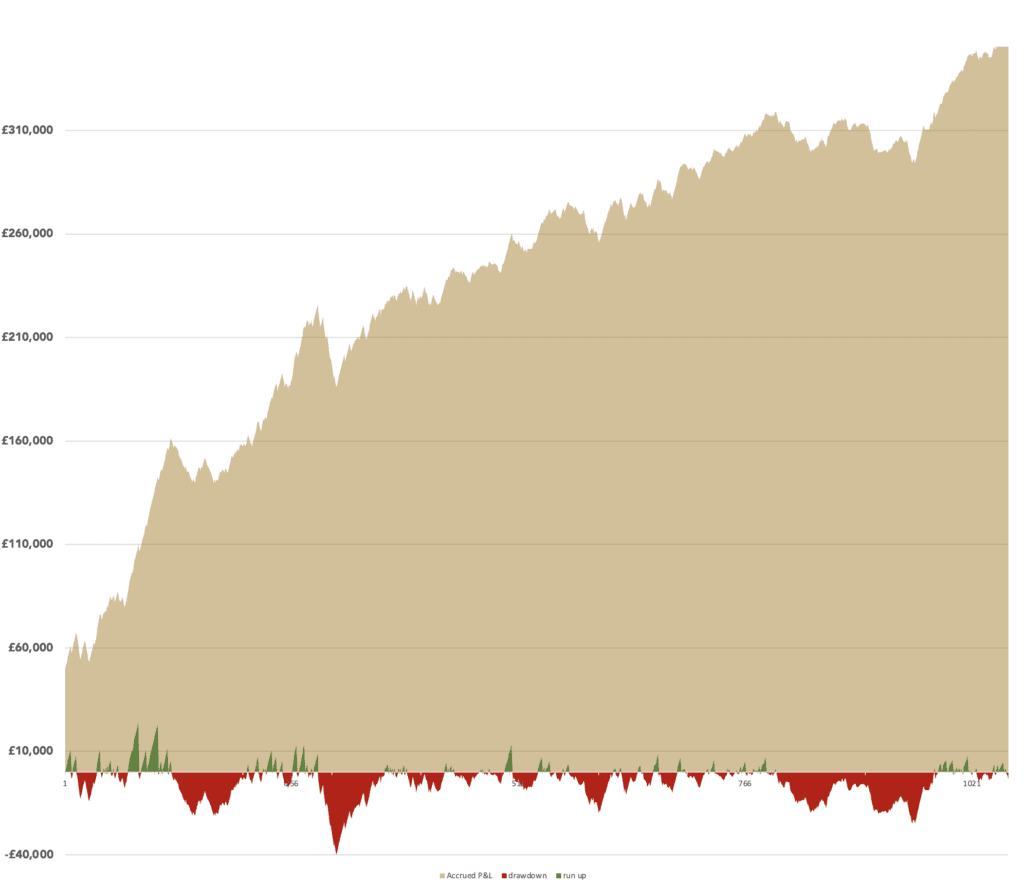
Then I thought I’d add a visual for drawdowns and run-ups to the chart, which looked like this …
Of course, I’m no stranger to drawdowns – including uncomfortable ones. But what really struck me on this chart is just how much time we spend in drawdown, compared to the amount of time we spend hitting new highs. Throughout that red area, we’re in drawdown. The small green spikes are when we are in run-up …
Remember – this is a really profitable trading system. Yet, the experience of trading it is to spend most of your time either losing money, or recovering from losing money.
This balance between drawdown and run-up isn’t unusual. The chart below shows the S&P in an uptrend …
It’s no wonder that trading is so tough on us psychologically.
The Reality of Drawdowns
So, given that – as traders – we’ll spend most of our lives in drawdown – we need to get really good at handling it – and not letting it grind us down.
If we don’t, there are three pitfalls we’re prone to fall into …
- giving up because we’re losing money
- taking excessive risks to ‘dig ourselves out of a hole’
- just being generally miserable about our trading
What the illustrations above show clearly is that drawdowns aren’t a ‘part’ of trading – they are actually MOST of trading. So, if you feel like you’re always underwater with your equity, or just treading water at best … then, well done – you’re probably trading very profitably!
What’s important is to listen to your emotions as you hit a losing run. Yes, I know everyone tells you trade without emotion! But the reality is that we do have emotions, and if they are telling us to worry that we’re losing money – they probably have a point.
We’re not going to ignore our emotions – we’re going to manage them, keeping our trading on track, and our sanity intact!
How to cope with drawdowns
Everyone has a different attitude to risk, and we’ll all have a personal point of pain when it comes to a losing run.
Some people can cope with a 50% drawdown … others are losing their minds at a 10% drawdown.
It can be hard to know exactly where your pain levels are until you hit them, so a drawdown plan can be tweaked if your comfort levels aren’t what you thought they were.
So, the first flag is that you’re feeling uncomfortable with the level of loss …
Level 1: Discomfort
If you’re uncomfortable, act NOW, before you hit the point of pain.
Here’s what to do …
- Don’t stop trading, just slow down
- Apply your drawdown limit – this means that you stop trading for the day if you hit a drawdown of X%; or it might be a weekly limit, so you stop trading until next week if you’ve hit a drawdown of X%. (You can find more on drawdown limits HERE)
- Check your trading journal for any issues – are you sizing positions correctly? Following your own rules?
These steps should help to stem losses, reducing your losses and the stress associated with it. The most important thing to do in a drawdown is to maintain our fund – focus on that rather than trying to make back losses.
However, it’s possible that your losing run isn’t done with you yet … or it could be that you missed the point of discomfort, and jumped straight to the point of pain …
Level 2: Pain
Now your drawdown has moved beyond the ‘normal part of trading’ to becoming a problem. Sure, this may still be a valid bump in the road of your trading strategy – but if it’s causing you pain, it needs to be addressed.
At this point, we need take more drastic action … we need to go into survival mode …
- Close your positions – this may feel like the wrong thing to do, as we’re always hopeful that things will turn around. But if your stress levels are getting too high, then you shouldn’t be in these positions in the first place. You’ll instantly find some respite if you accept the losses and are out of the market.
- Take 3 days off trading to get perspective
- Look at your trading journal to see if you can pin down where the issue is. Maybe this strategy is just too volatile for your risk appetite.
- Build your trade size up slowly – don’t rush to make back those loses.
Managing drawdowns long term
If you find that you’re hitting Level 1 (or Level 2, for that matter) too often, the message is clear – you’re trading too big for your comfort levels. Reduce your position size, and look for other ways you can reduce the volatility of your returns.
But if you spend most of your trading life teetering on the edge of the discomfort zone – then you’re probably doing just fine. Keep an eye on the big picture with a trading journal that monitors your profitability and your drawdowns, so you can be confident that you’re heading in the right direction.
And, despite what the trading ‘rules’ tell you – listen to your emotions. Trading shouldn’t be about stress and sleepless nights. Your emotions will tell you when to act to stem losses, before you get into trouble.
To enjoy more content and get it faster