December 11, 2015by Mark Rose- 1 comment
6 questions to ask before making a trade you’ll regret
There’s always a degree of risk in trading – however safely you play it. That’s all part of the process.
However, we want to keep risk to the managed type – not the head-in-hands, I-can’t-believe-I-made-such-a-school-boy-error type!
This fast checklist should ensure you’re not making any stupid trading mistakes …
1. Where is the longer term trend?
It’s trading kindergarten stuff – but so often ignored. If we trade in the direction of the trend, it’s going to be easier to make money. If we trade in the opposite direction, making a profit is like trying to walk backwards up an escalator – yes, it’s possible, but it’ll take you longer to get there, requires more effort, and makes you look a bit daft.
But the problem is that when we’re day trading, it’s easy to lose sight of the over-arching trend in the market – we get so bogged down in the small ups and downs of the day.
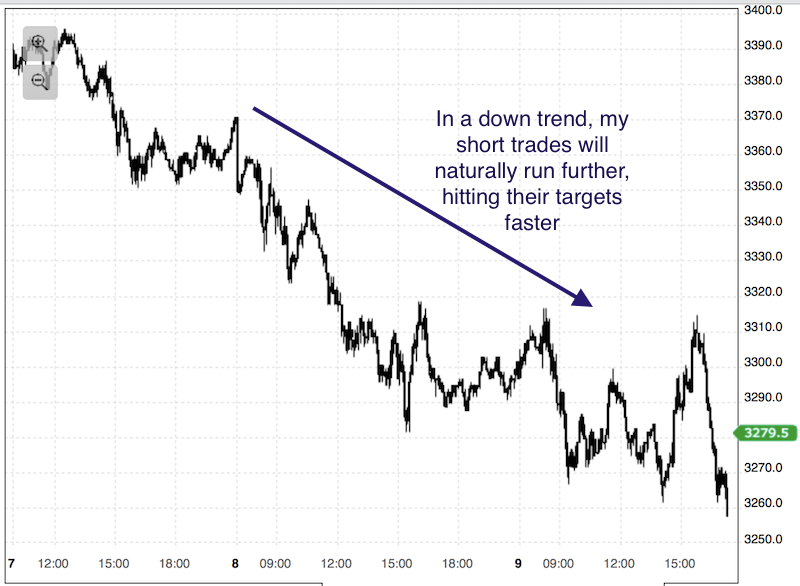
The chart below shows 5minute candles over a 3 day period, where the market is clearly in a downtrend. While day trading, it would be easy to miss this unless you pull out to look at the bigger picture.
2. Are there any key levels I have to break through?
We’ve all done it (well, I know I have) – mechanically setting my stop loss and profit target according to the rules of my strategy … only to realise too late that to win, the price would have had to move through a significant key level. Or that the stops loss is on a round number, where the price is likely to be driven like a magnet.
On the chart below, we get a signal to sell into this downtrend …
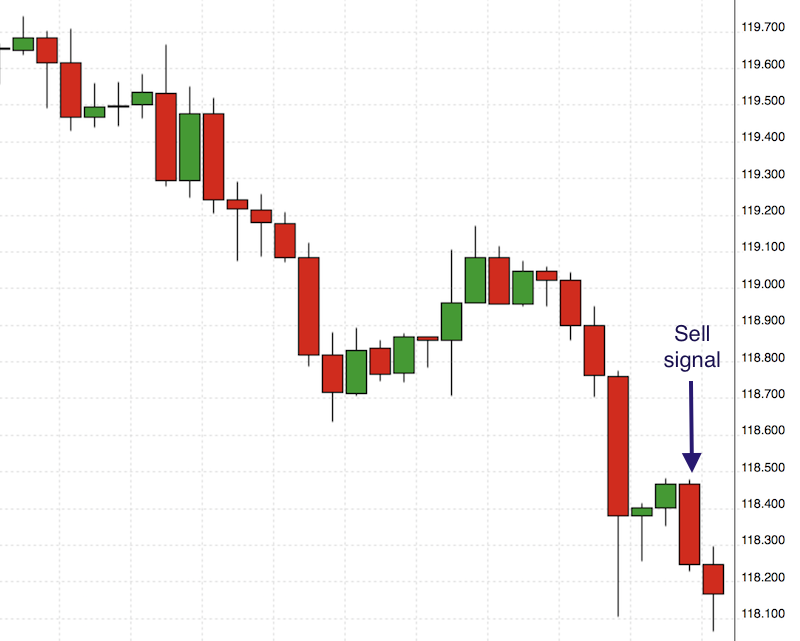
However, when we look at the same moment on a daily chart, we see that we’re selling just as the price hits a significant support level …
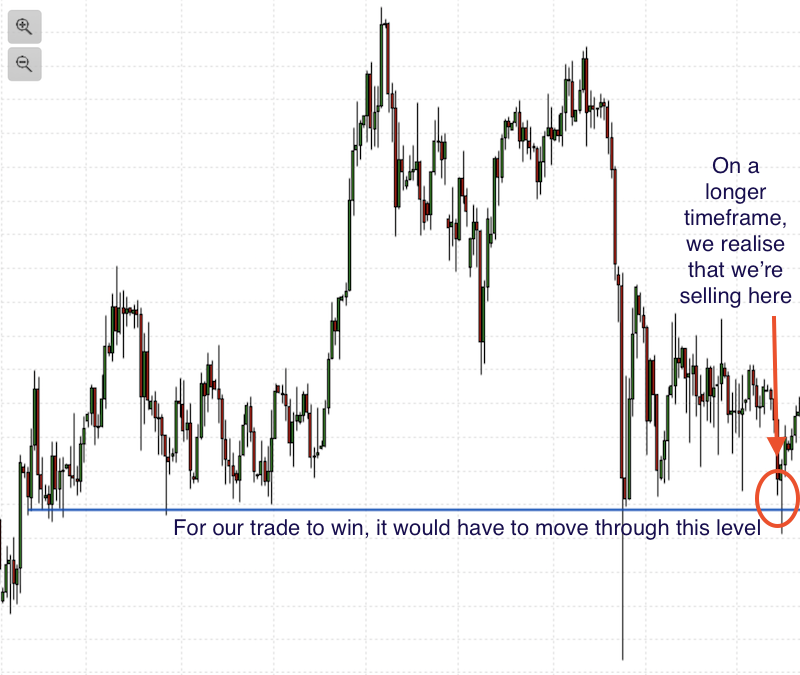
The way to avoid making this mistake is – again – to pull back and look at the bigger picture. It’s useful to draw a few key levels on your chart, so they’re still there to remind you, when you’re head-down day trading on a smaller timeframe.
3. What is my risk?
It’s so fundamental that we should NEVER enter a trade without a clear idea of what the risks are.
Day traders should risk more than 1 or 2% of their trading fund (this will vary, depending on the risk profile of the strategy) … and your total risk for a spread bet is calculated as your distance to stop multiplied by your stake.
There’s no excuse for straying from these rules … but errors do happen … fat fingers typing the wrong figure … a decimal point in the wrong place … But generally, it’s a mistake you only make once!
4. What are the criteria I’m following to enter this trade?
I’m going to take for granted here that you’re following a strategy with systematic trading rules.
So, the question is – are you following those rules?
Are you’re ‘adapting’ your rules to fit with what the market is doing?
This isn’t necessarily a crime (market conditions, like most things in life, rarely match the text books), but if it’s not already part of your strategy, it needs to be worked into it, so you consistently deal with situations.
If your’e struggling to know where to start, take a look at these three simple plans: Click here.
5. What are my criteria for exiting this trade, either as a winner or a loss?
Too often, our plans focus on what we’ll do when things go according to plan. But what will you do if they don’t?
Yes, have your clear take profit level, but what will you do if the price is hovering around your stop level? Will you cut and run, or wait for the trade to come good.
Do you have a timescale after which you’ll close the trade, whether it’s in profit or not? Remember, the longer your trade is open, the longer your money is at risk in the markets.
6. Major economic announcements due?
You don’t need a degree in economics to trade the financial markets – you just need to know when a piece of impending news could derail your trade.
While we can’t predict what bankers will announce, or what effect that will have on the market (it’s often the opposite of what we might expect), we can make ourselves aware of scheduled announcements.
Forexfactory.com lists all the economic announcements happening each week, and the markets they are likely to effect. The main events to watch out for are Non-Farm Payrolls on the first Friday of every month.
Of course, you can’t guard against the kind of financial news that doesn’t get scheduled!
And it’s important to remember that even a perfectly planned trade, with every base covered … will lose some of the time. Depending on your strategy, it might win more often than it loses. Yet again, it’s vital to keep sight of the bigger picture – your annual percentage gains, rather than individual winners an losers.










1 comment
Paul H
Very useful checklist for the trader. I always look at daily, weekly and monthly time frames to highlight the main support/ resistance levels which could stop any trade in its tracks.