The easy trailing stop trick that’ll help you hold onto your profits
In trading, we should always use a stop level to protect our downside. And we can also use these safety features to protect our position as we move through the markets – in the form of a trailing stop.
A trailing stop will follow our progress, reducing risk as we move into profit, and ultimately starting to lock in those profits as they build.
Trailing stops can be applied on many trading platforms as an automation. In this case, they’ll simply follow behind the price by a set number of points or pips.
Some platforms, like Trade Nation, won’t combine a trailing stop with a profit limit, so your only automatic exit will be through the stop level.
Others, like Spreadex, also give you the option to set a trailing step …
What’s a trailing step?
A trailing step allows you to manage your trailing stop much more accurately. It means that the stop will only jump up at fixed intervals.
For example, if you’re short on the GBPUSD, with a trailing stop of 30 pips, and a step set to 15, your stop won’t move until the market has moved down by 15 pips.
You can use this kind of trailing stop for simple trade-management tasks, like bringing a stop to breakeven, when the price is halfway to your profit target. Just set the step to 50% of your target, and the trailing stop equal to your initial stop distance.
When properly managed, trailing stops can be a powerful tool to manage risk, as well as helping maintain our sanity.
But there are some key issues to be aware of …
There are two main problems that can arise with trailing stops
1 • exiting too early
The nature of a trailing stop is that it takes you out of a trade during a pullback, before too much of a downturn occurs.
That’s great for protecting you against that downside … but it can also limit the upside.
If you weren’t using a trailing stop, it’s possible that after the temporary downturn, the price could have gone on to win.
In the example below, we’re in a buy trade, with a 20-point trailing stop, a 10-point trailing step, and a 50-point profit target …
What happens is that the price moves 40 points into profit, with the stop trailing behind. The trade is then closed out as the price retraces, giving us a 20-point profit. However, we miss out on the 50-point profit that we could have achieved without the trailing stop.
It’s the rub that comes with using a trailing stop. Generally speaking, in a world with unlimited funds and unlimited time … the tighter a stop, the less profit we’ll make. But in the real world … these trailing stops help to keep us in the game, so our trading banks and our trading resolve don’t get depleted.
It’s worth noting that, if you didn’t have a trailing stop in the scenario shown above – at the moment just before you’d hit your target, you’d be risking 69 points (49 points of profit, plus 20 points initial stop distance). Trading with this higher risk levels can be both stressful, and turbulent for your bank balance.
2 • badly positioned stops
The second issue that arises with trailing stops only happens if you’re using an automated stop, that just blindly follows the price. These stops can end up falling in zones which, technically, you’d never choose to have a stop – like the wrong side of obvious support/resistance levels.
The solution to this is to use a technical trailing stop …
On most trading platforms, this will mean a level of manual checking and adjusting.
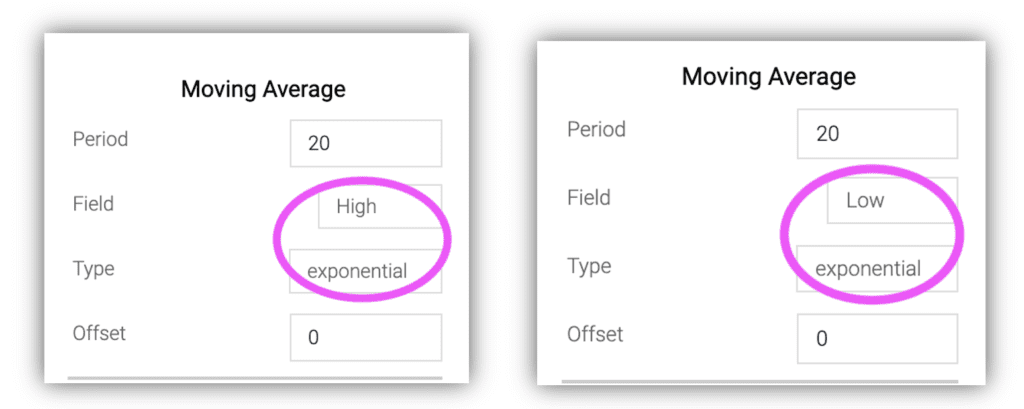
The simple tool I want to show you here is a moving average … but with a little bit of adjustment. I’ll show you the exact settings in a moment.
By shifting the stop down in line with a technical indicator like this, we can reduce risk, lock in profits, but also be mindful of how the price is behaving within that trend.
But this is not your standard 20-period moving average.
This is an exponential moving average, which makes it more responsive to current market moves. Usually a moving average is based on the closing price of each candle, but in this case, I’m interested in the highs or lows that candles are hitting, so I’ve based the moving average off the candlestick highs in a downtrend, or the lows in an uptrend.
I recommend looking at over your charts to judge what would be the best moving average settings for your trading – over longer periods, a 50-period EMA may work better.
Ultimately, a trailing stop will allow you to push your profit targets further, without worrying about the downside. Rather than limit the profits you make, this can enable you to boost them – while also getting a better night’s sleep. It’s a win-win.