Balancing risk and reward: what’s the best risk to reward ratio?
I’m sure we’ve all heard the saying, ‘cut losses short and let your profits run’ – it’s an old truism in trading, which is about as useful as advising someone to ‘make more money’ from their trading.
Anyone who’s left their profits to run, will be all too familiar with the experience of those profits evaporating and turning into a loss. And those of us who’ve cut losses too quickly, will have observed that if we’d held our nerve long enough, the market would have come good …
So, just how short should we cut those losses?
And how far is it safe to let profits run?
And what is the best risk to reward ratio?
How to measure it
The best way to measure just how far we run profits and cut losses is with our reward-to-risk ratio (RRR).
This is a simple figure which shows how we balance our trades.
If your profit distance is 5 pips, while your stop distance is 10 pips, then your reward-to-risk is 1:2
If your profit distance is 150 points, while your stop distance is 50 points, then your reward-to-risk is 3:1
Another old piece of trading advice relates to the ‘best’ reward-risk ratio (RRR). This tells novice traders that they should only enter the markets with a 2:1 reward to risk, or higher.
So, if your stop distance is 50 pips, your profit target should be at least 100 pips from your entry.
It’s another piece of trading wisdom that needs digging into.
Here’s why …
The stops and targets that give the BEST profits
Statistically, the best trading results come from trading with no stop loss at all – that way – as long as you had infinitely deep pockets – you’d never lose a trade. And you could happily snatch at any modest profits that come along – always winning, never losing (unless the market crashes to zero).
Of course, this only works in theory – no one can actually trade this way. And efforts to replicate it will see you quickly shaken down.
To explore which reward-to-risk ratios (RRRs) give the best results in the real world, I want to show this in practice with my actual trading results, looking at my Heikin Ashi Mountain strategy.
Traded results for different reward-to-risk ratios
Heikin Ashi Mountain is a once-a-day trend-following strategy. It’s dead simple, taking just 5 minutes a day, and has been consistently profitable across a range of profit targets – making it a useful example for us.
Heikin Ashi Mountain has two distinct profit-taking methods:
Either you can choose to run all profits to 2:1 (this is called the ‘big profits’ method);
or you can close out 50% at 1:2, leaving the second half to run to 2:1 (called the ‘combined’ method) – this gives a combined outcome of 5:4 if both halves win
It also uses trailing stops to reduce risk as trades progress, and to lock in profits – so we expect actual traded results to do a little better than the 2:1 or 5:4 that we’re look at when the trade is first placed.
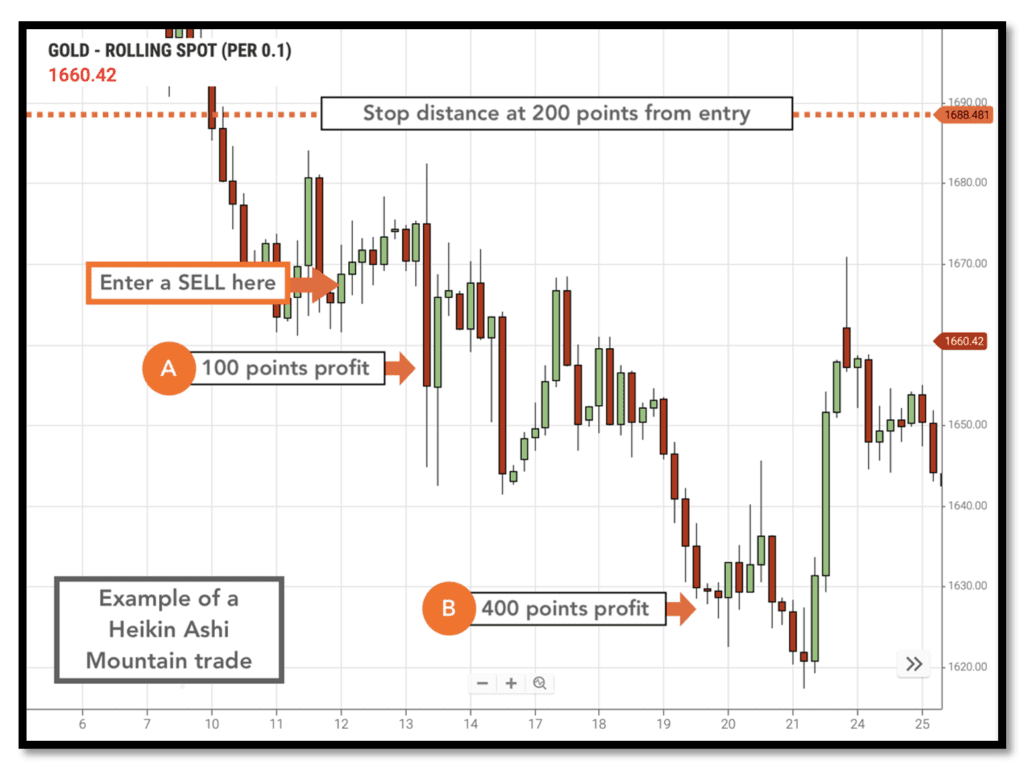
Here’s an example of a recent trade we took on Gold …
In the image above, the two profit-taking options would mean, either:
2:1 only: taking all profits at B, or
Combined: closing 50% at A, and 50% at B
So, either I can risk £200 to make £400 … or I can risk £200 to make £250.
What effect do these two different approaches have on performance?
The good news is that both methods are profitable. (Heikin Ashi Mountain is so robust that it’s even profitable if you just snatch all the profits at ‘A’ – but I don’t recommend this.)
I’ve got trading data for this strategy going back to mid-2019, so there’s plenty of stats to dig through to build a clear, reliable picture.
What the results reveal about the best risk to reward ratio
First up, because I also use a trailing stop, the RRRs are actually better than a simple 2:1 or 5:4.
For the ‘big profits’ method that lets all the profits run, the average win size is 2.11x the average loss size.
For the combined method, that closes 50% early, the average win size is 1.39x the average loss size.
So, the combination method has brought in profits of over £10k, winning £1.39 for every £1 given back to the markets. And it’s enjoyed a win rate of almost 50%.
But the big profits method has completely outstripped this by over 60%, at £16,519, and winning £2.11 for every £1.
Consistently, through the 3.5 years of results, letting profits run has given better performance.
Each day, we check the markets for trends, and if there’s a setup, we look for an ambitious 2:1 profit target – and it pays off.
But there’s a downside to letting profits run, which is why many Heikin Ashi Mountain members still choose to trade the combined method, even though all the evidence shows that they could make more going for big profits …
The cost of letting profits run
It would be nice to think that we could just keep letting profits run and making more and more money …
But it’s worth considering what trading with a 39% win rate feels like.
Sure, if you’ve been trading long-term, and bringing in over £2 for every £1 you give back – it feels pretty good.
But when you’re just starting out, it can be tough to take that rate of losing trades – some traders just drop out.
By contrast, using the combined method, which takes profits sooner, gives a 47% win rate so you’re winning almost as often as you lose (with winners still bigger than losses) – this is much easier to maintain psychologically. But it does cost you in terms of profitability.
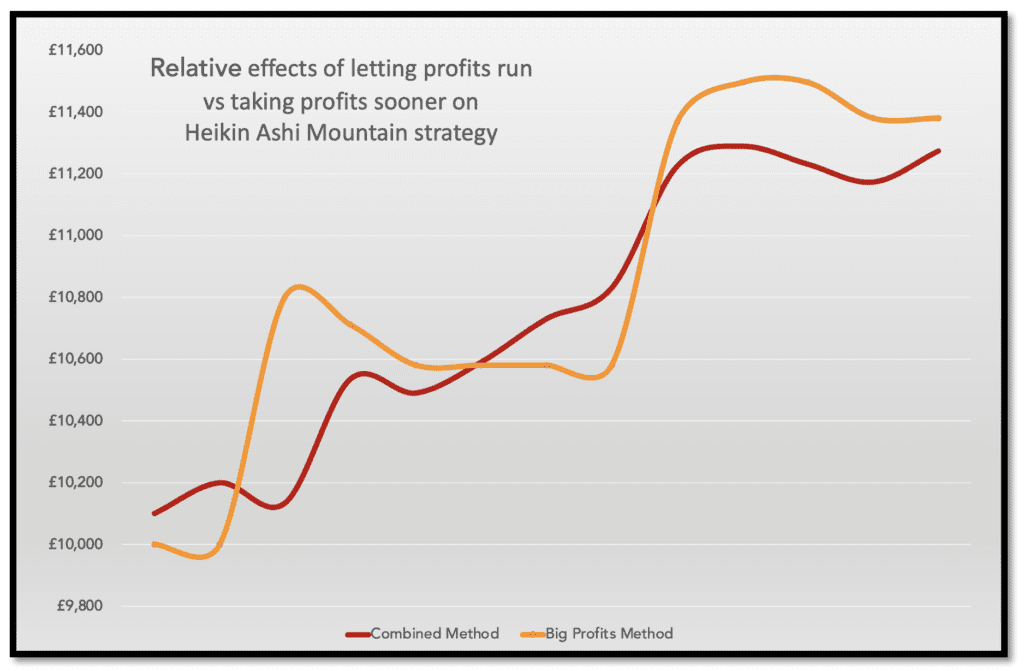
The chart below gives a picture of short-term trading. It’s a snapshot of Heikin Ashi Mountain performance taken over the past 3 weeks …
As we’d expect, the Big Profits method that runs profits has made more money – but it’s worth noticing the increased volatility.
As with most things – it’s about finding a balance between profitability and what works for you. And you should also match it to your trading style …
When letting profits run DOESN’T work
The trading strategy I’ve looked at here as an example is trend-following.
Trend-following strategies demand ambitious profit targets to be successful. There are can plenty of false signals when trend trading, but when the market does kick into action … it can run and run, collecting substantial rewards.
Range trading, by contrast looks for higher success rates and lower RRRs, of 1:1 or below.
For more information on what works for trends and what works for ranges, please check out this post.
And to find out more about the Heikin Ashi Mountain strategy I referred to earlier, please follow the link below, where you can claim a risk-free trial.
And if you’re already a Heikin Ashi Mountain member and you’re trading the combined method … perhaps it’s time to start pushing for even bigger profits …