April 6, 2017by Mark Rose- 1 comment
When should I stop trading?

The reason so many traders fail is because they carry on trading when they should stop … and then stop trading when they should carry on.
If you know the right moments to put the brakes on … and when to get back in … you can finally stop losing money to the markets.
How we get stuck in the drawdown cycle
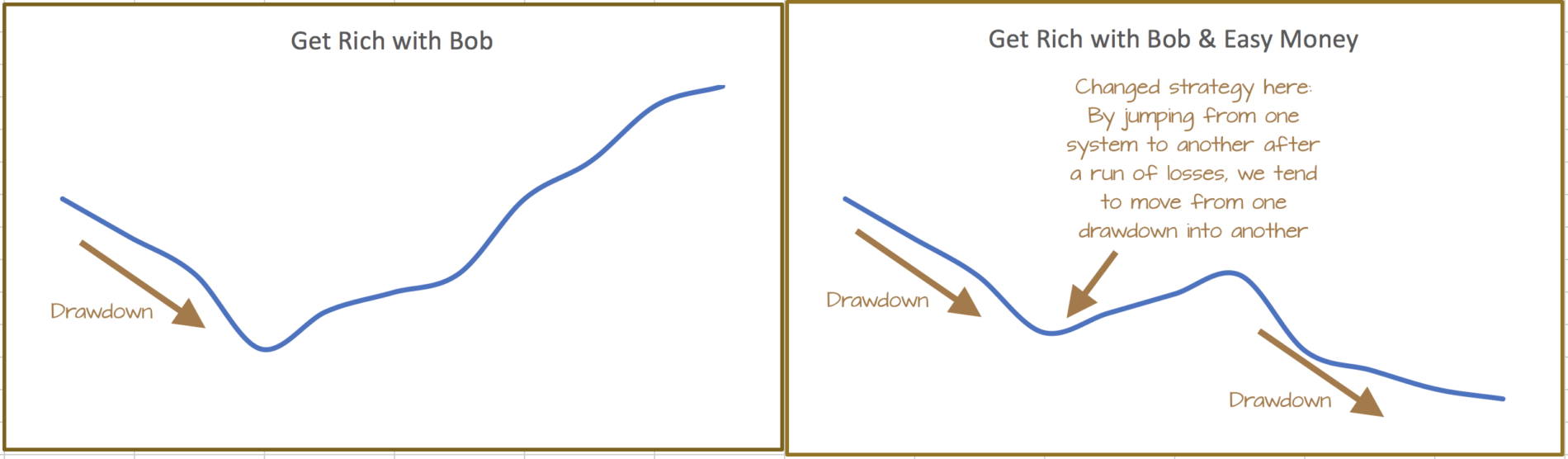
Some guy – let’s call him Bob – tells you about the great trading results he is getting, and how you should use his strategy. Let’s call it the ‘Get Rich with Bob’ system …
You start following the ‘Get Rich with Bob’ system just as its profits top out and it moves into a period of drawdown …
You think: “These aren’t the results I was expecting.” So stop using the method within a few weeks and look out for something better.
Then you read about the ‘Easy Money’ strategy … this seems to be making great profits, so you try this one out. Within a few weeks ‘Easy Money’ also suffers a drawdown – again, you’re left out of pocket.
Meanwhile, Bob’s system seems to have recovered from its drawdown period and is making fresh highs.
If you’d stuck with ‘Get Rich with Bob’, your profit curve would have enjoyed a recovery. But by switching systems, you’ve moved from one drawdown straight into another …

I see hundreds of traders follow this path – moving from drawdown to drawdown, and becoming more and more disillusioned with the process (understandably).
So, how do you break this cycle?
You’ll be pleased to hear that the answer does not involve trading remorselessly through losing runs. No one enjoys that!
It’s about knowing when to stop, and when to restart.
But first off, we need to consider the faith you have in the results before you began trading …
Remember ‘Bob’? He said that ‘Get Rich with Bob’ made great money … do we trust Bob?
If you doubt Bob’s results, you’ll need to check his reported profits by running a quick back-check against your charts (of course, you should have done this before you started following his system at all!) If they match up – then all’s good. If not, then Bob has some questions to answer, and you should stop following his methods.
So let’s now assume that Bob is a straight-up guy. But the trading method he’s given you is losing you money right now. You’re starting to worry about the losses you’re taking, and about whether Bob’s system is really robust enough for the current market conditions.
This is the moment to cut back on your trading. Either reduce your stakes, or switch to demo trading – before losses become too painful.
Carry on in this demo or low-stakes mode for a week, or until the start of the next month, always tracking the results. How long you stop for will depend on how often the system trades, and how much ‘pain’ you’ve suffered in the drawdown. But fix the date you’ll restart – and stick to that date.
So, you start trading again …
If the drawdown is over – great, you’ll be back in business to enjoy the profits.
If the drawdown is still going on, then after you’ve taken a few losses, go back into demo/low-stakes mode … and repeat until the drawdown is passed.
What could go wrong?
The good thing about trading this way is that:
- It accepts that profit curves don’t move in straight lines.
- It doesn’t force you to grin and bear it through losing runs
- And it doesn’t try to time the bottoms of profit curves (which would be impossible to do)
But it’s worth remembering that there’s a powerful force that keeps you trading in losing runs … your ego.
In trading, your ego is the devil on your shoulder who tells you, when you’re winning, that it’s down to your great trading technique and strong instincts. And it’s the same devil on your shoulder who tells you, when you’ve taken a few losses, that the market owes you a win, so you should keep going.
Ironically, it’s because of this that so many traders throw in the towel, because they’ve allowed losses to get out of hand.
If you caught my post last week about Nicolas Darvas, he’s a great example of someone who was driven my his ego … made some expensive mistakes … and then managed to overcome that ego to learn some tough lessons and become a huge trading success.
Ego is the thing that makes us carry on blindly, even when we’re doing ourselves some serious damage.
It takes some will power to stop during a losing run – it means accepting those losses. Which is why it’s good to draw up this ‘point of pain’ before you reach it.
Take a look at your trading account … where will losses be painful enough that you’ll want to take a step back? (I don’t mean so painful that you give up completely! We want to go into demo/low-stakes mode before we reach ‘max pain’.)
Write it down …
- When will you stop trading?
- Will you reduce stakes? Or go into demo mode?
- How long will you stop for?
These simple steps will enable you to break out of the drawdown-cycle for good.
Save
Save
Save
Save







1 comment
Geoff
A pro-active option you could take is to try to identify why the system is in drawdown. Is there a condition (explicit or inherent) which the market does not currently have?
The major part of the system I use is in drawdown this year, the reason being that volatility is very low (I trade stock indexes), so breakout or momentum trades have no follow through. So I am using alternative techiques which are proving more successful.