January 26, 2018by Mark Rose- 3 comments
Where to put your stop loss order so it doesn’t get hit
There are few worse feelings in trading than when your stop loss order gets hit … with the exception of your stop being hit several times in a row!
Is it possible to position our stops in such a way that they don’t get hit? That they can be tucked just out of harm’s way, keeping our trades safe, but not costing us money?
Here’s the answer …
Today I want to show you a clever stop loss order that’s easy to apply and will follow the price in a trend, but sill offer you a good degree of protection.
But before we look at this ‘smart stop’, it’s good to really understand what we want from our stop levels, and what we’re actually asking them to do.
Most traders have a pretty complicated relationship with stops.
We rely on them to keep us safe, but when they do step in to protect us, we resent them for doing so.
In the trading world, the stop loss order is the parent who says, ‘No, you’re not staying out that late …’ ‘… getting on the back of that motorbike …’ ‘… going to a party dressed like that …’
The stop loss is intent on spoiling the fun, and then expects us to be grateful that it has our best interests at heart.
And I’ve been more than a little guilty in my time of teenage-style huffing and slamming a few doors when my stop loss order has stepped in to ‘protect’ me.
But there’s a weird thing about stops …
… (unlike parents) … we could (in theory) be better off without them.
I’m not advocating that we get rid of our stops, but it’s worth noting that a trading strategy will, over the long term, have improved results if we traded with no stop level at all. Tests have shown, conclusively, that trading without a stop loss will be more profitable long-term, than trading with one. This theory assumes that we have a bottomless pit of money, so can ride any losing trade until it comes back into positive territory.
Of course, the huge flaw in this theoretical plan is that we don’t have a bottomless pit of money.
Stops hurt our profits, and the tighter the stop, the more it’ll hurt our profitability. BUT, the wider the stops we use, the more likely we are to be wiped out, or to suffer returns that are too volatile for ordinary mortals to cope with.
Successful trading is all about finding the balance between profitability and volatility. Traders who can weather hugely volatile ups and downs (and still keep the faith!), can ultimately make more money that those who want a smoother ride.
So, it’s important to find your ‘Goldilocks Zone’ of volatility and profitability – where you’re happy with the returns you’re getting, but not given vertigo by the ups and downs of winning and losing runs.
I’d urge you to keep this in mind when you’re looking for a stop loss that’ll suit your needs. A stop can’t be all things. It wouldn’t be doing its job of protecting you if it didn’t sometimes thunder in and ruin what could otherwise have been a winning trade.
A simple, smart way to place a stop level
The stop level I want to show you here isn’t promising to solve all your problems. It can’t help you avoid round numbers … it can’t look left on your chart to see where prices turned last time …
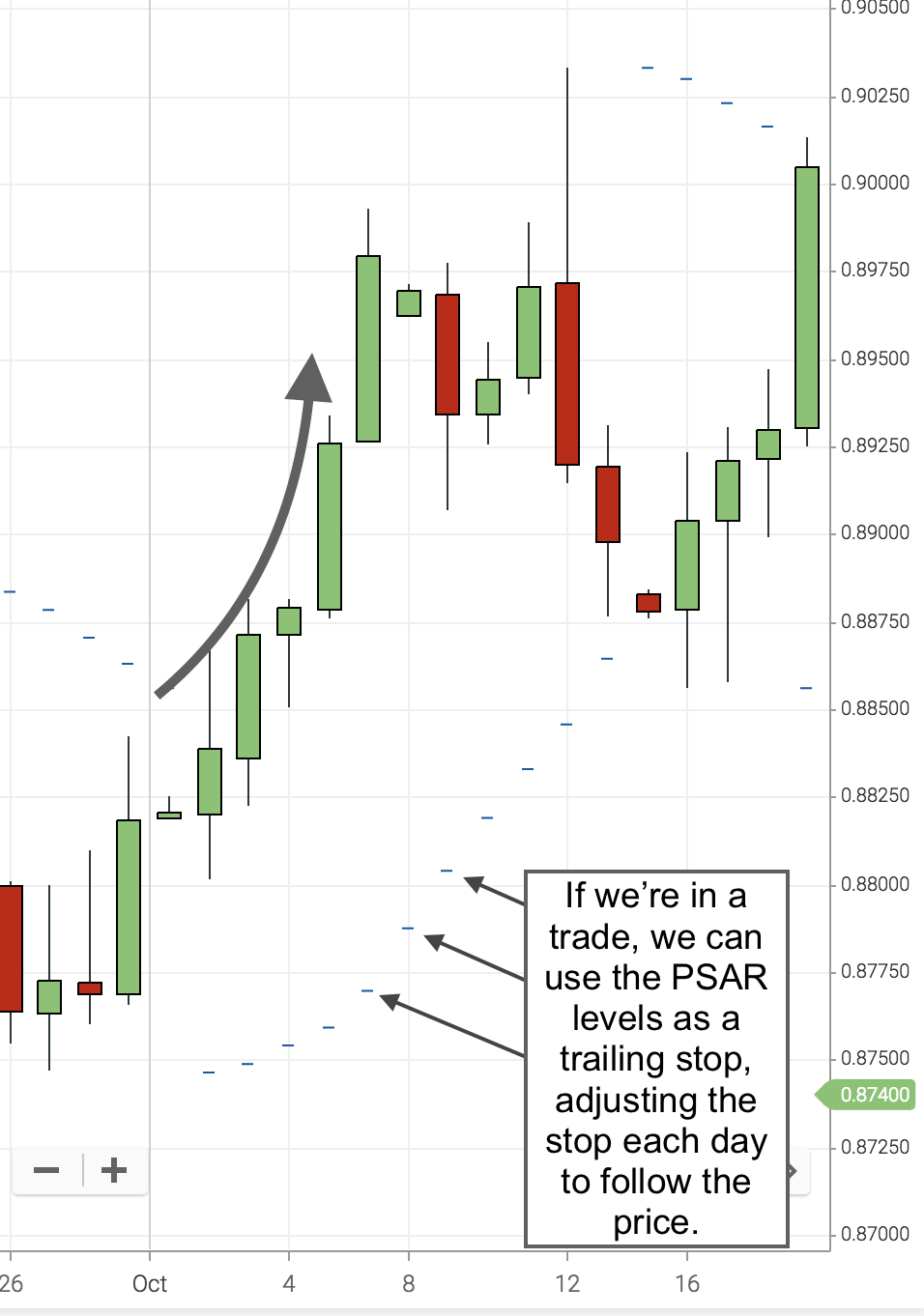
… But it can give some smart levels that’ll follow trends, reducing risk as your trade moves into profit, and then locking those profits in. And if the trend fails on you, it can also give you an early warning system, telling you it’s time to jump ship.
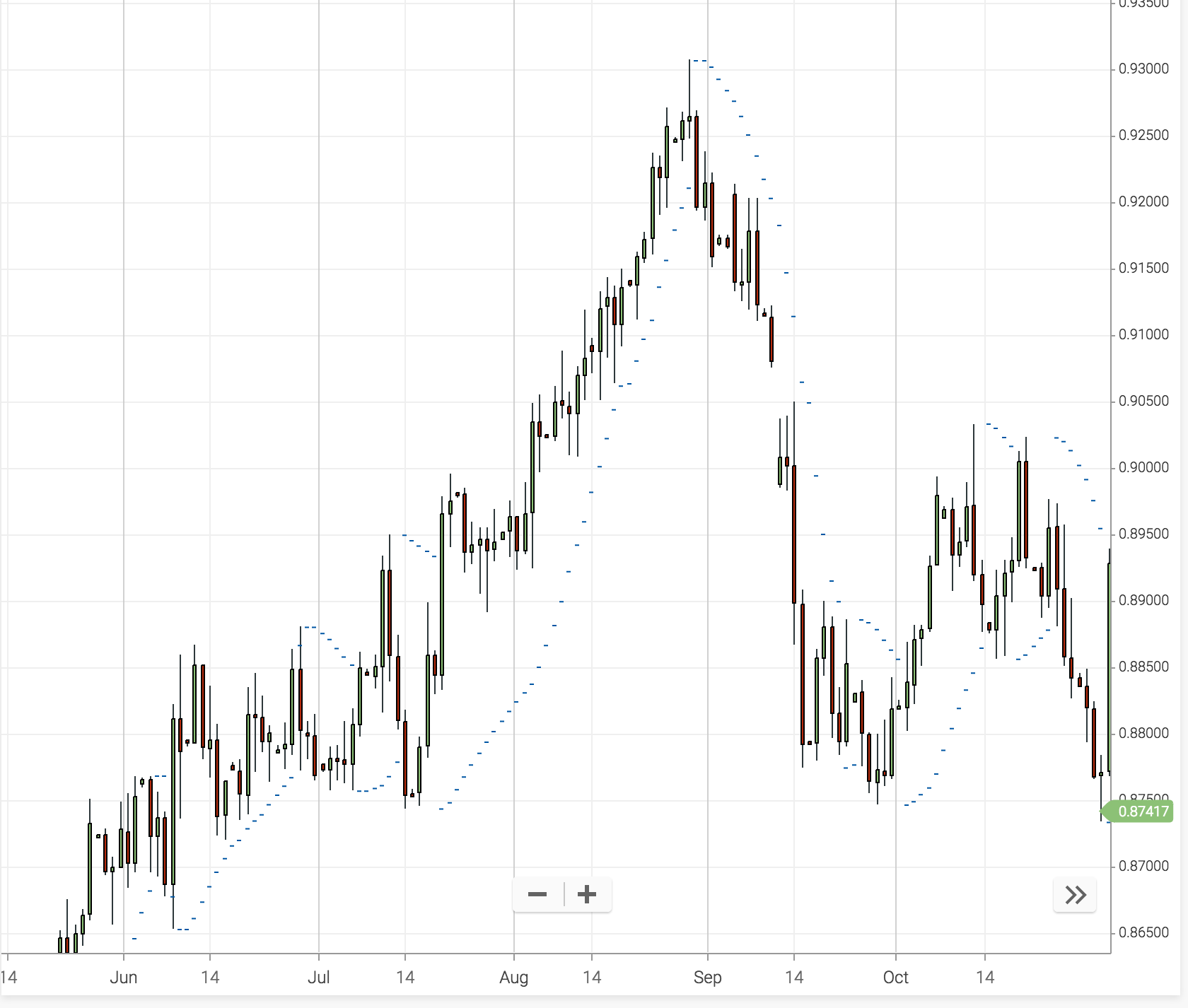
The Parabolic SAR (short for ‘stop and reverse’) looks a little different from the usual lines and oscillators on our charts. Instead, it’s a series of marks above or below the current price.
If the dots appear below the current price, it’s bullish; and if they appear above the current price, it’s bearish.

But we’re actually interested in the actual level the dots are showing … and we’ll use this as a dynamic stop level, so after each daily candle has formed, we can adjust our stop level, reducing risk or locking in profits.

Note how the distance to these points is affected by volatility, so sometimes they’ll be quite close to the price levels, and sometimes further away.
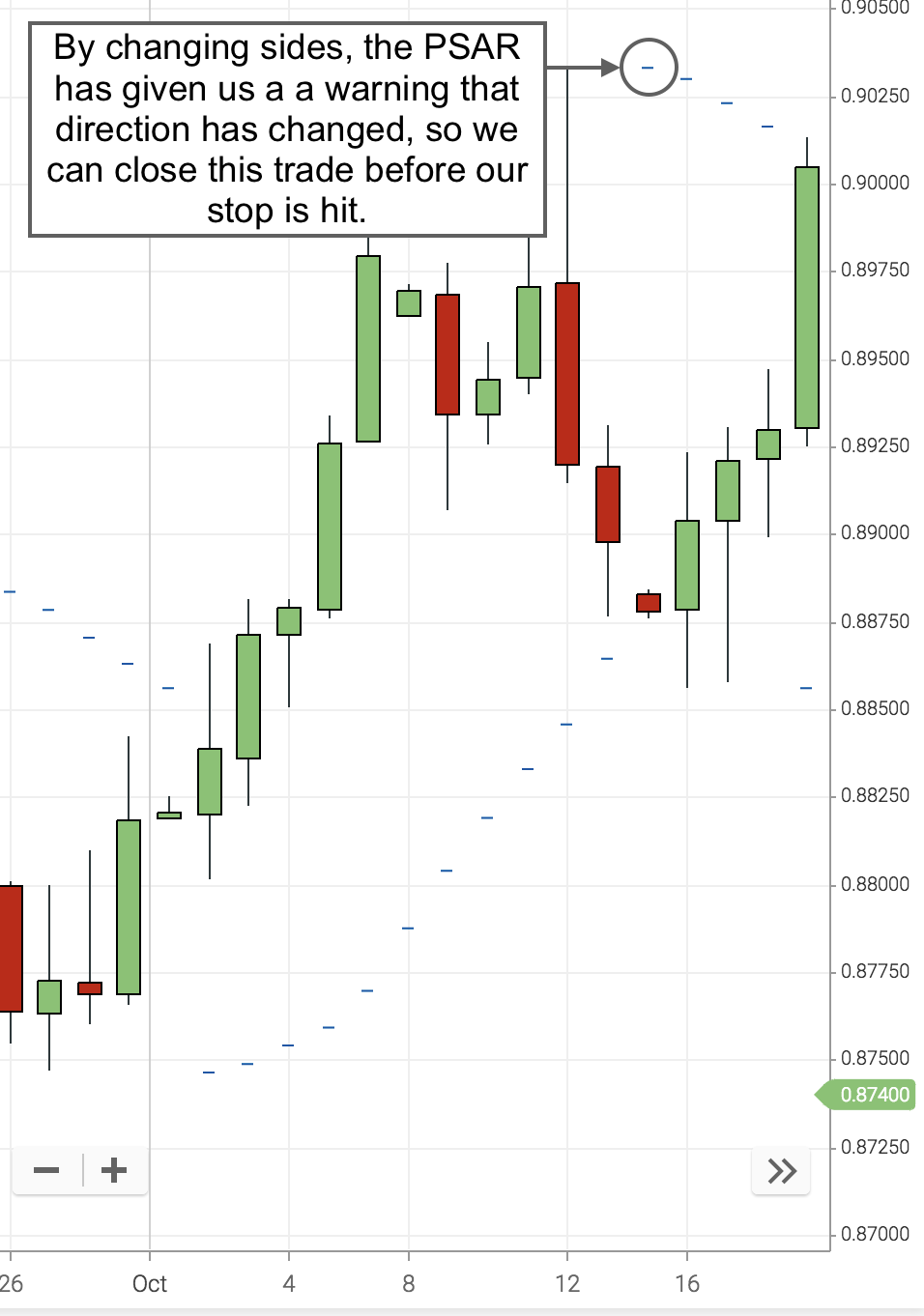
Of course, sometimes these stops will still be hit, and we’ll have to take a loss. However, the PSAR has another way it can help us, by warning us of a change in direction …

The great thing about the PSAR is that it’s intelligent while being easy to use – so you can start applying trailing stops to your trading, without having to pile on lots of technical analysis and a load of new lines to your charts.
And finally, remember that we don’t need to be at war with our stop levels – finding the right way to protect your trade is all about your tolerance to loss, and your tolerance to protective hand stepping in and spoiling your plans!
To enjoy more content and get it faster









3 comments
Mark Rose
Thanks for the feedback. I hope this helps you to lock in some extra profits!
Umer
You were right about “bottomless pit of money”. If one trades without stop loss, the price will come back to the same levels but it might even take years. The only way to survive that is by having lots of money..
Will give SAR a try and see how it goes.
Basil Croeser
Well well well!
There was I all these years thinking Parabolic SAR was just another, and very obvious, trend indicator.
Your article puts an entirely new perspective into the stop loss dilemma.
This should work very well for us swing traders who are using Month, Week and Day charts.
Thanks Mark. Much appreciated.
Basil