Your trade entry isn’t everything – how
you manage that trade and exit it are just as important. But without a good
entry, making money is a lot harder to do.
If you ensure you have these 5 factors
in place, you can be confident you’re giving your trade the very best start in
life.
1.
Move away from key level
Trade entries which see the price
bouncing away from a level or support or resistance have two big bonuses: there
is often momentum in the market as prices bounce from key levels, and we have a
very neat area where we can safely tuck a stop level …
2.
No significant support/resistance to block progress
Just as our first rule tucks a key
level behind our trade, like a safety net – we want to ensure there are no
similar barriers in its path.
The best trades have a clear path to
success with no obstacles. Look at your entry point and your profit target –
are there any areas of support or resistance between them? Or round numbers
that could cause the price to stall?
You may need to zoom out to a higher timeframe see this properly.
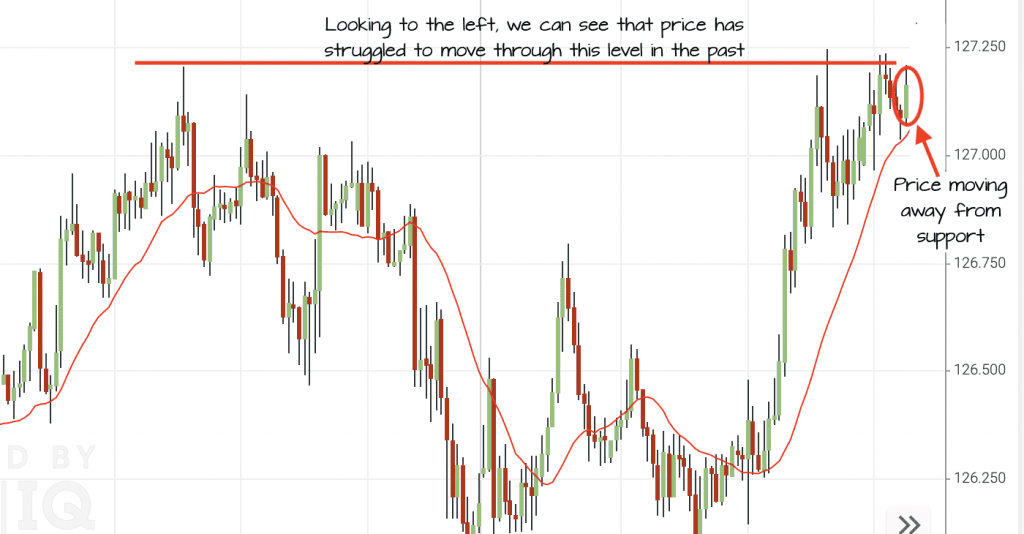
In the image above, we have what looks
like a good buying opportunity, with the price moving away from support.
However, if we look to the left on the chart, we can see that we’re moving into
a clear area of resistance where the price has struggled in the past. This
means we don’t have a clear path to success for this trade, so it will be
harder to win with a setup like this.
3. With trend
It’s perfectly possible to have a good
trade setup and to make money from it, trading against the trend. However, if
you’re with the trend, the price will tend to move further, giving us more
scope for bigger returns.
4.
Positive price action
Price candlesticks give an instant
snapshot of trader sentiment. They can tell us what other traders are thinking,
and that is invaluable insight when we’re deciding whether to enter the market.
Please don’t sweat over candlestick
pattern recognition. Just look out for these most useful price action signs …
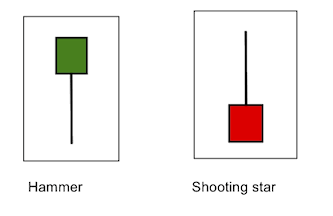
The long-wicked and short bodied doji,
in the form of a hammer (found on an area of support) or a shooting star (found
at an area of resistance) …
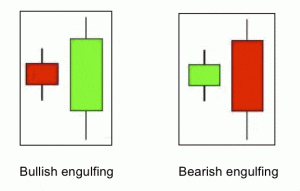
An engulfing pattern consists of two
candles, where the second candle has a different colour to the first and is
larger, engulfing the entire body of the first candle. If it engulfs the wicks
too, then it’s an even stronger signal …
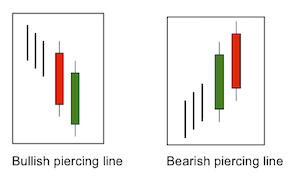
The piercing pattern is similar to the
engulfing, but not quite as powerful. In this case, the second candlestick
covers at least half of the length of the previous candlestick body …
Here’s how they look in action …
If you’re worried that waiting around for a candlestick pattern to form could leave you missing out on profits, you can always zoom in to a shorter timeframe to get immediate insight.
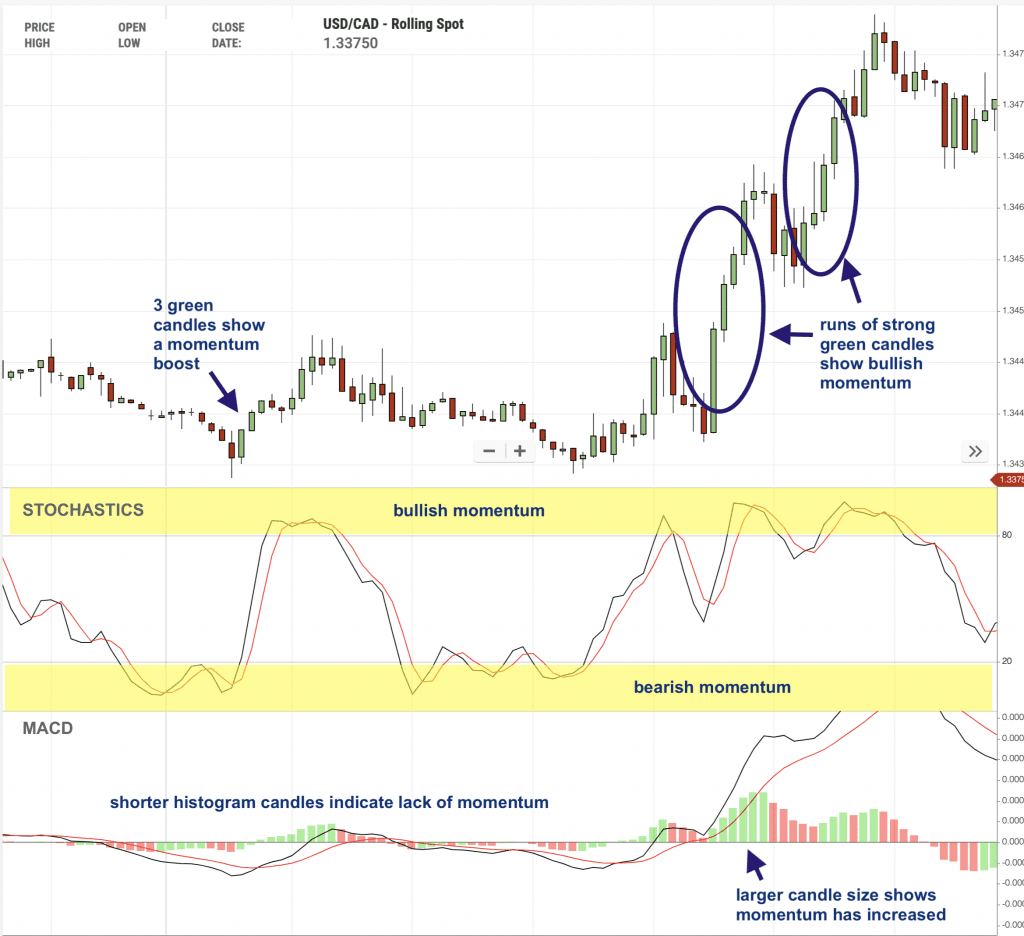
5. Momentum growing
The final piece of the jigsaw is to follow the momentum. Momentum
is the force that drives prices neatly to their profit targets, so we’re not
leaving our money at risk for any longer than we need to.
To get an indication of momentum, we want to judge just how
many other buyers (in the case of a long trade) or sellers (in the case of a
short trade) are jumping in too. This will drive prices in the direction we
want to go. The way to judge what other traders are doing is to look at the
scale of the candlesticks – a long green candle for example, shows buyers
piling in. But we can also use momentum indicators.
The image below shows how momentum can be seen in the size
of the candles, the Stochastic indicator, and in the MACD histogram …
If you’d like find out more about momentum indicators, please check out this post.
Of course, you may not get all five of these stars perfectly aligned for your trade, but these are key elements that tell us we’ve got a good set-up and can feel confident putting our money into the markets.