August 5, 2016by Mark Rose- 3 comments
Which is the best time frame to trade?
A study of 60,000 traders by the University of California found that one group outperformed the rest by 5–10% per year.
They weren’t the most experienced group, or the hardest working group …
They were the traders who traded the least.
The 20% who traded most actively underperformed the 20% who traded least actively by up to 10% per year.
It’s been shown again and again – the less you trade, the more money you can make. While those of us who can’t resist dipping into and out of the markets (sometimes several times a day), are paying a price for it.
Timeframes explained
The traders who trade the most are those who are scalping – looking for small moves, many times a day, even many times an hour.
It’s hard work … it’s risky … and you end up giving most of your profits back to your broker in trade charges.
While those who take positions and sit in them for days, weeks or even months, pay negligible broker charges, and are more likely to catch substantial market moves.
In terms of finding signals, our long-term trader may be looking at weekly charts, daily charts, or even 4-hourlies and hourlies.
Meanwhile, our short-term trader will be probably be looking at trades on charts of 30 minutes or less.
Why the long-term trader has a better chance of success
If you take a look at the chart below, it shows the equity curve for a market index …
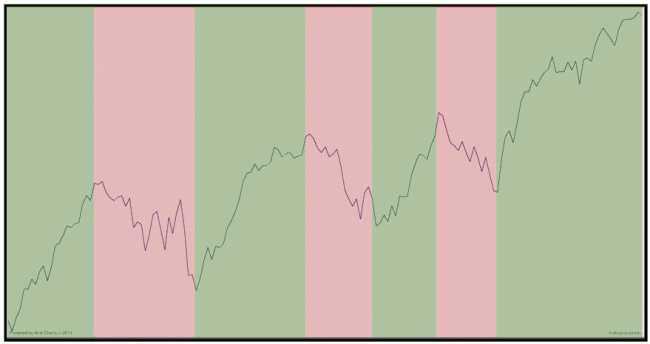
If our long term investor had bought this market, just about anywhere, and held on until the current level, he or she should have done very nicely.
But what about our short-term investor, who likes to nip in and out of the market? If this investor had perfect timing, he or she could catch all those green ups, and skipped all the red down periods. But this investor would need to have good timing to succeed – he or she could just as easily get in during one of the red patches, and miss an all-important green patch.
They’ve made their job much more difficult, and riskier than that of the long term investor.
The lure of day trading
I used to think that day trading was so tempting because I wanted excitement and believed I could make more money, faster that way.
These days, I’m less interested in getting excitement from my trading … and I’m all too aware that this isn’t the optimum way to trade.
So why am I still tempted by shorter term trades? Is it plain stupidity?
What I’ve realized is that it’s a great place to learn – if I’d only ever taken trades on weekly charts, I’d have a fraction of the experiences that I’ve learned from in my trading career. For this reason, I believe that shorter term trading has value – but it’s not the place to make our income.
Switching timeframes
There’s no shortage of opportunities on daily charts – but if you’re used to spending hours in front of your screen watching ticks, you may find you’re twiddling your thumbs.
But patience is another important skill for traders to learn.
Higher timeframes will give you less market noise, stronger signals, and more time to plan your trades. Plus, they mean you get to keep a greater chunk of your profits, rather than making your broker rich.
What’s not to love about that?
Save
Save









3 comments
Paul
The problem with scalping and day trading in general is market manipulation in the lower time frames i.e. HFT’s, stop hunting; algorithms etc. where the big players have an unfair advantage. These problems can be largely avoided by longer term trading on the higher time frames.
Ray
I agree about longer-term trading, but I still think there is a place for scalping! However, I don’t want to scalp manually – it is just too difficult to make an overall profit. But there may be a way, if we can build good mechanical rules into an auto-trader, and with small stops we could ramp up the lots size but still be within our defined maximum loss percentage of your bank, and if we can maintain a risk:reward of 1:1 or a bit better, then we can win overall.
I might have upset a few people, and if this is you, then I apologize in advance! It’s a good discussion topic, if nothing else. Thanks, Mark, for your thoughts.
Laurie
I’m convinced! 🙂
Thanks Mark – I’ve been angling towards this sort of trading for a while and set and forget is my preferred trading style. It takes all of the emotion out of it and we don’t need to tinker with the market moves during the course of the day. Broker charges are minimised with longer term time frame trading and by its nature it will allow us to take our time in getting into a trade.
In contrast, a scalping trade needs a quick decision and when we multiply that scenario across numerous scalping trades during the day, the potential for mistakes is proportionately increased.