November 12, 2010by Mark Rose- 0 comments
Don’t make the same mistake as me

Do you feel that chill in the air?
Must be the icy wind blowing over from Korea, where the “currency warriors” have been doing battle this week.
It would appear that the dollar and the yuan can be used very effectively as weapons – and I’m not talking about paper cuts here.
Having been hugely critical of China’s devaluation programme, Obama went into these meetings hot on the heels of Ben Bernanke’s $600 billion package of quantitative easing.
China was on equally shaky ground, with their trade surplus for October announced this week, at $27bn.
If global trading is going to get us out of the financial crisis, the US and China look like two shipwreak survivors making holes in each other’s lifeboats – while the rest of the G20 countries huddle together, complaining about the water lapping around their ankles.
Even Sarah Palin – the renowned sage on economic policy – has stepped in.
“When Germany, a country that knows a thing or two about the dangers of inflation, warns us to think again, maybe it’s time for Chairman Bernanke to cease and desist… We don’t want temporary, artificial economic growth bought at the expense of permanently higher inflation which will erode the value of our incomes and our savings.”
The hyperinflation experienced by Germany in the 1930s led to the establishment of the Nazi regime. However, I expect that Germany’s reservations about Bernanke’s fiscal stimulus are more to do with the competitive threat of US exporters who’ll benefit from a dip in the value of the dollar.
Or perhaps Sarah Palin is right, and pumping money into the economy will lead to extreme right-wing political figures gaining ground in the US ….
Ahem.
** Surely it can’t be that simple? **
Tea Party or not, these monetary wranglings leave the markets even less predictable than usual – yet they can offer more opportunities for the forex trader to snatch a profit.
But, beware …
At any time, I find that my biggest trading errors come when I try to get too clever. And in uncertain times – this is more true than ever.
I have an unfortunate tendency to add too many technical indicators to my charts – in a bid to make my trading more “sophisticated”. (Don’t ask me who I’m trying to impress!)
I’m always reminding myself that, just because I know a technical indicator – doesn’t mean that I need to apply it to my trading.
The trick is finding the ones that work for you, and applying them correctly.
The truth is that – more often than not – a good trading system is a simple one.
If you watch trading gurus – you will find that they are usually following a pretty simple strategy, with at most two indicators.
It is not how complicated or how many indicators you use that determine your trading success. It is your mindset and discipline that really makes or breaks your trading career. A strategy that you understand, that is easy to execute is always more profitable than one that is hard to trade with.
** Old favourites **
For simplicity, old wisdom, like following the trend, is where it’s at.
If you haven’t yet guessed where I’m heading with this … let me put you out of your misery!
Yes – I’m back to my favourite subject – moving averages. I haven’t got up on my soapbox about MAs for some time now, so I just couldn’t resist a little rant here.
The moving average is a technical line you can add to your charts which smooths out past price data. Moving averages vary depending on the number of days they are calculated over. Put simply, the longer the time frame, the smoother the line. A shorter time frame will be more sensitive, but will also give false moves generated by market noise. Most traders have a couple of favourites that work best for them.
MAs are probably the most useful technical analysis tools in your armory. Provided you remember one simple fact about them – moving averages tell you about where the price has been, not where it’s going. Because moving averages are – by definition – based on old prices, their wavy line will always lag behind where the market is heading.
The “traditional” moving average signal is to buy when the price breaks out above the moving average; and to sell when the price breaks out below the moving average.
It’s a great principle, and works again and again for traders, provided they put in place a number of extra “filters” to guard against false signals, or whipsaws. Traditional filters include a rise in volume on the instrument, a significant scale of breakout, and a length of time that breakout has held for.
But the simplest filter of all is to just use (you guessed it!) another moving average.
Here I’ve got two moving averages (10-period in blue, and 20-period in pink) plotted on a forex chart:
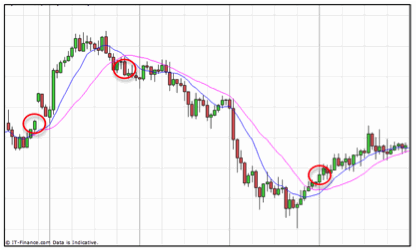
In an uptrend, we can expect the more sensitive MA (the blue one) to be above the less sensitive one (the pink one). In a downtrend, we expect the blue to be below the pink.
Therefore, if our breakout shows the price breaking both MAs, plus a crossover of the two lines – this gives added confirmation to the signal.
Of course, a trading signal is only part of the story. Before entering the trade, you’ll need to have your exit strategy – where you’ll take your profits or cut your losses – in place.
Simplicity itself!