November 13, 2015by Mark Rose- 14 comments
Easy Trigger Line Trades
Trade entries don’t come much simpler … two lines cross, and a trade is triggered.
I’m a big believer that trade signals needn’t be as complicated as many traders make them. With that in mind, here’s a dead simple trigger-line signal, which uses the ‘daddy’ of moving averages – the MACD indicator …
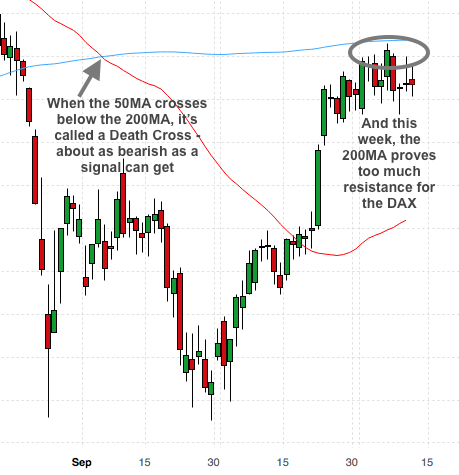
We’ve looked quite a bit at moving averages lately, and if you’re in any doubt about their power, just look at the battle the DAX index is currently having with the 200MA …
The MACD is an indicator for lovers of moving averages. It measures how two moving averages are moving in relation to each other, and then – because it just can’t get enough of moving averages – it plots a moving average of that!
It shows this information in the form of two lines and a histogram. The faster line is the moving average of the distance between our moving averages … the slower one is a smoothed out moving average of the first one … and the histogram simply plots how the two lines are moving closer and further from each other …

The MACD indicator is often used by traders looking for a sign that a trend is running out of steam, but here I’m going to explore a much simpler, trigger-line trade we can take from the MACD, when the two lines cross each other …
The single trigger line trade
As the faster line (the orange one) cuts above the slower line (blue), we get a buy signal. And when the faster line cuts below the slower one, we get a sell signal. Here you can see it in action …

As you can see, each of these signals gives scope for collecting profits, but in some cases, we’re getting into a move that isn’t very strong, which makes managing that trade to extricate those profits more tricky.
So, next I’m going to add another trigger to our arsenal …
Double trigger line trade
Of course, a single trigger system can fire off when you don’t want it to, which is why most traders would recommend adding two layers to any signal.
So I’m going to use two trigger lines …
The Stochastic and MACD indicators look so similar, it’s easy to think that they are replicating the same information. But they are actually built on very different technical premises – the MACD is a trend indicator, while Stochastic is a momentum indicator.
This combination uses the MACD to give us a secure signal that the trend is in position … AND uses the Stochastic to tell us whether that trend is powerful enough, or if it’s already running out of steam and we’d be getting in too late.
The signal to enter a trade is a crossover on the MACD, where the Stochastic has also crossed over within the previous two candlesticks.
Here’s how it works …

At A, we have a sell trigger on the MACD, however the crossover on the Stochastic was much earlier, which tells us that this signal isn’t worth risking our money on.
At B, we have a buy trigger on the MACD, and the Stochastic trigger was just two candlesticks earlier, which confirms this as a buy.
At C, we have a sell trigger on the MACD, but there’s no recent trigger on the Stochastic, so this isn’t a trade.
At D, again the MACD trigger isn’t backed up by the Stochastic (the Stochastic crossover was three candles earlier, so this doesn’t count as a trade).
And at E, we get the MACD and Stochastic crossovers almost simultaneously – signaling a sell trade.
So, we get a Buy at B, and a Sell at E, which both look like good places to be getting into a trade.
But then what?
A good thing to notice from adding the Stochastic is that it gives us an indication of how far the trend has already moved – and what kind of move we can expect. Note that by taking trades where the Stochastic hasn’t crossed the 50 line (i.e. is above 50 for a sell trade, or below 50 for a buy trade), we can expect to get a longer ride in that trend.
All this can be used to help us judge where we should be getting out of these positions.
As I’ve already stressed – a successful trade is about a lot more than a successful signal. Anyone who’s ever watched a good trade turn bad will know too well, that we’ll often see our trades move into profit, but it’s another matter successfully banking that profit.
As with entries, it’s not always about getting in or out at the perfect moment, but at the safest moment. And next week I’ll look at some simple tools to help you get out of your trades with safe profits to show for it.








14 comments
Nkosikhona
Thanks Mark it means a lot it what i do when I want pull a trigger. thought I was wrong all along . I’m happy that I have someone who says things the way I do.
thank you.
Mark Rose
I’ve only used this on shorter timeframes – 5 minutes to hourly (max). I’m not sure about it’s accuracy in picking up longer term moves, but would be interested to hear if you have any luck testing over longer periods.
John Hodgins
May I ask what timeframes you would prefer on this?
Nkosikhona
I use it to H4 and Daily it real works
Ray
An excellent and informative article, Mark. I have played with both MACD and Stoch on their own, but never together. Could this be automated, do you think?
GB
Thanks Mark for these articles.
Firstly, a query on terminology. My understanding (from several sources) is that a Death Cross forms when the 50MA crosses below the 200MA AND both MAs are falling. Conversely, a cross is Golden when the 50MA crosses the 200 MA and both are rising.
More importantly, I studied your final chart with interest. I have played a little with MACD and Stochastic and abandoned both, so I am far from an expert on either. Using the chart shown, the Stochastic on its own gives better signals – earlier entry and more trades. The only downside is the quickly reversed signal on day 2. Would this be the case in general?
Mark Rose
Hi GB, my definition of a death or golden cross would be the 50 / 200 crossover, but that’s not to say others don’t define it differently! I’ll admit that I don’t know which is the ‘right’, text-book definition. You’re right that the Stochastic gives faster entries, and more of them. The problem is that there will be more false signals. The downside of the MACD is that the signals are more reliable, but because they’re later, you’re sometimes getting in too late. That’s where I find the Stochastic filter helps – letting you know when you’ve missed the boat, so you don’t risk you’re money unnecessarily.
Paul H
Hello Mark, Nice idea ! Could be a good system to use on a spread betting platform with alerts when stochastics hit overbought/ oversold levels. Even better if the platform allows the alerts to be set up on MACD crossovers.
Mark Rose
Hi Paul, Thanks for the feedback. You could probably set up an alert on Capital Spreads to tell you when the MACD histogram crosses over. Or MT4 could make it even simpler.
David Knowles
very interesting
Unfortunately my MACD only displays one EMA so how do I action the other (using 12,26,9)
Hope you can help – thanks
Mark Rose
Hi David, My charts are taken from Core Spreads, but the histogram also shows the crossovers – it crosses the zero line when the two lines cross each other, so you should be able to use that. Hope that helps.
Michael Upton
Very interesting and useful article. The problem is trying to remember different strategies and indeed deciding which ones to use. (We can’t use all of them).It would be interesting if someone produced a table of different strategies and their success rates.
Mark Rose
Thanks for the feedback. I agree, it’s tough to know which strategy to use – which is one of the reasons I began writing Trader’s Bulletin. And what works for one person, won’t always work for someone else, if the timing or risk levels aren’t a good fit. The problem with looking at success rates, is that it becomes tempting to chase after whichever system is doing best at that time – they’ll all have ups and downs, and we can fall into the trap of jumping into a system just as it’s winning run comes to an end, then switching to the next one … and so on … As I hope to show in the coming weeks, a lot of success is about managing your trades and your exits, rather than chasing after whichever entry system works best …
Anthony
An excellent article Mark. Thank you.