Does technical analysis work equally well on different timeframes?
A lot of novice (and not so novice) traders make this simple mistake when trying to jump between timeframes.
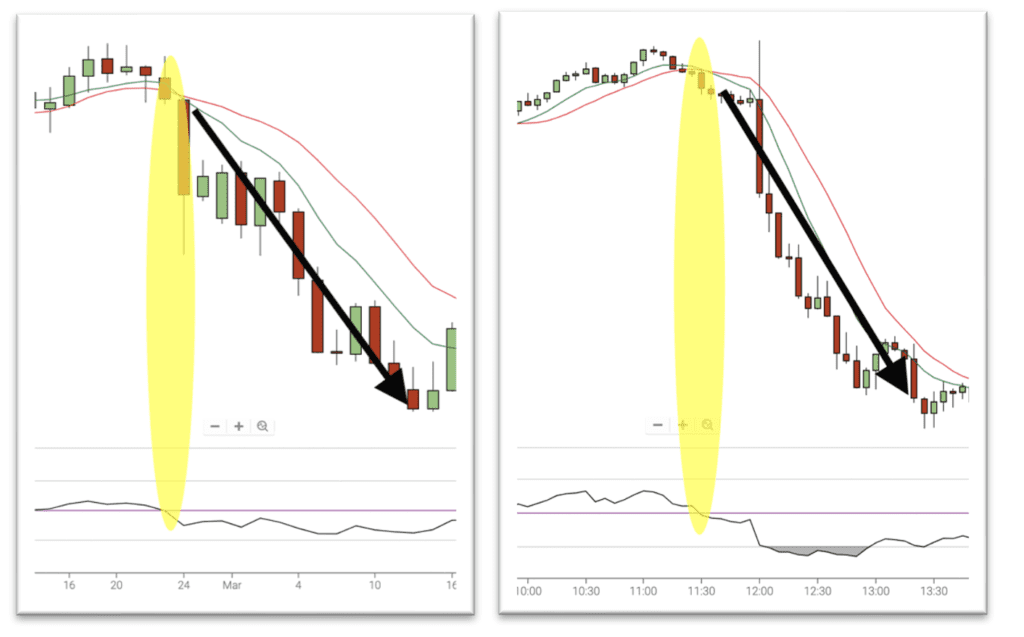
Technical analysis set-ups look identical, whether you switch from 5-minute charts, or dailies … so the temptation is to trade them in exactly the same way.
The two technical setups above are on a 5-minute chart, and on a daily chart. They look very similar, and we’d expect to treat them the same way. But there are fundamental differences between short-term and long-term trading that are often overlooked.
The obvious differences are to do with costs and scale – but I’m talking about something more nuanced here …
Slow-twitch VS fast-twitch trading
Fast-twitch muscles are associated with powerful, short bursts of activity. They are the ones called into action by sprinters, power-lifters and long-jumpers. Slow-twitch muscles are about endurance – these are the leaner-looking muscles we associate with marathon runners.
There are many things that amaze me about long-distance runners, but one of the things that really sticks in my mind is when they fall over in a race, and yet go on to win. I can think of Mo Farah back in 2016, and Sifan Hassan in 2021. Even at that level of competition, there is still this margin for error. It’s unthinkable in a shorter race, where it’s just not possible to lose focus for even a second.
Long-term trading also offers us margin for error which isn’t there for short-term traders. Trading on daily or weekly charts means we have time to think. Trading on 5 minute charts, instead, relies on fast decisions based on experience rather than planning.
What happens when we try to use our long-term rules on short-term trading
I spend most of my trading time looking at short-term charts, of 15 mins or under. That’s not because this is where I do most of my trading volume, but this is just the more time and labour-intensive end of trading.
The trading I do on weekly and daily charts takes just a few minutes, either once a week, or once a day.
My long-term trade set-ups will usually involve simply checking against my rules and placing trades or changing parameters. Easy.
I’ve put a lot of effort into trying to make this formulaic, rules-based trading fit into shorter timeframes.
But I run up against the same problems again and again.
Short-term technical indicators are more jumpy by their nature. The tighter stops mean that we’re vulnerable to this unpredictability. Again and again, with short-term trading, I rely on experience and knowledge and need to be able to make fast decisions on the hoof.
In contrast, my long-term positions fit neatly with rules-based trading, where the generous margin of error means I’m not always watching my back, and have no shortage of time for decisions and adaptations. Trading on daily or weekly charts means that I don’t have to time my entry so accurately – if I’m 30 minutes late logging into my account, it’s no big deal. My stop loss is likely to be well out of reach of short-term wobbles … and I won’t have to watch the markets like a hawk all day.
Technical analysis is no less valid on short-term charts, it’s just that it’s not as easy to follow.
It’s all too easy for the cost of the spread to bump you out of a position, because trading costs are such a significant percentage of your profit margin.
So, if you want trading that demands you to make fast-paced, high-pressure decisions and rely on experience, shorter time frames offer exactly that. But if you prefer simple, rules-based trading, this is best suited to longer timeframes.
Thank you, Mark. have been puzzling over this for some time. Your info has helped to clarify for me. I still have a question about the relevance of PSAR and simple moving averages on different time frames. Are they still helpful on all time frames?
Hi Bob, Thanks for your feedback. Sorry for the delayed response – I’ve been slowly catching up after a bout of Covid. I find moving averages useful on all timeframes – although might look at the more reactive types on shorter timeframes, like the exponential MAs. Personally, I use PSARs on my longer term trading – it’s really about fitting the indicator to the job that needs doing.











2 comments
Bob McCulloch
Thank you, Mark. have been puzzling over this for some time. Your info has helped to clarify for me. I still have a question about the relevance of PSAR and simple moving averages on different time frames. Are they still helpful on all time frames?
Mark Rose
Hi Bob, Thanks for your feedback. Sorry for the delayed response – I’ve been slowly catching up after a bout of Covid. I find moving averages useful on all timeframes – although might look at the more reactive types on shorter timeframes, like the exponential MAs. Personally, I use PSARs on my longer term trading – it’s really about fitting the indicator to the job that needs doing.