August 23, 2013by Mark Rose- 4 comments
Three best candlestick patterns every trader should know

Some people naturally pick up new languages. Others don’t.
And I definitely fall into the latter camp.
I just get overwhelmed by the number of words I need to remember. And the grammar – ergh!
But a friend of mine who’s a language teacher persuaded me that knowing the language is just a tiny part of being able to communicate when abroad. She claims that with just a handful of words, no knowledge of grammar, and a bit of body language, we can be very effective communicators in any language.
Of course, this puts Brits at a natural disadvantage. We’re not big on waving our arms around, generally preferring to restrict gestures to our eyebrows.
But let me give you the excruciating picture of myself, in a Parisian restaurant with my family, trying to communicate with a waiter who was clearly enjoying my distress. My body language curling in on itself, and my school-boy French evaporating from my brain mid sentence.
Compare this to just a week earlier, enjoying dinner with an Argentinian friend over a bottle or two of red wine – over the course of the evening, my Spanish and his English improved enormously (or at least, we felt like it had!)
The point I’m trying to make is that having a huge bank of knowledge isn’t what matters. It’s knowing a few key pieces of information and having the confidence that you can apply it at the right time and place.
It’s not what you know …
If you want to overwhelm yourself with trading vocabulary, a good place to start is with Thomas Bulkowski. What this man doesn’t know and hasn’t meticulous recorded about candlesticks, isn’t worth putting on a chart.
But if an in-depth analysis of over 100 candlestick patterns seems like over-kill to you (it’s definitely more than my brain wants to cope with on a Friday afternoon), instead I’m going to give you just three – the very best candlestick patterns.
One of the things you learn as you plough through Bulkowski’s studies is just how unreliable many of the patterns he’s studied are, and all the highly complex provisos that they can come with. So the three I’m offering up here are what I believe are the cream of the crop.
Apply these alongside your other trading techniques, and you’ll be able to achieve faster and more accurate entries, plus you’ll be able to filter out weaker signals that aren’t matching up to our candlestick standards …
The doji

A doji is a candlestick with a small body and long wicks. This indicates that the price has moved a good deal during the period of this candlestick, but then finished at the same price that it started at.
The basic doji candlestick is a sign of market indecision – nothing more. So, on its own, a doji gives us very little information.
What’s important about a doji is what shape it takes, and where we find it …
The two key shapes we’re looking for are hammers and shooting stars …

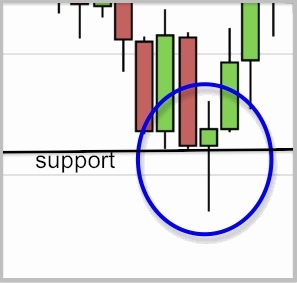 And we want to find these candlesticks at key turning points in the market, where the hammer will give us a bullish signal, and the shooting star will give us a bearish signal …
In the example shown on the left, here, the hammer forms right on the level of support – giving us a big hint that the price is ready to make a reversal.
And in the example below, we have a shooting star touching up a historic resistance level – this is a bearish signal that the price isn’t ready to move through.

Engulfing candles
The really exciting candlestick patterns, like a Long Island Reversal … or Diamond Tops … just don’t come around very often.
The beauty of engulfing candles is they are all over the place.
Of course, in trading, getting too many signals isn’t a good thing. But if you’re looking for that final confirmation of a move to get into a trade – engulfing candlesticks can be a real trader’s work-horse.

An engulfing pattern consists of two candles, where the second candle has a different colour to the first, and is larger, engulifing the entire body of the first candle.
For it to be a bullish signal, the first (small) candle is red, and the second (large) candle is green.
And vice-versa for a bearish engulfing pattern.

Triangles
Shut my three kids (all boys) up in a car for an extended period (can you tell I’ve just been on a family holiday?), and you’re going to experience some turbulence. You can guarantee when we reach the destination and the doors open, they’ll almost explode through them.
Price consolidations are a bit like that – when the door opens, the price often bursts out with some force.
Now imagine the price (or my kids) being enclosed in a space that keeps getting smaller. Imagine the force it’ll breakout with then.
Well, that’s how triangles work. A price consolidation is getting tighter and tighter, until the price explodes out of it.
A triangle patterns look something like this …
 Text books will tell you that a triangle is a continuation pattern, and that the price will resume its direction when it breaks out of the consolidation. Some will tell you that an ascending triangle is bullish (well, it is getting higher lows) and a descending one is bearish (because of those lower highs).
However, in my experience, a triangle pattern on its own won’t give you information about how strong the levels of support/resistance that border it are. It could go either way – so you should be prepared for breakouts in either direction.

The great thing about the three candlestick patterns I’ve shown you here is that you won’t be waiting an age to find them on your charts.
They crop up all over the place, so you can practise spotting them, and will quickly become competent in using them for your everyday trading.
If you want to learn more about trading price action and candlestick patterns, don’t forget that my free price action manual can be downloaded from the website here.






4 comments
Mark Rose
Pleased you’ve found this helpful – it’s always good to remind ourselves of these important signs on our charts.
Bob Woodward
Thanks so much for your down to earth explanations.
Robert tsen
It is like a revision many thanks Mark
Vic
Hi Mark, Just downloaded the candlestick guide – great, thanks!